

Most sales teams confuse activity with progress. They chase volume metrics—more dials, more emails, more touches—while pipeline stays flat. The real problem isn’t effort; it’s targeting. When you ignore signals like fit, intent, and reachability, you waste time on prospects who will never convert.
We’ll show you how to prioritize leads using data-driven signals, match your outreach strategy to each prospect’s readiness, and eliminate wasted effort so every touch counts.
What Actually Wastes Your Outreach?
Doing more outreach to automatically receive more pipeline is a common misconception. But if you’re ignoring critical signals like fit, intent, and reachability, much of that effort is wasted.
Consider this: your team makes 50 dials to contacts pulled from a broad, untargeted list. Activity metrics look great at first glance. But how many of those prospects actually match your Ideal Customer Profile (ICP)? How many were actively researching solutions in your space? And critically, how many could you even reach on the first attempt?
Contrast that with a different approach: ten thoughtful, personalized touches to hand-picked accounts that are a perfect fit, showing intent signals, with accurate, verified contact data. Which one drives more meaningful conversations and pipeline?
The opportunity cost of spray-and-pray prospecting is real. You burn through lists faster, risk higher unsubscribe rates, and miss timely engagement with accounts sending clear buying signals right now.
Pro Tip
Before your reps dive into their next round of outreach, have them pause and tag each lead with the primary signal they’re acting on, whether it’s strong fit, recent intent, or a direct line to the decision-maker. That extra moment of reflection can be the difference between a dead-end touch and a well-timed conversation that converts.
Which Signals Should Guide Prospecting?
Focus on three critical signals—fit, intent, and reachability—to avoid wasting outreach.
- Fit: how closely an account matches your ICP
- Intent: how actively users are researching topics or solutions related to your offerings
- Reachability: how accessible and accurate the contact data is
For example, let’s say you sell marketing automation software. You might decide to immediately call a prospect who’s a spot-on ICP fit, has been reading your competitor’s blog posts this week, and has a direct dial you’ve recently verified. Compare that to an account with a generic Gmail address that hasn’t shown any research activity lately.
When you use these signals together, you determine exactly who to contact, how to personalize your approach, and how quickly you need to act. This is especially powerful when you layer in intent data to catch accounts at the perfect moment in their buying journey.
Pro Tip
Treat each signal as a confidence score, not a binary yes/no. A lead with strong fit and moderate intent may warrant outreach sooner than a lead with perfect intent but weak fit. Let the combination of signals guide your prioritization, and adjust thresholds as you learn what converts best for your team.
How Do You Prioritize Leads Fast?
When your lead list is longer than your team’s capacity, you need a way to prioritize fast. Use your strongest available signal and back it up with one supporting factor to keep it simple. Then route leads to the right play based on their mix of fit, intent, and reachability. Here’s how that breaks down in practice:
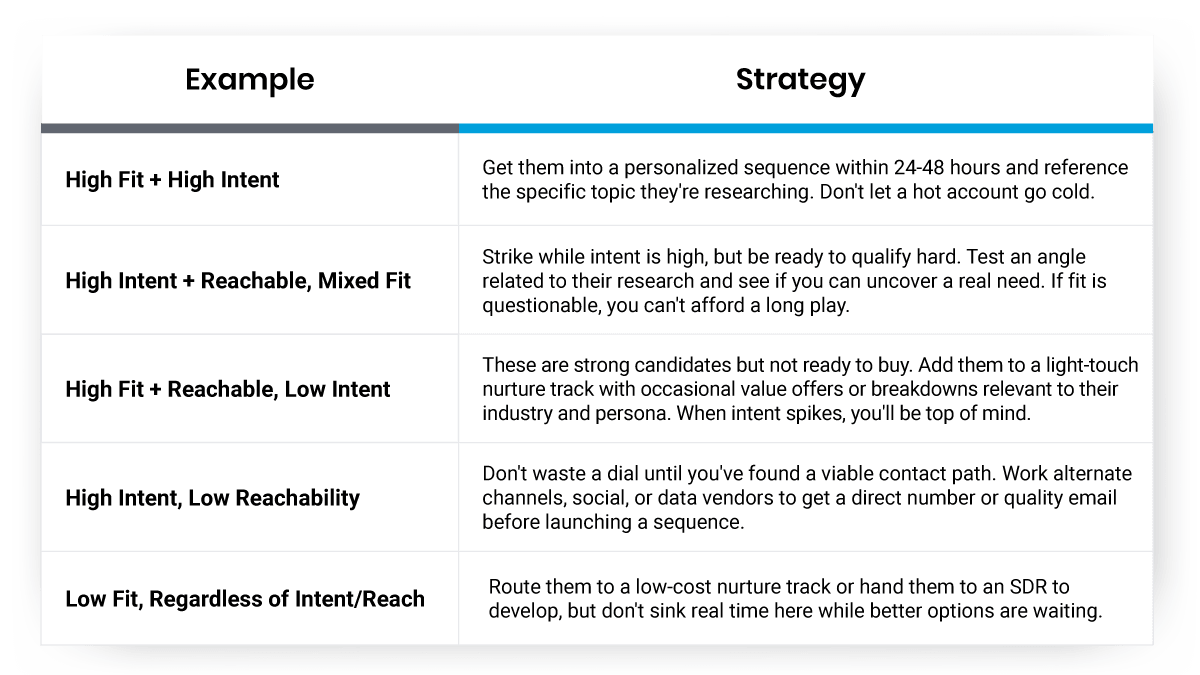
This approach aligns your sales prospecting strategies to the leads most likely to convert right now. You’re not chasing ghosts or relying on an arbitrary score. As signals change, you can adjust your strategy on the fly.
Which Prospecting Strategy Fits Your Signals?
Prioritizing leads by signal is a great start, but you need to operationalize it. Each combination of fit, intent, and reachability should trigger a specific prospecting play, one that aligns your outreach strategy to the data you have. Document these plays so your reps aren’t improvising every time.
Here are five prospecting strategies worth building out:
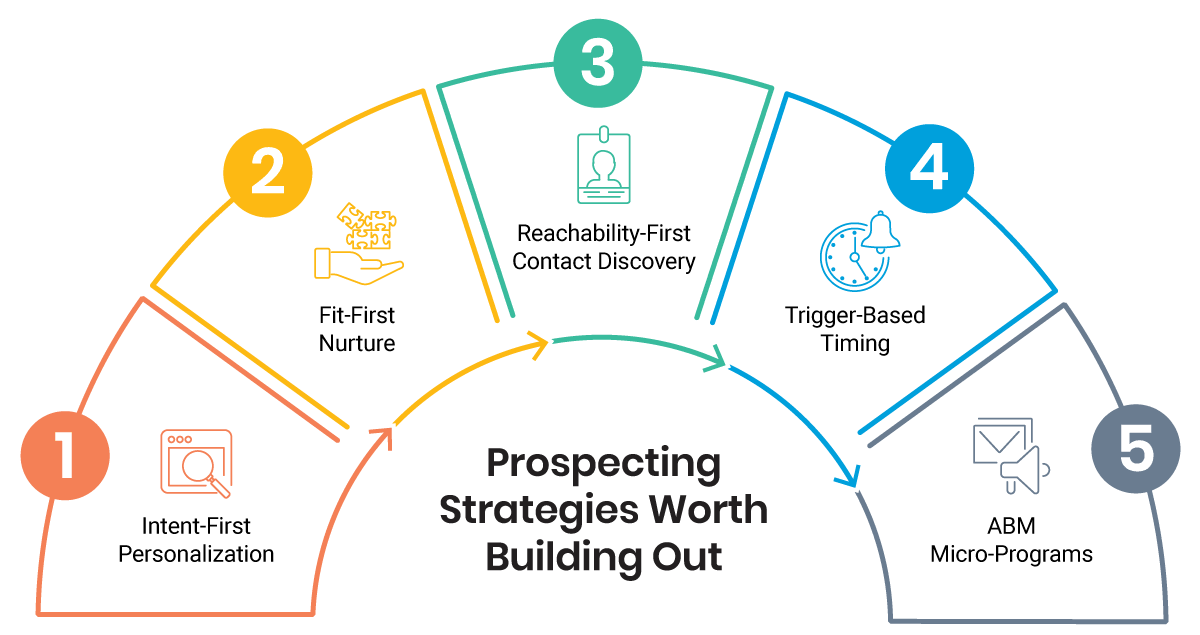
- Intent-First Personalization
When you catch a high-fit account researching relevant topics, reference the specific asset they downloaded or page they viewed, then pose a thoughtful question that builds on that topic. Show you’ve done your homework.Pro Tip
Reserve this for accounts where both fit and intent are strong. If you can’t verify recent intent activity within the past 7-14 days, the window may have already closed.
- Fit-First Nurture
For target accounts that aren’t showing much intent, build a nurture track that mixes helpful content, case studies, and thought leadership relevant to their industry and role. The risk: if you nurture too long without a trigger event, you become background noise.Pro Tip
Set a threshold. If no intent signal appears within 90 days, either re-score the fit or pause outreach to preserve list health.
- Reachability-First Contact Discovery
If intent is high but you’re hitting dead ends, treat contact discovery as its own play. Have reps exhaust alternate channels, social sleuthing, and data append options before launching a high-value sequence.Pro Tip
If you can’t find a verified contact within 48 hours, route the account to a slower research queue rather than guessing at outdated emails.
- Trigger-Based Timing
Build plays around sales triggers like leadership hires, funding rounds, or technology changes. The caveat: not all triggers are equal. A VP of Sales hire at a high-fit account is worth immediate action; a mid-level role change at a low-fit company isn’t.Pro Tip
The key is speed—get a relevant message out within 24 hours of the event to ride the momentum.
- ABM Micro-Programs
Orchestrate a surround-sound approach for high-value accounts. Blend display ads, social touches, direct mail, and human email outreach to key personas. Sync timing and themes across channels to make your message unavoidable. The investment: this requires coordination across marketing and sales, plus budget for paid channels.Pro Tip
Save this strategy for accounts where the deal size justifies the cost, typically your top 10-20 target accounts per quarter.
This level of specificity boosts your response rates and protects your domain from the spam complaints that tank your deliverability. Plus, it gives your team clear decision rules instead of vague best practices.
When Should You Go Multichannel?
Not every lead needs a multichannel blitz. In fact, over-investing in channels too early can waste budget and dilute your message. The decision to go multichannel should be driven by two factors: the strength of your signals and the size of the opportunity.
Start with a single channel—usually email or phone—for leads with moderate fit or intent. If you get no response after 3-5 touches, check your signals again. Did intent drop off? Is the contact data stale? If signals are still strong, that’s your cue to add a second channel. Try LinkedIn outreach, a handwritten note, or a targeted display ad to break through.
For high-fit, high-intent accounts with large deal potential, go multichannel from day one. Coordinate email, phone, social, and even direct mail to create multiple touchpoints within the first week. The goal is to make your message unavoidable during the narrow window when they’re actively evaluating solutions.
Pro Tip
Track response rates by channel and signal combination. You’ll quickly learn which channels work best for different lead types. For example, you might find that high-intent leads respond faster to phone, while high-fit, low-intent accounts engage better with LinkedIn content. Use that data to refine your playbook over time.
What Fails When You Ignore Data?
When prospecting data is scattered, outdated, or incomplete, even the best strategy falls apart. Reps waste time chasing dead leads, duplicate efforts across the team, and miss high-value opportunities because no one knew they existed.
The most common failure mode: reps pull a list from the CRM, make a few calls, hit a wall of bad numbers and bounced emails, then move on to the next list. They never stop to ask whether the data was any good in the first place. The result is a cycle of low activity, low confidence, and low results.
Another failure: teams invest in intent data or technographic enrichment but never integrate it into their workflow. The data sits in a separate platform, and reps don’t have time to cross-reference it before every call. So they default to the same spray-and-pray approach they’ve always used, and the investment goes to waste.
Centralize your prospecting data as the fix. Give your team one place to sort leads by signal strength, priority, and outreach status. That could be your CRM, sales engagement platform, or a purpose-built prospecting tool. The key is to build at-a-glance confidence in who to target and why, so reps can make smart decisions without jumping between five different systems.
Metrics That Keep Your Prospecting Honest
Activity metrics like dials and emails sent are easy to track, but they don’t tell you whether your prospecting is working. To keep your strategy honest, you need metrics that connect effort to outcomes.
Start by tracking these five metrics:
- Contact rate: The percentage of leads you can reach by phone or email. If this is below 40%, your reachability data is weak, and you’re wasting time on dead ends.
- Response rate by signal type: Compare response rates for high-fit vs. high-intent vs. high-reachability leads. This tells you which signals matter most for your audience and where to focus your data investments.
- Time to first response: How long does it take for a lead to reply after your first touch? For high-intent leads, this should be under 48 hours. If it’s longer, you’re either too slow or targeting the wrong leads.
- Conversion rate by play: Track how many leads convert to meetings or opportunities for each prospecting play (intent-first, fit-first, trigger-based, etc.). This shows you which plays are worth scaling and which need refinement.
- List exhaustion rate: How quickly are you burning through your target account list? If you’re churning through leads faster than marketing can generate new ones, you’re either over-prospecting low-quality leads or under-investing in data quality.
These metrics give you a clear picture of where your prospecting engine is strong and where it’s leaking value. Use them to adjust your strategy every month, not just at the end of the quarter when it’s too late to course correct.
Pro Tip
Set a monthly review cadence with your sales and ops teams to walk through these metrics together. Look for patterns and adjust your targeting, data sources, or plays accordingly. The teams that win at prospecting treat it like a system to optimize, not a set-it-and-forget-it process.
Conclusion: Stop Wasting Outreach with Smarter Prospecting and Better Data
The biggest cost of bad prospecting isn’t the wasted dials or bounced emails; it’s the time your best reps spend on leads that were never going to convert. Every hour spent chasing low-fit, low-intent prospects is an hour not spent closing deals or building relationships with high-value accounts.
Incorporating smarter prospecting strategies gives you that time back. When you prioritize leads by signal strength and match your outreach to their readiness, your team can focus on conversations that matter. The result: higher productivity, better morale, and faster pipeline growth.
Ready to stop wasting outreach and start building pipeline that converts?
Salesgenie® gives you the verified contact data and filtering tools to make signal-based prospecting your default, so your team spends less time chasing dead ends and more time closing deals.
FAQs
The three critical signals are fit (how well an account matches your ideal customer profile), intent (whether they’re actively researching solutions in your space), and reachability (having accurate, up-to-date contact information). Using these signals together helps determine who to contact, how to personalize your approach, and when to act for maximum impact.
Keep it simple by using your strongest available signal backed by one supporting factor. Prioritize high fit + high intent leads for immediate personalized outreach within 24–48 hours, while routing other combinations like high intent + mixed fit or high fit + low intent to appropriate nurture tracks or qualification processes.
This approach wastes effort by targeting untargeted lists without considering fit, intent, or reachability signals. It leads to faster list burnout, higher unsubscribe rates, and missed opportunities with accounts showing clear buying signals right now.
Use intent-first personalization for high-fit accounts researching relevant topics, fit-first nurture for target accounts with low intent, and reachability-first contact discovery when intent is high but contact paths are unclear. Each signal combination should trigger a specific, documented prospecting play rather than improvised outreach.
Centralized data gives reps a unified view of fit, intent, and reachability signals, enabling smart decisions and preventing duplicate efforts. It builds “at-a-glance” confidence in targeting decisions and ensures every touchpoint starts with a real signal rather than generic assumptions.