

If you’re a small business owner or part of a lean marketing team, you need a digital marketing glossary that explains terms in context, not in textbook detail. You don’t have time to memorize every acronym and buzzword because your focus is on the handful of concepts that drive decisions and revenue.
That’s exactly what this guide delivers. We’ve curated the essential terms you’ll use weekly to plan, spend, and measure across channels. Instead of encyclopedic definitions, you’ll find plain-English explanations tied directly to the actions you’ll take next.
Which Marketing Terms Actually Matter Now?
Not all marketing terms deserve your attention. The ones that matter are the ones that change what you do next week, whether that’s tweaking your ad copy, adjusting your targeting, or reallocating your budget.
This section breaks down the core metrics and concepts you’ll use weekly to plan campaigns, allocate budgets, and measure performance across channels.
Budget and Channel Basics
Before diving into specific metrics, you need to understand three foundational terms that shape every marketing decision:
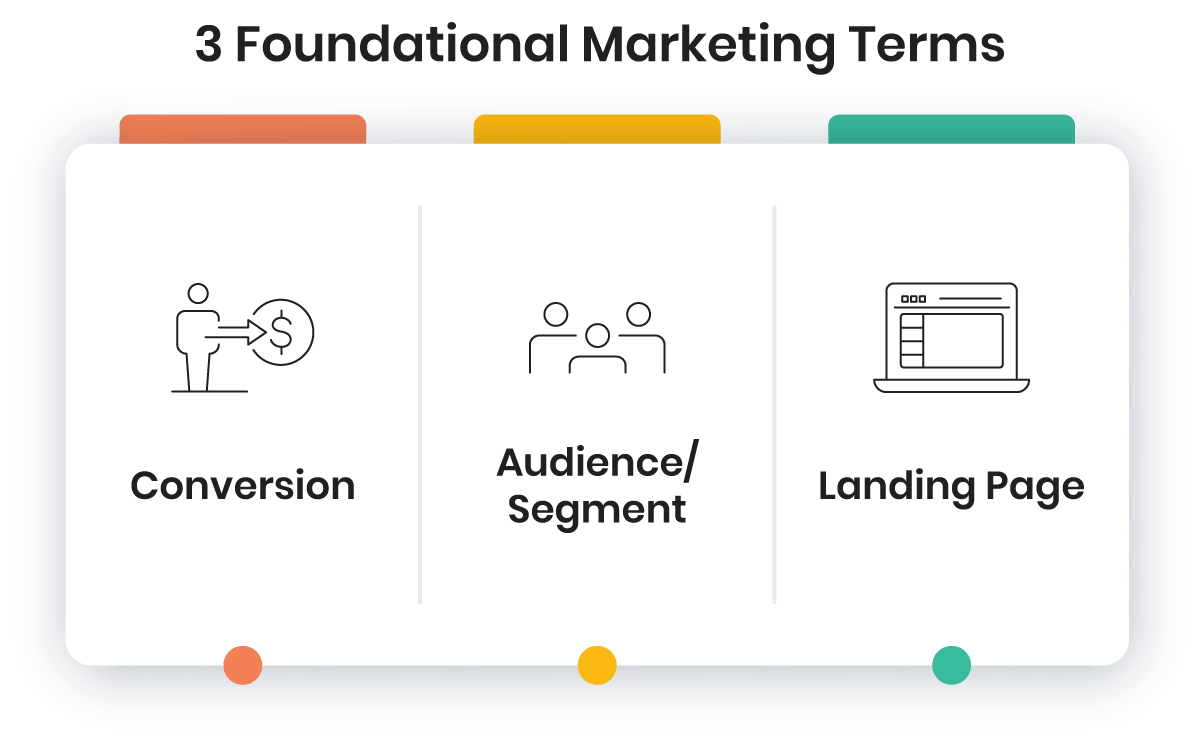
- Conversion: Any action that moves a prospect closer to becoming a customer, like filling out a form, downloading a guide, or making a purchase.
- Audience/Segment: A group of people who share common characteristics, behaviors, or needs that make them more likely to respond to your message.
- Landing Page: The first page a visitor sees after clicking your ad or link; it should match your ad’s promise and guide visitors toward a single, clear action.
These three terms form the backbone of every campaign you’ll run. If you can’t clearly define your conversion, audience, and landing page experience, you’re not ready to spend.
Core Metrics You’ll Use Every Week
When you dive into your marketing reports, you’ll encounter a slew of metrics, but not all these data points are needed. To make smart decisions and optimize your campaigns, you need to focus on the core metrics that directly influence your next steps.
Here are the key metrics you’ll likely use on a weekly basis to gauge your performance and adjust your strategy:
- Conversion Rate: The percentage of visitors who take a desired action on your website, such as making a purchase or filling out a lead form.
Pro Tip
It’s generally accepted that a rate of 2–5% is considered good for most businesses, so if your conversion rate is low, it may indicate a mismatch between your messaging and your target audience, or a poor user experience on your landing page.
- Cost Per Acquisition (CPA): How much you’re spending to acquire each new customer or lead.
Pro Tip
To calculate your CPA, divide your total ad spend by the number of conversions generated. Compare your CPA to your profit per sale—if you’re spending more to acquire a customer than you earn from them, your campaign isn’t sustainable.
- Click-Through Rate (CTR): The percentage of people who click on your ad after seeing it. To give you some perspective, HubSpot reports that the average email CTR is 2.5%, regardless of industry.
Pro Tip
A high CTR suggests that your ad is relevant and compelling to your target audience, while a low CTR may indicate that your ad copy or targeting needs improvement.
- Impression Share: How often your ad is shown compared to the total number of eligible impressions for your targeting criteria. For example, if your impression share is 50%, that means your ad is being shown half the time it could be shown based on your budget and targeting settings.
Pro Tip
Monitoring your impression share can help you gauge your competition and identify opportunities to expand your reach.
Think about metrics like this: if a metric doesn’t change what you do next week, it’s not a core metric for your business.
What is a Conversion Funnel?
A conversion funnel is the series of steps a potential customer takes from their first interaction with your brand to the moment they make a purchase or become a lead. At each stage of the funnel, there are opportunities to guide the customer closer to a conversion, but there are also risks of losing them along the way.
Conversion Funnel Stages in Plain English
Here’s how most customer journeys break down:

At each stage, you control the quality of your traffic, the strength of your message match, and the friction in your checkout or lead capture process.
How to Find and Fix Funnel Leaks
A funnel leak is any point where potential customers drop out of the funnel before completing a conversion. For example, if 100 people click on your ad but only 10 make a purchase, you have a leak somewhere between awareness and conversion.
Identifying and fixing these leaks is critical to improving your overall conversion rate and getting the most value from your marketing spend.
Pro Tip
Fix the smallest, closest-to-revenue leak first. A 10% improvement in your checkout conversion rate will often outperform a 50% increase in ad clicks.
What’s the Difference Between PPC vs. CPC?
PPC and CPC get used interchangeably, but they mean different things, and understanding the distinction helps you evaluate ad platforms and agency proposals more clearly.
- Pay-Per-Click (PPC) is a broad advertising model where you pay each time someone clicks your ad. It’s the umbrella term for platforms like Google Ads, Facebook Ads, and LinkedIn Ads.
- Cost Per Click (CPC) is the actual dollar amount you pay for each click. It’s a metric within PPC campaigns. For example, if you spend $500 on a PPC campaign and get 250 clicks, your CPC is $2.
To help give you some context, when an agency talks about “running PPC,” they’re describing the channel. When they talk about “lowering your CPC,” they’re describing the efficiency of your spend within that channel.
Which Email Marketing Terms Matter for Beginners?
Email marketing has its own vocabulary, but you only need to track a handful of terms to run effective campaigns and troubleshoot performance issues.
Here are the three email metrics that matter most:
- Open Rate: The percentage of recipients who open your email. A low open rate usually signals a weak subject line or poor sender reputation.
- Click Rate: The percentage of recipients who click a link in your email. This tells you whether your message and offer are compelling enough to drive action.
- Unsubscribe Rate: The percentage of recipients who opt out after receiving your email. A spike in unsubscribes often means you’re sending too frequently, targeting the wrong audience, or delivering irrelevant content.
If you’re just getting started with email marketing, focus on improving your open rate first. Without opens, nothing else matters.
Not seeing the results you’re looking for? Learn more about our Data Enhancement Services.
Do You Need to Know These Channel-Specific Terms?
As your marketing mix expands, you’ll encounter terms tied to specific channels such as SEO, social media, display advertising, and more. But here’s the truth: you don’t need to learn every channel-specific term upfront. You only need to learn the vocabulary for the channels you’re actively using and measuring.
Example
If you’re not running display ads, you don’t need to know what “viewability” or “frequency capping” means. If you’re not investing in SEO, you can skip “domain authority” and “backlink profile” for now.
The key is to expand your glossary as your strategy evolves. When you add a new channel or tactic, spend 15 minutes learning the three to five terms that will show up in your reports and influence your decisions.
Where Do Small Businesses Overcomplicate Jargon?
Small businesses often get tripped up by terms that sound important but don’t change day-to-day decisions. Here are a few common examples:
- Engagement Rate: It sounds valuable, but unless you’re a content creator or influencer, engagement rarely ties directly to revenue. Focus on conversions instead.
- Brand Awareness: Hard to measure, harder to act on. If you’re spending limited dollars, prioritize campaigns with clear conversion goals.
- Omnichannel Strategy: A buzzword that often means “we’re doing a lot of things without a clear priority.” Start with one or two channels that reach your best customers, then expand.
If a term doesn’t help you decide where to spend, what to test, or what to fix, it’s not a priority.
Which Digital Marketing Terms Can You Deprioritize?
Not every marketing term deserves your attention. Here are a few you can safely ignore until they become directly relevant to your business:
- Programmatic Advertising: Automated ad buying that’s typically overkill for small budgets.
- Lookalike Audiences: Useful once you have a large customer list, but not a priority when you’re just starting out.
- Marketing Automation Workflows: Powerful for scaling, but unnecessary complexity if you’re still figuring out your core message and offer.
Avoid distractions, focus on the terms that unlock decisions, and park the rest until they’re relevant.
How Should You Use This Glossary Day-to-Day?
Think of this glossary as a reference tool, not a study guide. You don’t need to memorize every term—you just need to know where to look when you encounter unfamiliar language in a report, proposal, or sales call.
Here’s how to use it effectively:
- Before a vendor call: Skim the terms related to the channel or tactic you’ll be discussing so you can ask sharper questions.
- During campaign planning: Review the metrics section to confirm you’re tracking the right KPIs for your goals.
- After a performance review: Look up any terms that appeared in your reports but weren’t immediately clear, then decide whether they’re worth tracking going forward.
Revisit this glossary each quarter as your marketing mix evolves. The terms that matter most will shift as you test new channels, refine your audience targeting, and scale what’s working.
Conclusion: Make Better Marketing Decisions with Plain-Language Terms
You don’t need to memorize every marketing acronym or master every channel-specific metric. What you need is a clear understanding of the terms that change what you do next. By focusing on the handful of concepts that directly impact your decisions, you can tune out the noise and concentrate your energy where it counts.
And when you’re ready to act on those insights, tools offered by Salesgenie® give you access to high-quality business and consumer data so you can identify and prioritize your best prospects, and focus your marketing dollars where they’ll have the greatest impact.
FAQs
This glossary is specifically created for small business owners and lean marketing teams who need practical, action-oriented explanations rather than textbook definitions. It focuses on terms you’ll use weekly to make real business decisions about budgets, audiences, and measurements.
Ask yourself: “How would this change our budget, audience, or measurement?” If a term doesn’t influence your next actions or decisions, you can safely ignore it until it becomes more relevant to your goals. Focus only on terms that directly impact your day-to-day marketing decisions.
Focus on conversion rate (percentage of visitors taking desired actions), cost per acquisition (spending per new customer/lead), click-through rate (percentage clicking your ads), and impression share (how often your ads show versus total opportunities). These metrics directly inform your next optimization steps.
A conversion funnel tracks the steps customers take from first awareness of your brand to making a purchase, including awareness, interest, consideration, intent, conversion, and retention stages. Understanding this helps you identify where potential customers are dropping out and optimize each stage to improve your overall conversion rate.
Revisit your priority terms quarterly as your business evolves and marketing mix shifts. Take stock of which channels drive the bulk of your results and ensure you’re comfortable with the core concepts for those areas, while continuing to ignore terms that don’t impact your decision-making.