
If you’re like most small business owners or marketers, you’ve felt the quiet pain of email bounces, spam complaints, and decaying subscriber data, all silent threats that steadily drain your deliverability and revenue while you focus on growing your list. Shockingly, inaccurate data causes 40% of business objectives to fail.
When the question of “how often should we update our mailing list?” comes up, many teams default to an annual “spring cleaning” of their database, not realizing that waiting a full year between updates leaves them exposed to compounding list quality issues.
To ensure your lists are in top shape, this guide provides information on how to choose the right email list update frequency for your business based on three factors:
- Your typical send volume
- Your list growth trajectory
- Your tolerance for compliance risk.
Plus, you’ll walk away with simple rules to implement both real-time hygiene triggers and scheduled updates to keep your list clean, your deliverability high, and your email marketing revenue flowing.
Is an Annual Cleanup Enough?
Picture this: your marketing team just completed their yearly email list cleanup. Satisfied with their work, they queued up the next big campaign, only to find that bounce rates are already creeping up again after just a few sends.
The reality is that relying solely on annual list maintenance leaves your email program vulnerable to rapid data decay between cleanings. People change jobs, switch email providers, or abandon old addresses more frequently than most marketers assume.
While annual cleanings are a good baseline, they’re not enough on their own. To protect your deliverability, you need a more proactive approach that combines real-time hygiene with frequent strategic updates.
What Dictates Update Frequency?
So if annual updates aren’t enough, how often should you clean your email list? The short answer is “it depends,” but that doesn’t mean the decision is arbitrary. In reality, a few key variables reliably predict how frequently you need to refresh your contacts:
- Send volume and cadence: The more frequently you send email, the faster you’ll expose data quality issues like invalid addresses or inactive contacts. Senders who email daily or weekly need more aggressive suppression schedules than those who send monthly.
- Acquisition source quality: Where you source your contacts has a big impact on data decay. Lists built from event registrations, co-registration deals, or scraped data tend to churn much faster than opt-in lists—and require more aggressive filtering as a result.
- List growth vs. churn: If your list is growing rapidly, you need to be especially vigilant about data quality. Weekly deduplication and validation are essential to avoid compounding bad data as you scale.
- Complaint and bounce trends: Rising complaint rates or spiking bounces are clear signs that your list contains outdated contacts. If you see negative trends, tighten your update schedule and consider a re-engagement campaign to salvage inactive subscribers.
- Sales cycle length: B2B companies with long sales cycles can sometimes afford slower list updates, since their audience isn’t expected to engage as frequently. However, they still need to be vigilant about opt-in status.
- Regulatory and compliance risk: For companies in regulated industries like finance or healthcare, poor email hygiene cam also be a legal liability. If you’re subject to regulations like GDPR, HIPAA, or CCPA, plan on logging every list update and verifying explicit consent more frequently.
Pro Tip
Track your list-wide hard bounce rate and complaint rate on a rolling 30-day basis. If either metric crosses a predetermined threshold, trigger an immediate cleanup even if it falls outside your normal update schedule.
Next up: learn how often you should update your email lists.
How Often Should You Update Mailing List?
What’s the right email hygiene cadence for your business? The truth is, there’s no universal “best practice” that fits every sender. But there is a clear pattern that top-performing email programs follow: they combine real-time updates for obvious problems with regularly scheduled reviews to catch issues that are harder to spot in the moment.
Let’s break that down into clear decision rules you can apply to your own list.
Which Real-Time Triggers Demand Immediate Updates?
Certain signals demand immediate action no matter your underlying update schedule. When you see any of the following, suppress the affected address right away:
- Hard bounces with a permanent (5xx) error code
- Spam complaints from trusted feedback loops
- Obvious role accounts (sales@, info@, etc.)
- Addresses with a missing or malformed domain
- Unsubscribe requests (to respect recipient choice)
- Known disposable or low-quality domains
- Duplicate or conflicting records
Pro Tip
Automate as much of this as possible. The less manual work required, the easier it is to stay on top of urgent hygiene tasks.
How to Implement Scheduled Reviews That Keep Hygiene Tight
Real-time maintenance catches the most egregious problems, but it’s not sufficient on its own. To keep your list truly clean, you also need regularly scheduled reviews to catch issues that are harder to spot in real time.
For most senders, a two-tier schedule works well:

Monthly checks for high-growth lists
If you’re adding hundreds or thousands of contacts per month, aim for a quick monthly spot-check. Focus on removing duplicate records, normalizing key fields (like job titles), and validating email addresses for your newest cohorts.

Quarterly audits for all email programs
Every three months, block off time for a deeper list audit. In addition to the monthly checks above, look for opportunities to re-engage or remove inactive contacts, update segmentation rules, and enrich missing profile data that improves targeting.
The exact schedule you choose depends on your list size, growth rate, and appetite for risk. But as a rule of thumb, if you go more than three months without a systematic list audit, you’re putting your sender reputation at risk.
When Should You Clean Dormant Contacts?
Inactive subscribers are one of the trickiest segments to manage. They haven’t bounced, and they haven’t complained. They’ve just stopped opening your emails. But letting them sit on your list indefinitely can quietly erode your sender reputation and skew your engagement metrics.
So when should you clean dormant contacts? The answer depends on your typical engagement window and your tolerance for risk.
Try these steps to decide:
- Start by defining what “dormant” means for your business. For a daily newsletter, 90 days of inactivity might be the threshold. For a quarterly B2B publication, you might wait a full year before flagging someone as disengaged.
- Once you’ve identified dormant contacts, don’t immediately delete them. Instead, run a targeted re-engagement campaign to give them one last chance to opt back in. Send a clear, benefit-focused message that reminds them why they subscribed and offers an easy way to update their preferences or confirm their interest.
- If they still don’t engage after your re-engagement effort, it’s time to suppress them. Continuing to send to unresponsive contacts hurts your open rates, increases the likelihood of spam complaints, and signals to inbox providers that your content isn’t relevant.
The key is to treat dormant contact cleanup as a regular part of your hygiene schedule. Build it into your quarterly audits, and track your inactive rate over time to spot trends early.
What Does a Quarterly Audit Include?
A quarterly audit is your chance to step back from day-to-day sending and take a comprehensive look at your list health. It’s helps you remove bounces, validate data quality, check compliance, and identify opportunities to improve targeting.
Here’s what a thorough quarterly audit should cover.
Review Deliverability
Start by reviewing your core deliverability metrics over the past 90 days:
- Hard bounce rate
- Soft bounce rate
- Spam complaint rate
- Unknown user rate
- Blocklist status
If any of these metrics are trending in the wrong direction, investigate the root cause. Are you seeing clusters of bounces from a specific domain? Are complaints concentrated in a particular segment? Use these insights to tighten your suppression rules and adjust your targeting.
Review Data Quality
Next, turn your attention to the data itself:
- Duplicates: Merge or remove duplicate records to avoid sending the same message multiple times to the same person.
- Formatting errors: Standardize fields like phone numbers, job titles, and company names to improve segmentation accuracy.
- Missing data: Identify records with incomplete profiles and consider enriching them with third-party data to improve targeting.
- Role accounts: Flag and suppress generic addresses like info@, sales@, and support@ that rarely engage like personal inboxes.
- Disposable domains: Remove addresses from known temporary email providers that indicate low commitment.
Finally, review your opt-in status for all contacts. If you can’t confirm explicit consent, consider running a re-permission campaign to verify their interest.
Learn more: Salesgenie® Data Enhancement Services
How Do You Measure Over- or Under-Investing?
How do you know if you’re spending too much or too little on list hygiene? The answer lies in tracking the right metrics and understanding the trade-offs between cost, effort, and deliverability risk.
Start by calculating your list maintenance cost per contact. This includes:
- Staff time spent on manual reviews
- Email verification and enrichment tools
- Data append or third-party validation services
- Opportunity cost of delayed campaigns due to hygiene work
Next, compare that cost to the value of a clean list. Look at metrics like:
- Revenue per email sent
- Cost per acquisition for new subscribers
- Lifetime value of engaged contacts
- Deliverability rate and inbox placement
The bottom line? Treat list hygiene as an investment, not an expense. Track your return on that investment over time, and adjust your cadence and tooling to maximize efficiency without sacrificing deliverability.
What If You Rely on Purchased Lists?
Purchased or rented lists come with unique challenges. Unlike opt-in lists built organically, purchased contacts often have lower engagement rates, higher bounce rates, and greater compliance risk. That doesn’t mean you can’t use them, but it does mean you need to be extra vigilant about hygiene.
If you rely on purchased lists, follow these best practices:
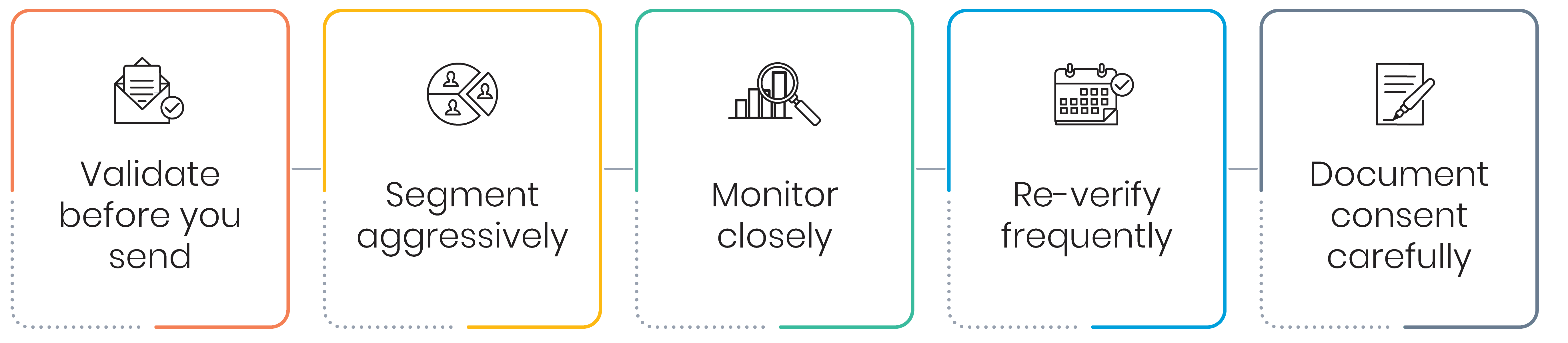
Validate before you send
Run every purchased list through an email verification service before loading it into your ESP. This removes obvious bounces, disposable addresses, and spam traps before they damage your reputation.
Segment aggressively
Treat purchased contacts as a separate segment with its own sending cadence and engagement thresholds. Don’t mix them with your organic list until they’ve proven their value.
Monitor closely
Track bounce rates, complaint rates, and engagement metrics for purchased contacts separately. If a batch underperforms, suppress it immediately and investigate the source.
Re-verify frequently
Purchased lists decay faster than organic lists. Plan on re-validating them every 30 to 60 days, and remove any contacts that show signs of disengagement.
Document consent carefully
Make sure you understand the opt-in status of every purchased contact. If you can’t confirm explicit consent, consider running a re-permission campaign before sending promotional content.
Finally, be realistic about the ROI of purchased lists. They can be a useful tool for reaching new audiences quickly, but they’re rarely a substitute for building your own engaged subscriber base over time.
Conclusion
When it comes to email list hygiene, the “just right” cadence is the one that keeps your sender reputation spotless and your revenue growing. The truth is, there’s no such thing as a “perfect” email list, and data will always decay, but with the right cadence and the right mix of automatic safeguards and strategic audits, you can keep your list clean enough to hit the inbox and convert, week after week and month after month.
Try Salesgenie® today so we can help you validate, enrich, and protect your sender reputation on your schedule, without driving yourself crazy or robbing hours from selling.
FAQs
Most email programs need a combination of real-time updates for urgent issues and scheduled reviews every 1-3 months. High-volume senders or rapidly growing lists should perform monthly checks, while quarterly audits work for most other programs.
Hard bounces with 5XX error codes, spam complaints, unsubscribe requests, role accounts, and known disposable domains all demand immediate suppression. Continuing to send to these addresses can quickly damage your sender reputation and deliverability.
No, annual cleaning leaves your program vulnerable to rapid data decay between cleanings. With B2B data decaying at 3% per month and 30% of corporate email addresses turning over yearly, you need more frequent maintenance to protect deliverability.
Key factors include your send volume and frequency, acquisition source quality, list growth rate, bounce and complaint trends, sales cycle length, and regulatory compliance requirements. Higher-risk profiles require more frequent updates.
If hard bounce rates exceed 0.5% for any single campaign, pause sending immediately and perform urgent suppression of invalid addresses. Track your 30-day rolling bounce and complaint rates, and trigger cleanups when they cross predetermined thresholds.