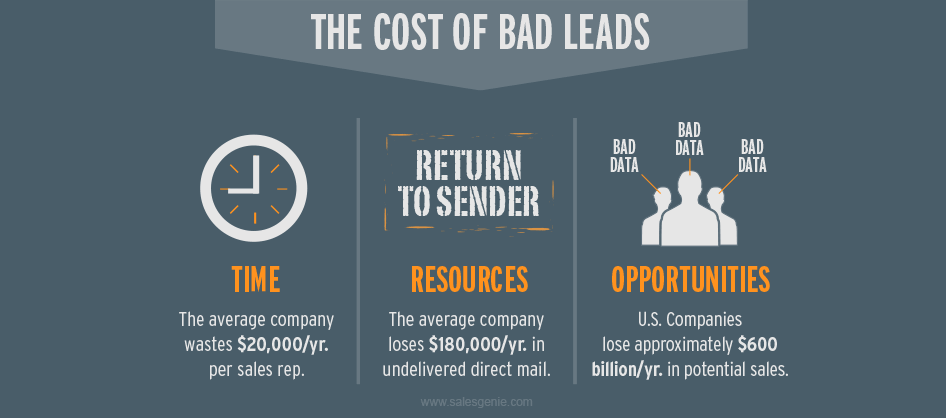

Most B2B teams treat customer lifetime value (LTV) as a lagging indicator—something to report on, not something to control. But here’s the truth: your LTV is largely determined before you ever make contact with a lead. The quality of your acquisition inputs, including fit, intent, and reachability, sets the ceiling for how much value each customer will generate over time. If you’re trying to boost LTV through retention tactics alone, you’re starting in the wrong place.
Continue reading our blog on customer LTV to learn how to raise customer lifetime value by fixing lead quality at the source, including what to measure, how to calculate LTV correctly, and where to focus your efforts for the biggest impact.
What is Customer LTV, Really?
Customer LTV is more than a financial metric. When defined clearly and calculated correctly, it becomes a decision-making tool that guides how you acquire, serve, and retain customers over time. Plus, there’s data to back up why keeping customers matters. Salesforce’s latest State of Sales report showed that recurring revenue is a top revenue source for 42% of sales leaders.
The problem is that many teams rely on misleading averages or incomplete ratios. Blended averages hide important variations between customer segments, leading to one-size-fits-all strategies that underperform. Ratios like “5:1 LTV to CAC” can create false confidence while unit economics quietly deteriorate.
To avoid these pitfalls, write out your customer LTV definition in plain language and specify the time horizon, revenue types, and cost inclusions that matter for your business. A clear definition ensures you’re making apples-to-apples comparisons across segments and acquisition channels.
Pro Tip
Write your one-sentence LTV definition and pin it to your acquisition brief. Use it to align your targeting, offers, and channel mix around finding and winning your most valuable customers. Resist the urge to dilute your definition as you scale, because precision matters more than vanity.
Why Doesn’t Retention Alone Move LTV?
It’s tempting to think that post-sale tactics are the key to improving customer LTV. Keeping customers is important, but retention has limits. Even the best onboarding and lifecycle marketing can’t fully compensate for acquiring the wrong customers in the first place.
Consider two customer cohorts:
- High-fit leads who go through a modest onboarding process
- Low-fit leads who receive world-class lifecycle marketing.
In most cases, the high-fit leads will deliver higher LTV. They stick around longer and spend more because they’re a better match for your product from day one.
If you’re trying to boost customer LTV, starting with retention is like building a house from the roof down. Build a strong foundation of high-quality acquisition first. Focus on finding better-fit leads and making your offer more compelling. Then, with a stronger base of good-fit customers, your retention efforts will have a bigger impact.
Pro Tip
If your retention experiments are improving LTV by a modest amount compared to your acquisition changes, shift more of your effort upstream. Focus on acquisition quality for a quarter or two, then layer in retention optimization once you’ve improved the inputs.
How Lead Quality Sets Your LTV Ceiling
The quality of your leads—their fit, intent, and reachability—determines your customer LTV long before your first touch. Here’s how each factor contributes:
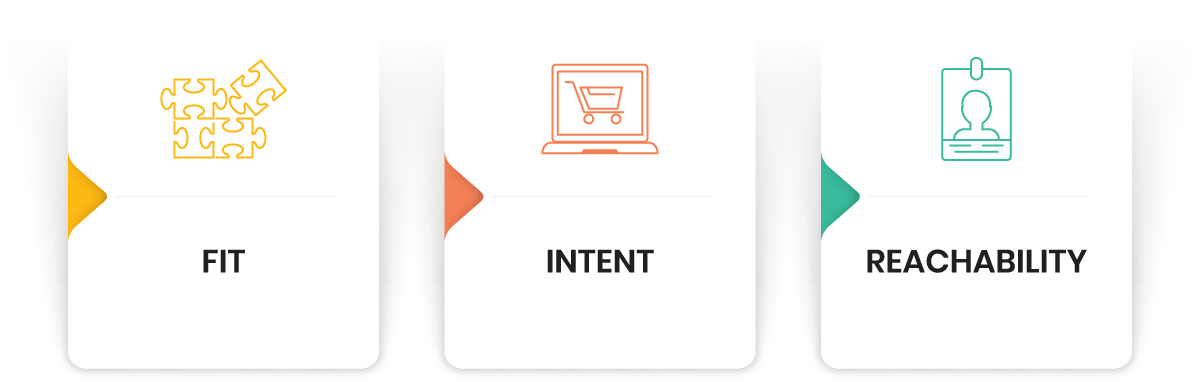
- Fit: Predicts activation and margin. Leads who closely match your ideal customer profile (ICP)are more likely to find value quickly and pay full price.
- Intent: Predicts engagement and longevity. Leads actively looking for a solution like yours are more motivated to buy and stay loyal over time.
- Reachability: Enables timely nurturing and re-engagement. Leads with valid, multi-channel contact information can be reached consistently to drive action.
When you acquire high-fit, high-intent, easily reachable leads, you’re stacking the deck in favor of higher LTV.
The impact of lead quality is visible in your funnel if you know where to look:
- Qualification rates: A high percentage of leads disqualifying during sales outreach points to poor fit.
- Time-to-first-value: Slow adoption or low feature usage signals a mismatch between your product and the lead’s needs.
- Refund/return rates: Early buyer’s remorse or high return volume within the first 30 days suggest low intent or oversold value.
If you see these red flags, don’t just blame your onboarding sequence. Take a hard look at your acquisition sources and audience targeting. The root cause is likely further upstream.
Pro Tip
Track LTV by lead source and audience segment. If you spot a source driving significantly lower LTV than your baseline, reduce spend or tighten your filters immediately. Trying to message your way out of a bad source is like pumping a leaky tire: plug the hole first, then optimize the pressure.
How Do You Calculate Customer LTV Today?
Simple formulas and a few key distinctions will get you actionable insights without the headache. The two most common approaches are cohort-based and blended LTV.
Cohort LTV tracks the value generated by a specific group of customers acquired in the same period. It’s ideal for comparing the quality of acquisition sources over time and isolating the impact of upstream changes.
Blended LTV averages the value across all customers, regardless of when they were acquired. It’s useful for getting a bird’s-eye view of your customer base and estimating overall business health.
Neither method is perfect on its own.
- Blended LTV can hide important variances between customer segments.
- Cohort LTV requires patience to reach statistical significance.
The real danger lies in using a single, average LTV for all decisions.
Example
Imagine you have two cohorts of 100 customers each. Cohort A has an average LTV of $1,000, while Cohort B is only $500. If you blend them together, you might conclude that you’re acquiring customers at an acceptable $750 LTV. But in reality, Cohort B is dragging down your average and may not even be profitable to acquire.
Don’t wait 12 or 24 months to course-correct a bad source. Report on early LTV indicators for each acquisition cohort, such as first-purchase margin, repeat rate, or time-to-second-order. If a cohort is materially underperforming your baseline, that’s a clear signal to revisit your acquisition strategy.
Pro Tip
Track 30-, 60-, and 90-day LTV-to-date for each cohort. Look for leading indicators that predict long-term value. If a cohort shows weak early signals, adjust your targeting or pause that source before the problem compounds.
The Limits of LTV vs. CAC
Many teams rely on the LTV to CAC ratio as a health metric, aiming for benchmarks like 3:1 or 5:1. But this ratio has serious limitations when used as a primary decision-making tool.
- The ratio obscures the absolute values. A 5:1 ratio sounds healthy, but if your LTV is $500 and your CAC is $100, you may still be leaving money on the table by underinvesting in acquisition. Conversely, a 2:1 ratio might be perfectly acceptable if your LTV is $10,000 and your CAC is $5,000, especially if payback happens quickly.
- The ratio doesn’t account for time. A customer who generates $1,000 in LTV over 12 months is far more valuable than one who takes 36 months to reach the same total, even if the ratio looks identical.
- Blended ratios can mask problems at the segment level. You might have a healthy overall ratio while certain acquisition sources or customer segments are deeply unprofitable.
Instead of relying on a single ratio, track customer LTV and CAC separately by cohort and segment. Look at payback period, contribution margin, and cash flow timing. These metrics give you a much clearer picture of where to invest and where to pull back.
Can You Predict High-LTV Leads Upfront?
The best time to identify high-LTV customers is before you acquire them. By analyzing the traits of your most valuable existing customers, you can build a predictive model that helps you prioritize leads with similar characteristics.
Start by identifying the four traits that correlate most strongly with high LTV in your business:
- Firmographic fit: Company size, industry, revenue, growth stage, or technology stack.
- Contact quality: Job title, decision-making authority, and verified contact information.
- Timing indicators: Budget cycle, hiring activity, funding events, or competitive displacement.
Once you’ve identified these traits, score your leads based on how many high-LTV indicators they exhibit.
This approach doesn’t require complex machine learning or expensive tools. A simple scoring model in your CRM, based on observable data points, can dramatically improve your acquisition efficiency.
Pro Tip
Review your scoring model quarterly. As your product evolves and your market matures, the traits that predict high LTV may shift. Keep your model current to maintain its predictive power.
Fix Acquisition Before Optimizing Retention
The path to higher-value customers runs through better inputs: cleaner data, sharper targeting, and offers that align with verified intent. No amount of post-sale optimization can fix a leaky funnel that’s bringing in the wrong leads to begin with.
Start by re-evaluating your audience criteria and acquisition mix:
- Tighten your filters: Sharpen your audience definition to focus on the attributes and actions that correlate with higher LTV. That might mean layering on technographic or firmographic data for B2B, or zeroing in on specific life events and past purchases for B2C.
- Prioritize high-intent sources: Double down on the channels and partners that bring in leads with demonstrated purchase intent. Leads that consume multiple pieces of bottom-funnel content or engage with your sales team are more valuable than those who only read top-of-funnel blog posts.
- Align offers to intent: Match your lead magnet or introductory offer to the level of intent shown by each audience. A high-fit, high-intent segment warrants a more direct response offer than a broad, unqualified audience that needs more nurturing.
Make these changes upstream, before you invest in new retention flows or upsell campaigns. Then, measure the impact on customer LTV at the cohort level to validate that your new inputs are driving the outcomes you expect.
Pro Tip
Make one significant audience or source change at a time, and use holdout groups to isolate the impact. This prevents you from mistakenly attributing LTV gains to downstream retention efforts when the real driver was upstream acquisition.
How Do You Prove It’s Working?
Once you’ve made changes to your acquisition strategy, you need a clear measurement plan to validate the impact. Track these metrics by cohort and segment:
- Early LTV indicators: First-purchase margin, repeat purchase rate within 30 days, and time-to-second-order.
- Activation metrics: Percentage of leads that complete onboarding, activate key features, or reach a defined “aha moment.”
- Engagement trends: Email open rates, product usage frequency, and support ticket volume in the first 90 days.
- Economic outcomes: Cohort-level LTV at 30, 60, and 90 days compared to your baseline.
The key is to measure early and often. Don’t wait six months to discover that your new acquisition strategy isn’t working. Build a dashboard that tracks leading indicators weekly, and review cohort performance monthly.
Pro Tip
Pair quantitative metrics with qualitative feedback. Interview customers from high-performing cohorts to understand what attracted them and what’s keeping them engaged. Use those insights to refine your targeting and messaging.
What Pitfalls Should You Avoid?
Even with a solid strategy, it’s easy to make mistakes that undermine your LTV improvement efforts. Watch out for these common pitfalls:
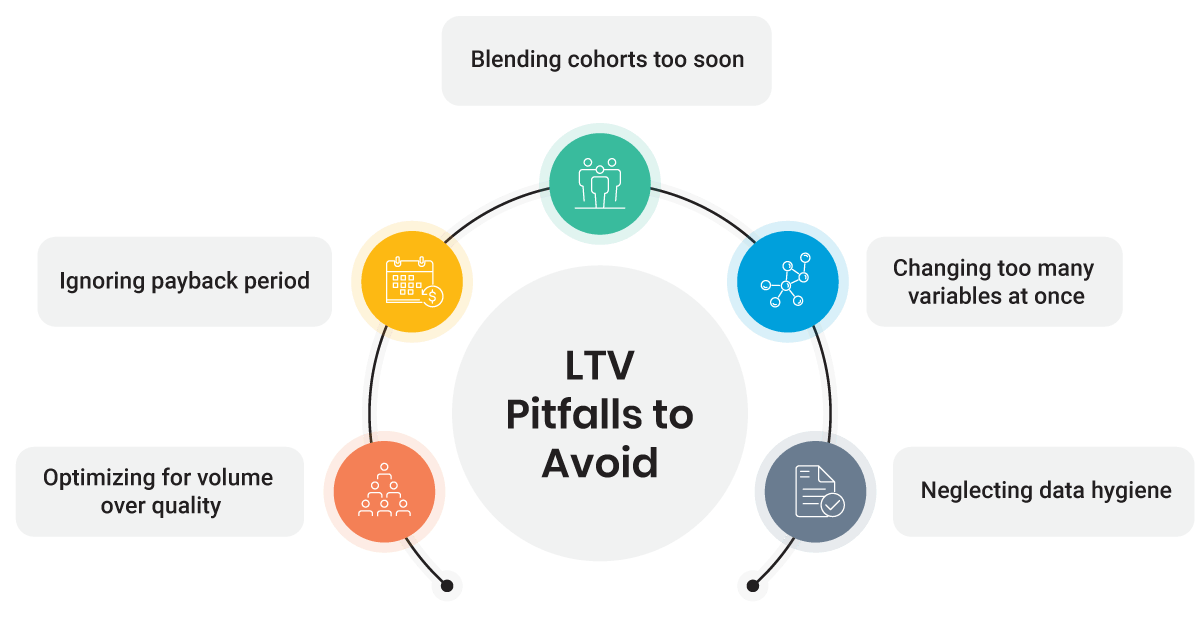
Optimizing for volume over quality
Hitting lead volume targets feels good, but if those leads don’t convert or retain, you’re just creating more work for your sales and success teams.
Ignoring payback period
A high LTV is meaningless if it takes three years to recover your CAC. Focus on cohorts that deliver strong early returns.
Blending cohorts too soon
Wait until a cohort has at least 90 days of data before blending it into your overall LTV calculation. Early blending hides problems.
Changing too many variables at once
If you adjust targeting, messaging, and offer simultaneously, you won’t know which change drove the results. Test one variable at a time.
Neglecting data hygiene
Inaccurate contact data, outdated firmographics, and duplicate records will sabotage even the best acquisition strategy. Clean your data regularly.
By avoiding these pitfalls and staying disciplined in your approach, you’ll build a sustainable engine for acquiring high-LTV customers.
Conclusion
Customer lifetime value isn’t something you fix after the sale. It’s determined by the quality of leads you acquire upfront. By tightening your targeting, prioritizing high-intent sources, and tracking LTV at the cohort level, you can raise the ceiling on customer value before your first touch.
Salesgenie® gives you a verified B2B contact database, with firmographic, technographic, and intent signals that help you identify and reach high-fit leads from the start. Stop trying to retain your way out of an acquisition problem. Build a better acquisition engine, and your LTV will follow.
FAQs
Customer LTV is a metric that measures how well you’re acquiring, serving, and retaining customers over time. When defined clearly and calculated correctly, LTV becomes your north star for sustainable growth, guiding decisions rather than just serving as a financial report.
Acquisition quality sets the foundation for LTV. Even modest onboarding with high-fit leads typically outperforms world-class lifecycle marketing with low-fit customers. While retention matters, focusing on acquiring the right customers first creates a stronger base that makes your retention efforts more effective.
Lead quality determines LTV before you make first contact through three key factors: fit (predicts activation and margin), intent (predicts engagement and longevity), and reachability (enables consistent nurturing). High-quality leads across these dimensions naturally drive higher LTV outcomes.
Cohort LTV tracks value from customers acquired in the same period, ideal for comparing acquisition sources over time. Blended LTV averages value across all customers regardless of acquisition date, useful for overall business health but can hide important variances between customer segments.
Focus on better inputs by tightening audience filters to attributes that correlate with higher LTV, prioritizing high-intent sources like engaged prospects, and aligning offers to demonstrated intent levels. Make these changes upstream before investing in retention tactics, then measure impact at the cohort level.