

Is your pipeline full of leads that stopped moving? Your prospects have downloaded content, attended webinars, opened emails, but then went quiet. Sales says they’re not ready. Marketing says they’re engaged. Meanwhile, competitors are closing deals you spent months warming up. The problem isn’t lack of activity. It’s that most nurture programs measure engagement instead of progression, reward clicks instead of readiness, and hand off leads based on arbitrary thresholds instead of actual buying signals.
This guide shows you how to build nurture programs that recognize when accounts are truly ready to advance, deliver content that moves deals forward, and create handoffs that sales can act on with confidence.
What Defines a Mature B2B Lead Today?
A lead that downloads three whitepapers isn’t necessarily closer to buying than one that downloads none. Activity tells you someone’s paying attention. Maturity tells you they’re ready to move.
The distinction matters because most nurture programs optimize for the wrong thing. They chase engagement metrics—like opens, clicks, form fills—and treat every interaction as progress. But a marketing manager who reads every email isn’t the same as a buying committee that’s aligned on the problem, has budget authority, and is actively comparing solutions.
Maturity in B2B lead nurturing means the lead or account has reached a point where your next action can actually advance the deal. That readiness depends on signals that span stakeholders, not just individual behavior. You’re looking for convergence across four dimensions:
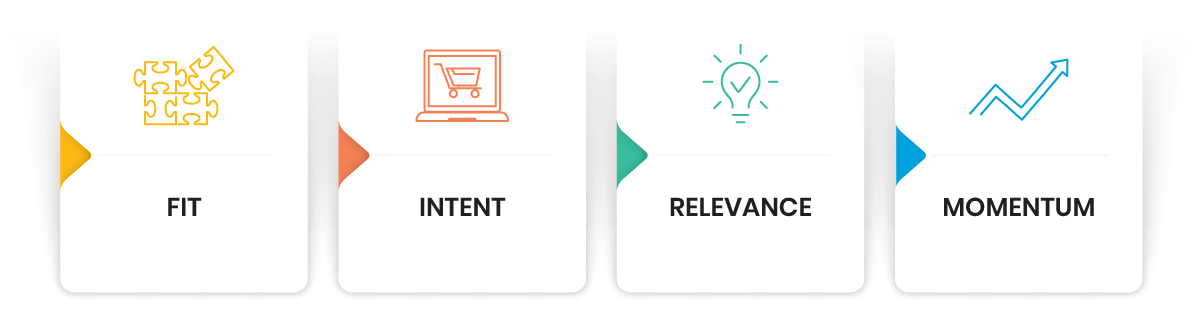
- Fit confirms the account matches your ideal customer profile—right size, industry, tech environment, and buying capacity.
- Intent shows the account is actively researching solutions in your category through third-party signals, repeated visits to high-value pages, or multiple contacts consuming decision-stage content.
- Relevance means your solution connects to a problem they’re trying to solve right now, not a theoretical future need.
- Momentum captures whether interest is building or fading based on velocity and recency across the buying committee.
When these signals converge across contacts, not just within one, you have a mature lead worth advancing.
How to Identify Account Signals vs. Contact Signals
B2B deals involve multiple stakeholders, which means tracking individual contacts in isolation misses the full picture. Contact-level signals tell you who’s engaged and what they care about such as email opens, content downloads, webinar attendance. Account-level signals reveal whether the buying committee is mobilizing together.
When three people from the same company engage in the same week, especially across different roles, that’s a stronger maturity indicator than one person clicking every email. A single champion at a great-fit account matters, but an account with multiple engaged stakeholders across functions often signals a deal that’s further along than individual scores suggest.
What are Positive and Negative Momentum Triggers?
Momentum isn’t just about cumulative activity. It’s about direction and acceleration, which can be positive or negative.
Positive triggers include:
- Multiple stakeholders engaging within a short window
- Repeated visits to pricing or comparison pages
- Demo requests from senior roles
- Increased frequency of high-intent content consumption
Negative triggers include:
- Engagement dropping off after a demo
- A champion going dark for more than two weeks
- Activity shifting to early-stage content after months of bottom-funnel engagement
Pro Tip
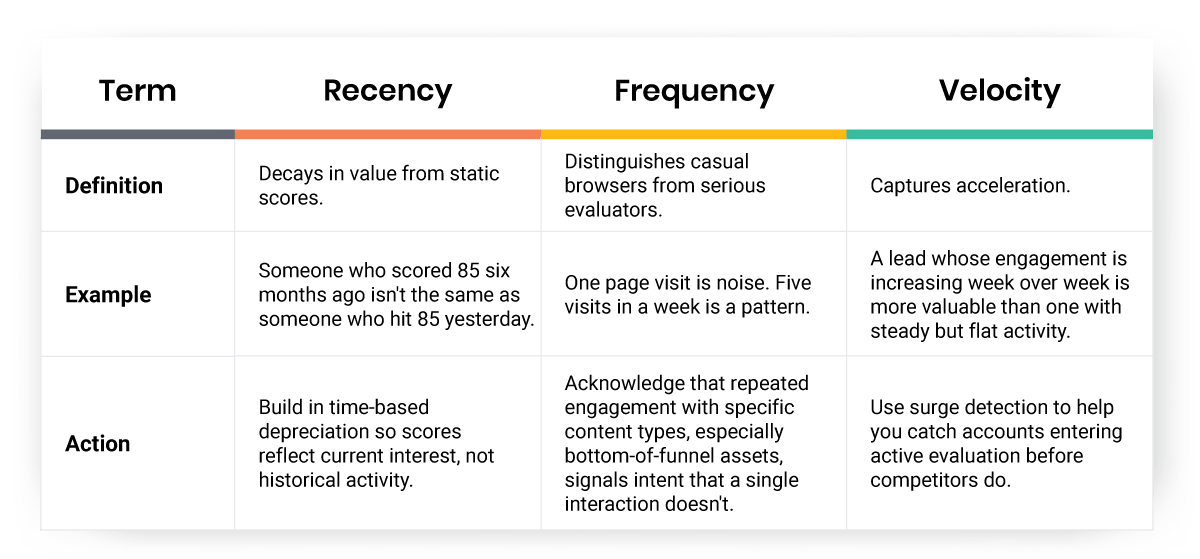
Build surge detection into your scoring model. Flag accounts where engagement velocity increases week over week, even if cumulative scores are moderate. These accounts are entering active evaluation and need accelerated outreach before competitors capture their attention.
Why Do Nurture Programs Stall?
When deals stop moving, the instinct is to add more touches. Send another email. Try a different subject line. Build a new sequence. But more activity rarely fixes a stalled pipeline. It just makes the underlying problems harder to see.
The real causes of stalled B2B lead nurturing programs fall into five categories:
- Scoring that rewards clicks over readiness overweights surface-level engagement while ignoring whether activity signals actual buying progress.
- Content that misses the stakeholder or stage sends technical guides to executives evaluating ROI or high-level thought leadership to practitioners ready to compare features.
- Cadence that’s either too aggressive or too sparse touches high-intent accounts once a month or blasts low-intent segments three times a week.
- Handoffs that leave deals in limbo pass leads based on ambiguous triggers or lack clear follow-up service level agreements (SLAs) between marketing and sales.
- No rules for disqualification or recycling clutter your database with bad-fit leads and unresponsive contacts that distort reporting and damage sender reputation.
Most nurture programs don’t fail because they lack content or automation. They fail because the underlying mechanics, such as scoring, targeting, timing, and handoffs, aren’t calibrated to how B2B buying works. Fix those, and your existing content starts performing.
How to Build Lead Scoring That Reflects Buying Signals
Effective scoring in B2B lead nurturing measures progression toward a buying decision. That means weighting three categories of signals: fit, intent, and momentum:
- Fit: Answers whether this account and contact should be in your pipeline at all. Company size, industry, tech stack, budget authority are table stakes. A contact at a company that’s too small, in an industry you don’t serve, or without purchasing authority shouldn’t score high no matter how many emails they open.
- Intent: Captures whether they’re actively evaluating a solution. Are they visiting pricing pages? Returning to comparison content? Searching for terms that indicate active research? Intent signals tell you someone is in-market, not just casually browsing.
- Momentum: Reveals whether interest is building or fading. A lead who engaged heavily six months ago but has gone silent isn’t qualified—it’s stale. A lead who just visited three pages in one session after months of inactivity is showing a surge worth acting on.
Account-Level vs. Contact-Level Weighting
Weight both individual and account-level signals, but don’t treat them equally. Here’s the difference:
- Contact-level scoring tracks who’s opening emails, attending webinars, and requesting demos.
- Account-level scoring aggregates behavior across the buying committee to catch mobilization that contact-level scoring misses entirely.
A single champion at a great-fit account with high intent is worth pursuing. But an account with multiple engaged stakeholders across functions often indicates a deal that’s further along than it appears.
Recency, Frequency, and Velocity
Pro Tip
Calibrate scores against historical conversions. Reverse-engineer which signals preceded sales-qualified leads in your CRM, then weight those higher. If demo requests from director-level contacts in mid-market companies convert at twice the rate of whitepaper downloads, your scoring should reflect that reality.
How to Map Content to the Real Buyer Journey
Most B2B nurture programs suffer from the same problem: a bloated library of assets deployed without regard for who’s receiving them or where they are in their evaluation. The result is noise that feels generic at best and irrelevant at worst.
Effective content mapping starts with two questions: What decision is this stakeholder trying to make right now? And what do they need to make it confidently? The answers change based on journey stage and role.
Below, you’ll find stage-to-stakeholder mapping examples:

Problem framing
Stakeholders are recognizing a gap or pain but haven’t committed to solving it. Executives need a short point-of-view piece that validates the problem’s business impact. Practitioners need a checklist or diagnostic that helps them quantify the issue in their own environment.

Solution validation
The buyer knows they have a problem worth solving and is now evaluating options. Managers comparing vendors need one-pagers that clarify differentiation. Executives need case studies with outcomes: revenue impact, time saved, risk reduced.

Risk mitigation
IT, security, legal, and operations stakeholders enter the conversation looking for reasons to slow things down. Give them security and compliance FAQs, implementation timelines, integration documentation, and data handling policies. These assets rarely generate excitement, but their absence generates delays.

Business case
Finance stakeholders need ROI ranges with clear assumptions they can stress-test. Sponsors need pilot plans that reduce perceived risk and make approval easier to justify. At this stage, your content isn’t persuading anyone—it’s giving them ammunition to defend the decision internally.
You should map content to stages and roles, but build flexibility into your nurture logic. Track which assets each stakeholder has engaged with, and use that history to inform what comes next.
Pro Tip
Audit your content library against actual deal progression. Identify the three to five assets that appear most frequently in won deals, then prioritize those in your nurture flows. A focused library of high-impact content outperforms a sprawling collection that dilutes attention.
What Cadence Builds Momentum Without Fatigue?
How can you determine what cadence structure is appropriate for your business? There are plenty of upsides and downsides, but it truly comes down to how frequently your prospects are engaging.
Structure your cadence tiers around observable behavior:
- Active evaluation (multiple touches in 14 days): Weekly contact with decision-stage content, stakeholder-specific assets, and direct sales outreach.
- Moderate interest (1–2 touches in 30 days): Bi-weekly nurture with stage-appropriate content and occasional check-ins.
- Low engagement (no activity in 30+ days): Monthly touchpoints with new angles, industry trends, or customer stories to re-ignite interest.
- Stalled post-demo (no response after sales contact): Immediate objection-handling sequence, then return to moderate-interest cadence if still unresponsive.
The goal is to implement timely touches that match where the account is and where they’re trying to go.
Fix Marketing and Sales Handoff Gaps
The marketing-to-sales handoff is where many promising accounts stall. If the trigger for passing a lead is ambiguous, or if there’s no clear service-level agreement for follow-up, warm accounts sit untouched while reps chase colder leads that happened to score higher.
Clear Routing Triggers
Define the exact conditions that trigger a pass to sales. Not just a score, but a combination of fit, intent, and stakeholder engagement that indicates genuine readiness:
- Account matches ideal customer profile (ICP) criteria (size, industry, budget capacity)
- Two or more stakeholders engaged in the past 14 days
- At least one bottom-funnel action (demo request, pricing page visit, comparison content download)
- Momentum score shows increasing velocity, not declining engagement
When these conditions are met, the lead moves to sales with full context: which stakeholders are engaged, what content they’ve consumed, and what questions or objections surfaced during nurture.
Post-Handoff Accountability
After handoff:
- Set a first-touch SLA. Sales contacts the lead within 24 hours of handoff, or the lead returns to marketing with notes on why contact wasn’t possible.
- Create a recycling rule for leads that don’t progress within two weeks.
- Return them to nurture with context intact, not as cold leads.
- Instrument feedback so you learn why deals stall.
- Audit your scoring model if sales consistently reports that leads aren’t ready.
- Examine whether your nurture set accurate expectations about next steps if leads go dark after handoff.
Pro Tip
Build a shared dashboard that shows both teams where accounts are in the journey, which stakeholders are engaged, and what content moved them forward. Transparency reduces friction and keeps both teams accountable to progression, not just activity.
How Do You Personalize at Scale?
Personalization in B2B delivers content that matches the recipient’s role, stage, and specific business context.
Start with segmentation that reflects how your buyers evaluate solutions:
- Industry-specific challenges: A healthcare CFO evaluating cost reduction cares about reimbursement models and compliance. A manufacturing CFO cares about supply chain efficiency and capital expenditure.
- Company size and complexity: Mid-market buyers need proof you can scale with them. Enterprise buyers need proof you can handle their complexity and integrate with existing systems.
- Role-based priorities: Executives want business outcomes. Practitioners want implementation details. Procurement wants vendor stability and contract flexibility.
Behavioral Triggers for Adaptive Messaging
Personalization improves when you respond to what people do, not just who they are:
- If someone downloads a technical guide, follow up with implementation resources, not high-level thought leadership.
- If multiple stakeholders from the same account engage with pricing content, trigger a coordinated outreach that acknowledges the buying committee’s interest.
- If a contact goes dark after a demo, send objection-handling content that addresses common stall points for their role and industry.
Aim for relevance at every touchpoint, which requires smart segmentation, dynamic content, and behavioral triggers that adapt messaging based on what you observe.
Which Metrics Prove Progression, Not Activity?
Most nurture dashboards measure the wrong things. Email open rates, click-through rates, and content downloads tell you whether people are paying attention. They don’t tell you whether those people are getting closer to a decision.
Shift your measurement framework to track progression:
- Velocity through stages: How long does it take accounts to move from awareness to consideration to decision? Are high-fit accounts moving faster than low-fit accounts?
- Multi-stakeholder engagement: What percentage of opportunities involve two or more engaged contacts? Do deals with broader committee engagement close at higher rates?
- Content consumption by stage: Are contacts engaging with content appropriate to their journey stage, or are they stuck consuming early-stage assets months into the relationship?
- Handoff conversion rates: What percentage of leads passed to sales result in meaningful conversations? What percentage advance to qualified opportunities?
- Time to re-engagement: When leads go dormant, how long does it take to re-activate them? Which tactics work best for different segments?
These metrics reveal whether your nurture program is really moving deals forward or just generating activity that looks productive in reports but doesn’t translate to revenue.
Pro Tip
Build a cohort analysis that tracks groups of leads from first engagement through closed deal or disqualification. Identify which signals, content types, and cadences correlate with faster progression and higher win rates, then optimize your program around those patterns.
When Should You Pause, Recycle, or Disqualify?
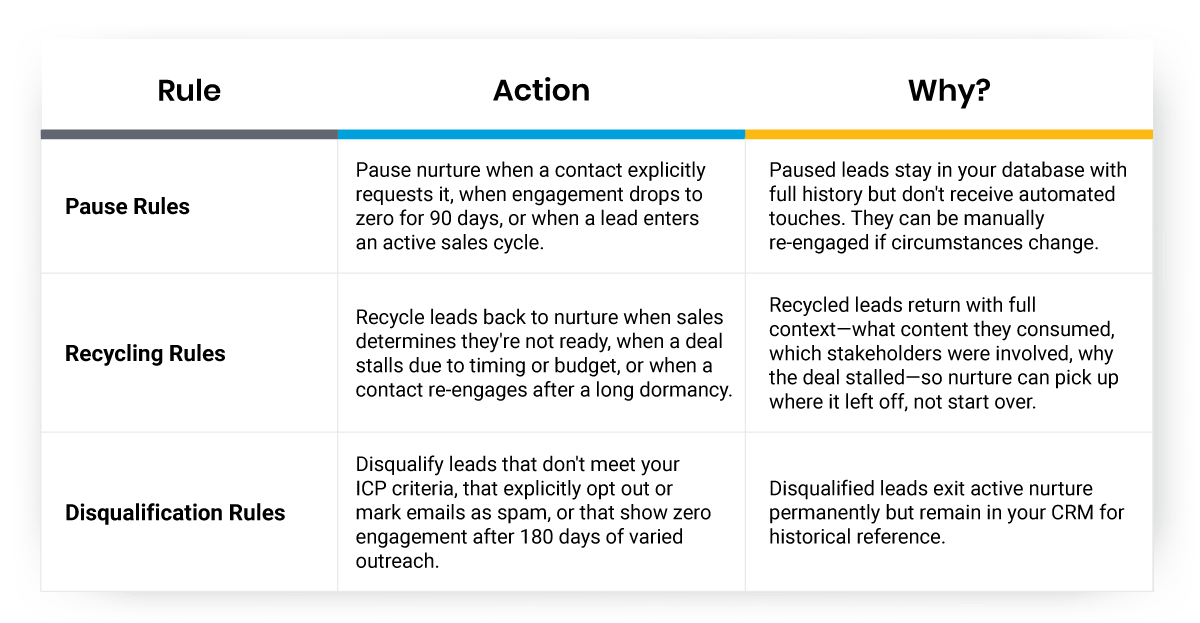
Not every lead deserves ongoing nurture. When you don’t exit bad-fit leads or rest unresponsive ones, your database becomes cluttered with deadweight that distorts reporting, damages sender reputation, and wastes resources.
Build clear rules for each exit path:
Pro Tip
Review your disqualified and paused segments quarterly. Market conditions change, companies grow, and priorities shift. A lead that wasn’t ready last year might be a perfect fit today—but only if you’re systematically revisiting exit decisions.
Conclusion
The difference between nurture programs that recover stalled deals and those that just add noise comes down to one shift: measuring progression instead of activity. When you score for readiness instead of clicks, map content to real stakeholder needs, adapt cadence to engagement signals, and hand off leads based on clear buying indicators, your pipeline fills with opportunities sales can actually close.
Salesgenie® helps you enrich account data with the signals that matter, orchestrate multichannel nurtures that respond to behavior, and operationalize clean handoffs that keep deals moving—so your team spends less time chasing stale leads and more time closing revenue.
Try Salesgenie today to see how it works in your environment.
FAQs
A mature lead has reached the point where your next action can actually advance the deal, showing convergence across fit, intent, relevance, and momentum. An engaged lead may open every email, but a mature lead demonstrates buying committee alignment, budget authority, and active solution comparison across multiple stakeholders.
Most scoring models overweight surface-level engagement like email opens and clicks while ignoring actual buying signals. Effective scoring should measure fit (can they buy?), intent (are they actively evaluating?), and momentum (is interest building or fading?) rather than rewarding activity that doesn’t indicate purchase readiness.
Content should be mapped to specific stakeholder roles and decision stages rather than deployed in generic sequences. Executives need business impact validation while practitioners need tactical diagnostics, and IT stakeholders need risk mitigation materials—all addressing the same stage but different concerns and detail levels.
Look for multiple stakeholders from the same company engaging within a short timeframe, especially across different functions or roles. Account-level scoring that captures cross-functional engagement often reveals deals further along than individual contact scores suggest, indicating genuine buying committee mobilization.
Start by auditing your scoring model against closed-won deals to identify which signals actually preceded conversions, then weight those higher. Define specific progression triggers for sales handoffs beyond just scores, and measure content performance by whether recipients advance to the next conversation rather than just downloads or clicks.