
Choosing the wrong direct mail format can sink your campaign before it reaches a mailbox. Because 76% of marketers use direct mail to drive purchases, it’s crucial to ensure you’re sending out an effective mail piece. Most teams default to postcards and letters due to their affordability and familiarity—all without asking whether the format actually fits the message. The result? Wasted budget, suppressed response rates, and missed revenue.
Instead, consider the CAB framework, a simple three-factor model that helps you align Complexity, Audience, and Budget to choose the right direct mail piece every time. This guide will help you learn how to score your campaign, avoid common format mismatches, and apply CAB in minutes to make smarter, more confident decisions.
Why Do Direct Mail Pieces Fail?
Most direct mail campaigns fall short for a simple reason: teams choose formats based on price or habit, not strategic fit. Postcards are cheap, so they become the default. Letters feel familiar, so they get picked without deeper analysis. But defaulting to the wrong format can undermine your campaign before it even reaches a mailbox.
The fix is straightforward:
- Define your campaign objective in eight words or fewer *before* you pick a format.
- Be specific. “Get more renewals” is vague; “Upgrade 100 dormant accounts to annual plans” is clear.
With your objective crystallized, you can evaluate direct mail formats based on their capacity to support your message, not just the cost.
Aligning format to objective is the first step in maximizing your direct mail ROI. In the rest of this post, we’ll unpack a simple framework for making those choices with confidence.
CAB Framework Overview
Choosing the right direct mail format doesn’t have to be a guessing game. The CAB framework, which stands for Complexity, Audience, and Budget, gives you a decision lens to align your format with your campaign goals in three simple steps:

- First, consider the Complexity of your message. How much detail does your offer really need to succeed?
- Second, think about your Audience. Who are they, what matters to them, and how do they typically respond?
- Finally, factor in your Budget. How much can you realistically invest in print, postage, and targeting to reach your goal?
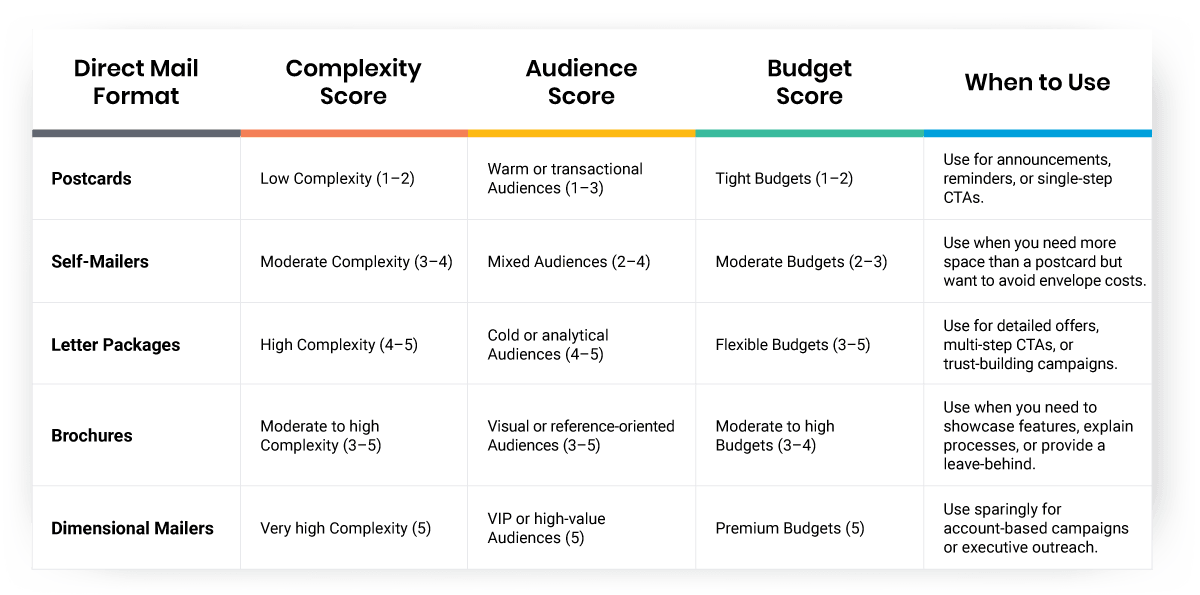
Scoring each factor from 1 to 5 will bring the trade-offs into sharp focus. Let’s say you have a complex offer (5), a time-strapped business Audience (4), and a moderate Budget (3). With scores of 5-4-3, you can immediately see that a simple postcard or a pricey dimensional mailer would be a mismatch. But a letter package or targeted self-mailer could hit the sweet spot.
How Does a Complex Message Change the Format?
The Complexity of your message is the first factor to consider when choosing a direct mail format. Is your offer simple and straightforward, or does it require more explanation and context to be compelling?
- Simple offers with a single call to action (CTA) tend to perform well on postcards. Think announcements, event invitations, or limited-time discounts. The recipient can grasp the value at a glance and take action without hesitation.
- If your message is more nuanced or your ask requires multiple steps, you’ll need a format with more room to build your case. A strong letter can unpack complex ideas, overcome objections, and guide the reader toward a decision.
The key to all of this is to match the depth of your format to the Complexity of your message.
Next, we’ll examine how your audience can impact responses.
How Does Audience Shape Response?
Your Audience is the second factor in the CAB framework, and it’s often the most overlooked. The same offer can perform wildly differently depending on who receives it and how they prefer to engage:
- Think about audience familiarity. Cold prospects need more context and credibility markers than warm leads or existing customers. A letter package with testimonials, case studies, or a detailed FAQ may be necessary to build trust with a new audience. But loyal customers who already know your value may respond faster to a streamlined postcard or self-mailer.
- Consider their decision-making style. Are they analytical buyers who need detailed specs and ROI calculators? Or are they fast-moving operators who value speed and simplicity? High-consideration Audiences often need more content to feel confident, while transactional audiences may tune out if you overexplain.
- Think about their available attention. Busy executives may skim a postcard but ignore a dense letter. Small business owners juggling multiple priorities may appreciate a brochure they can reference later. Match your format to the time and attention your audience can realistically give.
Now that you’ve identified your audience it’s time to consider which direct mail formats fit within the CAB framework.
Which Direct Mail Formats Fit CAB?
Once you’ve scored Complexity, Audience, and Budget, you can map those factors to the format that fits best. Here’s a quick guide to help you align CAB scores with direct mail formats:
Pro Tip
Avoid brochures for simple offers or transactional campaigns. If your message fits on a postcard, a brochure will feel like overkill and may reduce response.
If you’re incorporating more direct mail pieces into your marketing strategy, you may need to adjust your budget in certain areas. In the next section, let’s examine where you can adjust spending.
Which Budget Trade-Offs Matter?
It’s tempting to choose your direct mail format based on price alone. But the cheapest per-piece option can easily become the most expensive per response if it fails to engage your audience or convey your message effectively.
That’s why it pays to balance your budget across print, postage, and targeting, not just chase the lowest possible cost per piece. A well-targeted letter package with a compelling offer may cost more to produce than a saturation postcard, but it can also drive higher response rates and revenue per piece mailed.
The key is to align your format choice with the total response and revenue you expect from each audience, not just the up-front cost to reach them. When you match the right format to the right targets, your effective cost per sale can go down even if your per-piece expense goes up.
Next up, we’ll discuss areas in which CAB can be misapplied.
Where Does CAB Get Misused?
The CAB framework is simple, but it’s easy to misapply if you skip steps or let assumptions override data. Here are the most common misuses to avoid:
- Defaulting to the cheapest format without scoring Complexity or Audience: Budget is only one factor. If your message is complex or your audience is cold, a low-cost format may suppress response.
- Choosing a format based on what you like, not what your audience needs: Your preferences don’t predict response. Let CAB scores guide the decision.
- Overcomplicating simple offers: If your Complexity score is low, resist the urge to add a letter just because it feels more substantial. Match format to message.
- Underinvesting in high-value segments: If your Audience score is high and your expected revenue justifies it, don’t skimp on format depth to save a few dollars per piece.
- Skipping the test: CAB gives you a hypothesis, not a guarantee. Always test it with a holdout or split to validate your format choice.
How Do You Apply CAB Quickly?
You don’t need hours to apply the CAB framework. Here’s a five-minute checklist to score your next campaign and choose the right format:
- Write your campaign objective in eight words or fewer. Be specific about the action you want and the audience segment you’re targeting.
- Score Complexity from 1 to 5. How many key points does your offer require? How many steps does your CTA involve?
- Score Audience from 1 to 5. How familiar are they with your brand? How much time and attention can they give?
- Score Budget from 1 to 5. What’s your realistic cost per piece, and how does that align with expected revenue per response?
- Map your scores to the format guide above. Match your CAB profile to the format that fits best.
- Document your reasoning and plan a test. Note why you chose this format and how you’ll measure success.
Pro Tip
Use a simple spreadsheet to track CAB scores across campaigns and build a library of what works for each segment.
Which Metrics Determine CAB Success?
Once you’ve chosen a format using CAB, you need to measure whether it worked. Track these metrics to validate your decision and refine future campaigns:
- Response rate: The percentage of recipients who took your desired action. Compare across formats to see which drove the highest engagement.
- Cost per response: Total campaign cost divided by total responses. This reveals whether a higher per-piece investment paid off.
- Conversion rate: The percentage of responders who became customers or completed the full desired action.
- Revenue per piece mailed: Total revenue generated divided by total pieces mailed. This is the ultimate test of format effectiveness.
- Lift vs. control: If you tested multiple formats, measure the performance difference to quantify the impact of your CAB-based choice.
Pro Tip
Track CAB scores and results in a shared dashboard so your team can learn from every campaign.
These metrics help you build a data-driven playbook and prove the ROI of your format decisions.
Conclusion
When you align Complexity, Audience, and Budget deliberately, you stop guessing and start choosing direct mail formats with confidence. The CAB framework gives you a repeatable process to match your message to the right format, minimize waste, and maximize response. Whether you’re mailing to cold prospects or loyal customers, CAB helps you invest your budget where it will drive the most revenue.
Ready to build your next campaign? Salesgenie® gives you the targeting tools and mailing list quality you need to reach the right audience with the right format, so every piece you mail has the best chance to perform.
FAQs
Most campaigns fail because teams choose formats based on price or habit rather than strategic fit. This misalignment between format and campaign objectives can significantly depress response rates and increase cost per conversion.
CAB stands for Complexity, Audience, and Budget, three factors you should evaluate when choosing direct mail formats. Score each factor from 1 to 5 to identify the optimal format that aligns with your campaign goals and constraints.
Simple offers with single calls to action work well on postcards, while complex messages requiring detailed explanations need letters or brochures. If your call to action requires multiple steps, skip postcards and choose formats with more space to provide necessary context.
The cheapest per-piece option often becomes the most expensive per response if it fails to engage your audience effectively. A well-targeted, higher-cost format can drive better response rates and revenue per piece, making it more cost-effective overall.
Document CAB scores for your top customer segments and compare them to your current formats to identify misalignments. Test alternative formats where you’re out of alignment, and focus on matching format depth to audience needs rather than defaulting to familiar options.