
As a janitorial business owner, it’s tempting to chase every potential client and compete on price alone. This “do it all” approach often leads to commoditization, razor-thin margins, and missed opportunities with risk-sensitive commercial buyers.
In this blog, you’ll learn how facility decision-makers really choose vendors, how to position your value in terms they care about, and which janitorial business marketing strategies reliably start conversations with the right contacts, so you can escape the low-price trap and win higher-value contracts that recognize your true expertise.
What’s the Wrong Default in Janitorial Sales?
Most janitorial companies try to win every contract by offering the broadest possible range of services at rock-bottom prices. Their websites and proposals are full of generic promises like “we do it all” and “satisfaction guaranteed.” When you position yourself as a jack-of-all-trades, you’re signaling that you’re no different from any other cleaning company. Facility managers and commercial clients start to see you as a replaceable commodity, rather than a trusted partner who understands their unique needs and challenges.
This is especially problematic when you’re trying to win contracts in risk-sensitive industries like healthcare, manufacturing, or food service. These buyers need a provider who can meet strict compliance requirements, prevent costly downtime, and protect their reputation. If your messaging doesn’t speak directly to those concerns, you’ll struggle to even get a foot in the door.
As a first plan of attack, here’s what you can do to stand out from your competitors:
- Focus on a specific industry or service area where you have deep expertise and a track record of success.
- Rewrite your marketing materials and proposals to highlight the unique value you bring to that niche.
- Position your service around the outcomes buyers care about most.
Example
If you specialize in cleaning surgical suites for outpatient clinics, you might say: “We help outpatient surgery centers maintain a safe, audit-ready environment by following strict infection control protocols and providing detailed documentation for compliance purposes.” By speaking directly to the buyer’s top concerns, you immediately set yourself apart from the generalist competition.
Pro Tip
If your homepage or proposals lead with “we do it all,” you’re signaling commodity. Rewrite around one vertical and the risk you remove.
What Actually Drives Commercial Cleaning Decisions?
Understanding what motivates commercial buyers helps you position your services more effectively. While price matters, it’s rarely the deciding factor for risk-sensitive organizations. Two considerations consistently outweigh cost in the decision process
- Risk and Compliance: Facility managers in healthcare, food service, and manufacturing face serious legal consequences if cleaning standards slip. These buyers prioritize providers who can demonstrate expertise in their industry’s specific regulations and protocols. When you lead with compliance capabilities and risk mitigation, you speak directly to their primary concern.
- Access and Response Time: Even when a contract starts well, renewals depend heavily on how responsive you are when issues arise. Property managers and facility directors need to know they can reach you quickly when a tenant complains or an unexpected situation occurs. Your ability to provide consistent communication, flexible scheduling, and rapid problem resolution often matters more than your initial bid price.
Pro Tip
Build your first 30 seconds around one critical risk you remove, not your equipment list.
Who Hires Janitorial Services for Their Business?
Winning commercial cleaning contracts requires reaching the right decision-makers with the right message. The specific roles involved vary by organization size and type, but several key players typically influence janitorial purchasing decisions:

Facilities Managers or Operations Managers
Their focus: ensuring maximum uptime, maintaining a safe environment, and keeping operations running smoothly with minimal disruptions
What they need: reliability, responsiveness, and your ability to work around their operational needs

Property Managers or Asset Managers
Their focus: tenant satisfaction scores, response times to service requests, and meeting specific service level agreements
What they need: vendors who help keep occupancy rates high and minimize tenant churn

Office Managers or Practice Managers
Their focus: managing smaller organizations, in which they often wear many hats
What they need: vendors who make their lives easier through flexibility, predictable scheduling, and minimal disruption to the workday

Procurement or Finance
Their focus: evaluating pricing and contract terms, highlighting vendor consolidation opportunities, insurance requirements, and proper documentation
What they need: vendors who provide clear, thorough proposals to help streamline their approval process
In most cases, you’ll need to appeal to multiple stakeholders throughout the sales cycle. By tailoring your messaging and proof points to each stakeholder’s specific concerns, you can build broader consensus and increase your chances of winning the business.
How Should You Position Your Value?
Once you understand who makes buying decisions and what drives them, you need to articulate your value in terms that resonate. Generic claims about quality or service don’t differentiate you. Instead, structure your positioning around three specific elements:
- Name the vertical you serve and the specific facility types within it. “We work with medical practices” is better than “we serve all industries,” but “we specialize in multi-provider outpatient clinics in Class B office buildings” is even stronger.
- Identify the primary risk or compliance challenge your target buyers face. Healthcare facilities worry about infection control and audit readiness. Manufacturing plants need to prevent contamination and maintain safety certifications. Property managers focus on tenant retention and minimizing complaints.
- Offer concrete proof of the outcomes you deliver. Vague statements like “we provide excellent results” don’t build confidence. Instead, reference specific metrics, certifications, or track records: “We’ve supported 12 medical practices through successful Joint Commission surveys with zero cleaning-related findings.” When you can explain your niche, the risk you reduce, and the proof you offer in 30 seconds or less, you’re ready to have meaningful conversations with commercial buyers.
Choose a Vertical That Fits Your Strengths
Specializing in a specific industry vertical can differentiate your janitorial business and command higher margins, but not all verticals are created equal. Choosing the wrong niche can stretch your resources thin without delivering the returns you expect. Focus on a vertical that aligns with your existing strengths and capabilities rather than chasing the latest hot market.
Start by looking at where you’ve already solved high-stakes problems for clients. If you’ve helped a healthcare facility navigate a complex accreditation process or supported a manufacturing plant through a critical audit, those are strong indicators that you have the expertise and credibility to succeed in those verticals.
Next, you should evaluate market opportunity through the lens of your current operations. Ask yourself these questions:
- Can I meet the compliance requirements specific to that industry?
- Are the decision-makers accessible through my existing relationships or networks?
- Do the typical contract sizes match my operational scale and capacity?
- Are the jobs repeatable enough to achieve economies of scale?
By narrowing your focus to a specific facility type or service offering, you can become the recognized expert in that micro-niche and build a strong reputation that leads to repeatable wins.
Pro Tip
Start with “where have we already solved high-stakes problems?” Past wins predict faster traction than greenfield niches.
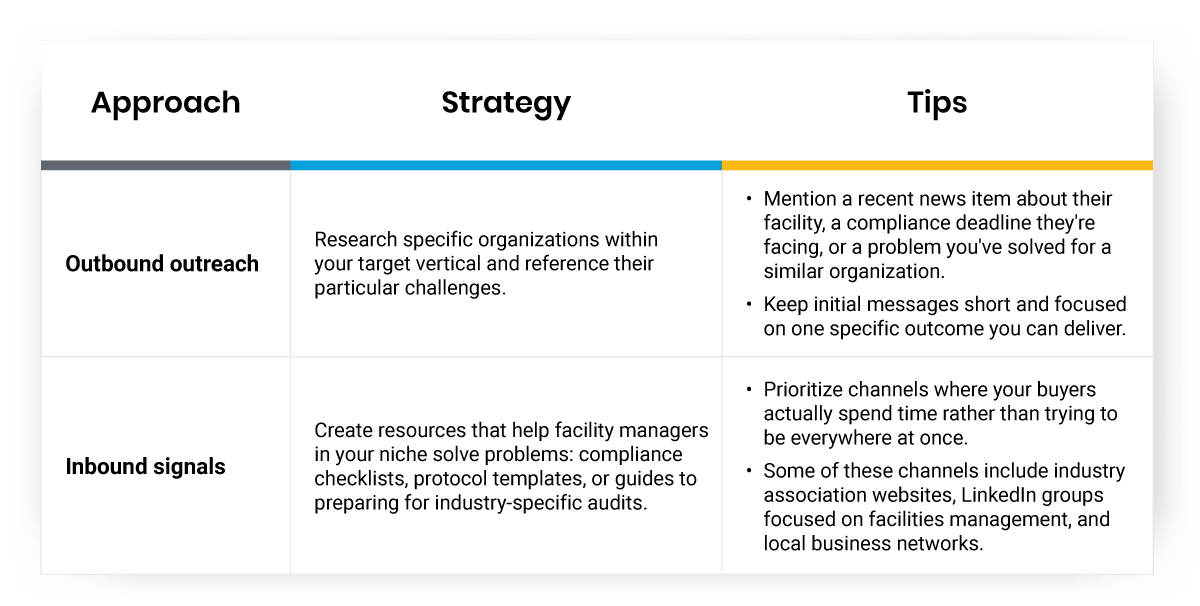
What Janitorial Marketing Strategies Win Meetings?
Once you’ve defined your vertical and value proposition, you need marketing tactics that actually start conversations with decision-makers. The most effective approaches combine targeted outbound outreach with inbound signals that demonstrate your expertise.
Are Your Proposals Helping or Hurting?
Your proposal is often your last chance to differentiate yourself before a buyer makes a decision. Many janitorial companies undermine their own positioning by submitting generic, price-focused proposals that look identical to every competitor’s. A strong proposal reinforces your specialized expertise and makes it easy for buyers to justify choosing you.
Here’s how you can strengthen your proposals to win more contracts:
- Open with the buyer’s stated risk or compliance goal, not your company history
- Present service scope as a risk-mitigation plan, not a task list
- Offer 2–3 tiered options (good/better/best) so buyers compare your packages, not you vs. competitors
- Include a one-page “Assurance Summary” with insurance, certs, and compliance documentation
- Close with next steps and a clear decision timeline
Proof, Credentials, and Insurance That Close Deals
Commercial buyers need assurance that you can deliver on your promises before they’ll sign a contract. The right credentials and documentation can actively differentiate you from less-prepared competitors.
So, what credentials can you present to potential clients that will help them feel confident in their decision?
- Industry-specific certifications signal that you understand the unique requirements of your target vertical. Don’t just list certifications in your proposal. Instead, explain what they mean for the buyer.
Examples
For healthcare facilities, CIMS certification or ISSA training in infection prevention protocols demonstrates specialized knowledge.
For food service environments, ServSafe or similar food safety credentials show you understand contamination risks.
- Commercial clients typically require specific insurance coverage and documentation before they’ll even consider your bid. General liability insurance is standard, but many industries require higher coverage limits or additional policies. Also be prepared to provide safety data sheets for all cleaning products, background check policies for staff, and detailed protocols for your quality control process.
Examples
Healthcare facilities often require professional liability coverage.
Properties with high-value equipment may require inland marine insurance.
Pro Tip
Keep a one-page “Assurance Sheet” with insurance limits, key certs, and compliance docs ready. Attach it to every proposal and RFP response.
Focus Wins More Commercial Contracts
As previously mentioned, focusing your messaging around a specific vertical and the unique value you deliver helps you position yourself to win higher-margin, multi-year contracts with clients who prioritize quality and reliability over rock-bottom prices.
To make this focused approach work, you need to be able to articulate your value proposition succinctly and persuasively. When a prospective client asks what you do, give your elevator pitch: within 30 seconds, explain your niche, the specific risks you handle, and the outcomes you can prove
Example
“We specialize in helping medical practices in the downtown area maintain audit-ready facilities and prevent cross-contamination incidents.”
Pro Tip
If you can’t explain your niche, risk you reduce, and proof in 30 seconds, you’re not ready to bid. Focus on tightening your story first.
Conclusion
Winning commercial cleaning contracts consistently requires moving beyond generic “we do it all” positioning and competing on price alone. By specializing in a vertical that fits your strengths, positioning your value around the specific risks you mitigate, and backing up your claims with clear proof points, you differentiate your business and command the margins you deserve. Remember, the right prospects are out there—you just need to reach them with messaging that speaks to their real priorities.
Salesgenie® helps janitorial businesses identify and connect with decision-makers in their target verticals through accurate contact data and industry-specific search filters, so you can focus your outreach where it matters most and start more of the right conversations. Reach out to our experts to get started.
FAQs
The “do it all” approach leads to commoditization and razor-thin margins because you’re competing solely on price with generic messaging. When you position yourself as a jack-of-all-trades, facility managers see you as replaceable rather than a trusted specialist who understands their unique compliance requirements and risk management needs.
The primary decision-makers include facilities managers (focused on uptime and safety), property managers (concerned with tenant satisfaction and lease retention), office/practice managers (seeking minimal disruption), and procurement/finance teams (evaluating pricing and compliance documentation). Understanding each stakeholder’s priorities helps you tailor your messaging throughout the sales process.
Focus on verticals that align with your existing strengths by evaluating where you’ve already solved high-stakes problems for clients. Consider whether you can meet compliance requirements, access decision-makers, handle the typical contract sizes, and deliver repeatable, profitable services within that industry.
Outcome-based messaging speaks directly to buyers’ specific concerns and job priorities, such as “maintaining audit-ready surgical suites” instead of “providing quality cleaning.” This approach immediately demonstrates that you understand their industry challenges and can deliver measurable results that matter to their business success.
You should be able to explain your niche, the specific risks you reduce, and concrete proof of outcomes in 30 seconds or less. For example, specify your target industry, mention compliance achievements like passing inspections with zero violations, and quantify results rather than making vague quality promises.