

Too many marketers still treat everyone “65 and older” as if they’re one homogeneous group. That outdated mindset leads to generic creative, wasted ad spend, and weak response rates because it ignores the very real differences in lifestyles, values, and decision-making across the broader senior population.
In this guide, you’ll learn how to market to seniors using a life stage framework that goes beyond age brackets and stereotypes. We break down how to:
- Segment older adults meaningfully, from active, recently retired explorers to later-stage retirees with distinct motivations
- Discover which channels truly reach today’s older consumers and why digital engagement matters more than many brands assume
Why Seniors Aren’t a Single Segment
Most marketing teams still treat adults over 65 as a single audience segment. But relying on age alone leads to generic creative, wasted spend, and low response rates.
The reality is, seniors are an incredibly diverse group. Their needs, preferences, and behaviors vary widely based on factors like work status, living situation, health and mobility, family context, and caregiver involvement.
Here are some initial actions you can take to properly market for older adults:
- Replace age-based segments with life-stage profiles.
- Mine your data for insights into roles, routines, health status, work situation, and caregiver context.
- Build 4–6 distinct profiles that reflect observable differences in how seniors make decisions.
Why does this approach matter? What resonates with a healthy 67-year-old who coaches her granddaughter’s softball team will ring hollow with an 84-year-old widower managing chronic conditions. Ultimately, misalignment erodes trust, lowers response rates, and drives up cost per acquisition.
Next up, we’ll dive into how to segment by life stages.
Which Life Stages Actually Matter Most?

The answer to this question depends on the life stages that matter most for your business. To start, choose 4–6 key phases, each with its own set of needs, challenges, and decision-making triggers.
For example, you might segment by:
- Still Working, 60s: Focused on the home stretch to retirement, juggling job responsibilities with planning for the future
- Newly Retired: Adjusting to a new identity, re-evaluating budgets, and making key benefits decisions around Medicare and Social Security
- Aging in Place, 70s–80s: Prioritizing home safety, transportation, routine care, and simplifying finances
- Caregiver-Influenced Households: Adult children or spouses are involved in decision-making, requiring clear information for multiple stakeholders
- Transitioning to Assisted Living: High-stakes decision requiring trust, clarity, and credibility from partners
Which Signals Can Identify Life Stage?
Look for observable cues that help you pinpoint where a senior is in their journey:
- Work status (employed, newly retired, retired 5+ years)
- Household composition (living alone, with spouse, with adult children)
- Recent moves or downsizing
- Major healthcare events or diagnoses
These kinds of signals give you a practical way to segment your audience and ensure your marketing is always relevant and helpful.
Pro Tip
Review your life stage definitions quarterly as economic conditions, healthcare policies, and social norms shift. Keep your segments aligned with current reality.
How Should You Segment Beyond Age?
Life stage segmentation requires data you can observe and act on instead of making assumptions. The goal is to build profiles that reflect real decision contexts, not demographic stereotypes.
Start with signals already in your CRM or customer data platform:
- Recent life events (retirement, relocation, widowhood)
- Purchase history (home modifications, travel, healthcare products)
- Engagement patterns (phone vs. digital preference, response to direct mail)
- Household indicators (multi-generational address, caregiver involvement)
Learn more: Targeted Turning 65 Medicare Leads
The Importance of Collecting Signals Ethically
When gathering data on seniors, prioritize transparency and control:
- Use clear opt-in language for phone and email outreach, compliant with TCPA and CAN-SPAM regulations.
- Offer multiple ways to update preferences or opt out.
- Avoid forced account creation or unnecessary data collection.
- Provide easy access to live support for questions about data use.
Pro Tip
Test your data collection forms with seniors before launch. If they can’t complete it in under two minutes, simplify.
The bottom line is that ethical data practices build trust and reduce opt-out rates over time.
What Do Older Adults Value in Marketing?
When it comes to marketing to older adults, it’s all about building trust and making things easy. Clever taglines and flashy designs might win points with younger crowds, but seniors have different priorities.
Anchor your creative around five key values:
- Clarity: Use simple language, larger fonts, high-contrast colors, and plenty of white space.
- Control: Offer multiple response options (phone, mail, online) and avoid forced account creation.
- Credibility: Trust is critical with this audience. Use social proof, clear disclosures, and access to licensed advisors.
- Convenience: Keep forms short, offer live phone support, and provide flexible scheduling.
- Cost Transparency: Be upfront about pricing and avoid bait-and-switch tactics.
When you anchor creative around these values, you’ll become known as a trusted resource seniors can count on.
Pro Tip
Run all senior-focused creative through an accessibility checker before launch. Test font size, contrast ratios, and tap target size on mobile devices.
Now that you understand how to target seniors in your marketing efforts, which channels are most likely to reach them?
Which Channels Reach Retirees Best Today?
A recent study on the media preferences of older adults showed that 74% of participants used television for their primary source for new products or services, but 89% of participants reported that they use a smartphone with 73% using Facebook daily. What marketers can glean from this information is that seniors as a cohort are using all types of technology, much like younger generations, offering new opportunities to connect.
When it comes to reaching retirees, match your channels to their reachability and trust level for each life stage. That means blending offline and digital tactics to meet their preferences.
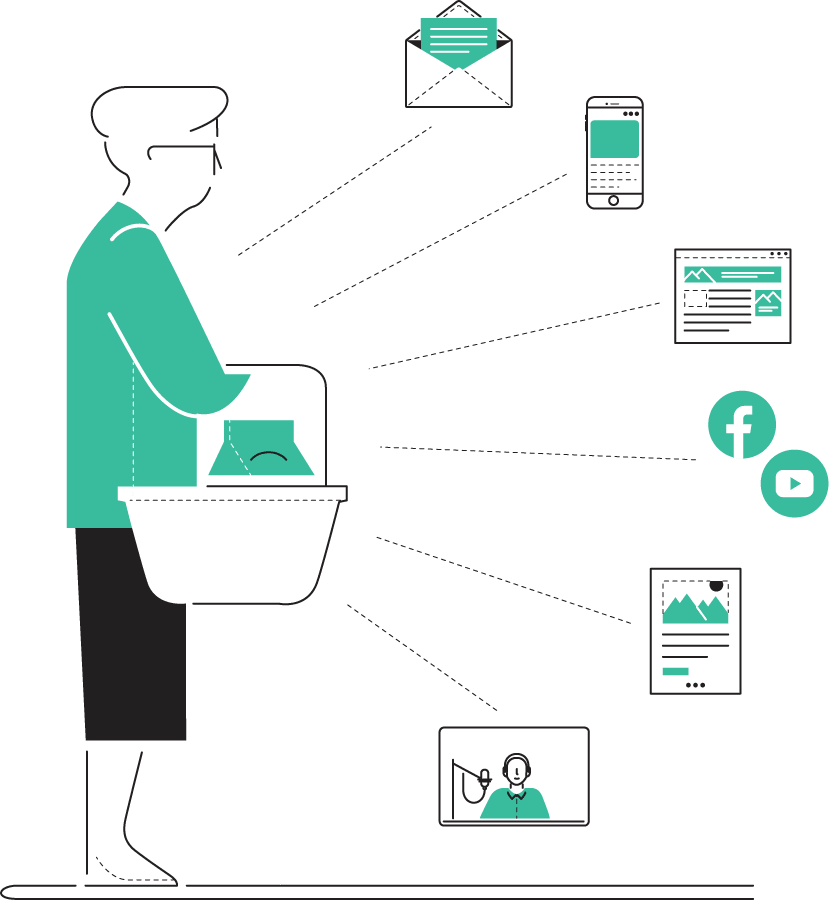
Deploy channels based on life stage and decision complexity:
- Direct Mail: Strong for education-heavy offers, local services, and building initial trust, especially when paired with a phone CTA.
- Phone (Inbound/Outbound): Essential for complex choices like healthcare or financial decisions. Staff with licensed experts and offer clear scheduling windows.
- Search + Landing Pages: Captures active research intent. Optimize landing pages for readability with large tap targets and short forms.
- Facebook/YouTube: Effective for building awareness and retargeting past site visitors. Focus on video formats and always include captions.
- Email: Powerful for nurturing leads and delivering confirmations. Optimize designs for readability with a single, clear CTA.
- Events/Webinars: Build credibility in high-trust categories. Promote via direct mail and phone reminders to boost attendance.
Pro Tip
Cap early-stage touchpoints at 2–3 per week. Only increase frequency once someone has actively engaged or requested more information. Seniors opt out quickly if they feel bombarded.
Using different channels to support each other creates a seamless experience that guides seniors through complex decisions without overwhelming them.
How to Sequence Messages Across Channels
When it comes down to it, effective senior marketing requires orchestrating a sequence that respects how seniors research and decide, using more than one channel to create a cadence.
Below are some examples of how you can map channel sequences to life stage scenarios:
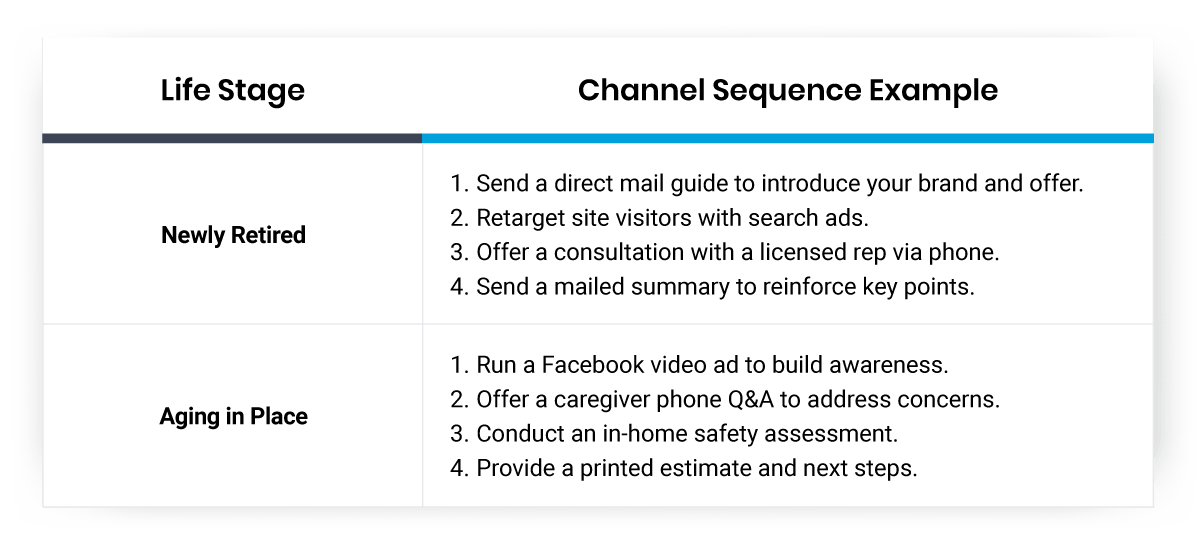
Each channel plays a specific role in moving the prospect through the decision journey. Being intentional about how and when you deploy each tactic creates a more effective and efficient marketing system while respecting seniors’ preferences and pace.
Pro Tip
Build channel sequences that allow seniors to “raise their hand” before increasing intensity. Let engagement signal readiness for the next step.
Where Do Most Senior Campaigns Fail?
Even well-intentioned senior marketing campaigns often stumble in predictable ways. Recognizing these failure points helps you avoid them.
Watch for these common pitfalls:
- Forcing digital-first journeys: Requiring online account creation or app downloads before allowing phone contact alienates seniors who prefer human interaction.
- Ignoring caregiver dynamics: Marketing only to the senior when adult children are heavily involved in decisions creates friction and delays.
- Overpromising outcomes: Guarantee-like language (“you’ll save thousands”) erodes trust when results vary by individual circumstance.
- Skipping accessibility basics: Small fonts, low contrast, and complex navigation create barriers that drive seniors to competitors.
Pro Tip
Before launch, walk through your entire campaign journey as if you were a 75-year-old with limited digital experience. If you hit friction, your audience will too.
Campaigns that ignore these failure modes waste budget on audiences who can’t or won’t engage. Worse, they create negative brand associations that are difficult to overcome in future campaigns.
How Can You Measure What Works?
To truly understand campaign performance, measure results by life stage and context. You should go beyond top-line cost-per-acquisition (CPA) and return on ad spend (ROAS) by tracking metrics that reflect senior-specific engagement, such as the following:
- Response rate by life stage: Which segments engage most with each offer?
- Channel-assisted conversions: How do direct mail, phone, and digital work together?
- Call duration and appointment set rate: Are phone interactions productive or frustrating?
- Opt-out rate by frequency: Are you contacting seniors too often?
- Accessibility compliance score: Are your digital properties meeting WCAG standards?
Testing That Respects Seniors
Ensure you test your efforts frequently but design those tests to maintain a positive brand experience. Here are some examples of how you can do so:
- Test messaging angles and creative formats within frequency caps.
- A/B test channel sequences, not just individual tactics.
- Use holdout groups to measure incrementality, not just response.
- Gather qualitative feedback through post-conversion surveys.
Measuring by context reveals which life stages respond best to which approaches, and without proper measurement, you can’t optimize or justify budget allocation.
Conclusion
To succeed in marketing to seniors, make your efforts relevant and accountable. Segment by life stage, reflect what seniors value in your messaging, choose channels that prioritize reach and trust, and measure outcomes by context. This approach creates more respectful and effective experiences for seniors, improves response rates and conversion lift, and provides clearer attribution of marketing spend.
With tools like Salesgenie®, you can access accurate, privacy-conscious senior segments and multi-channel outreach capabilities in one place.
FAQs
Seniors are incredibly diverse, with needs and behaviors varying widely based on work status, living situation, health, family context, and caregiver involvement. Taking a one-size-fits-all approach leads to generic creative, wasted spend, and low response rates because what resonates with a healthy 67-year-old will differ dramatically from an 84-year-old managing chronic conditions.
Focus on 4–6 key life stages such as “Still Working 60s,” “Newly Retired,” “Aging in Place 70s-80s,” “Caregiver-Influenced Households,” and “Transitioning to Assisted Living.” Look for observable cues like work status, household composition, recent moves, and major healthcare events to identify where seniors are in their journey.
Seniors prioritize five key values: clarity (simple language, large fonts, high contrast), control (multiple response options), credibility (social proof, clear disclosures), convenience (easy next steps, live support), and cost transparency (upfront pricing). Anchoring campaigns around these values builds trust and drives higher engagement than flashy designs or clever taglines.
Blend offline and digital channels based on trust level and reachability for each life stage. Direct mail and phone calls excel for complex decisions and building credibility, while search and Facebook work well for capturing active intent and retargeting. Events and webinars are particularly effective for high-trust categories like healthcare and financial services.
Measure outcomes by life stage and context, not just aggregate averages. Track metrics like response rate, call duration, appointment set rate, and assisted conversions by segment rather than only looking at top-line CPA or ROAS. This provides clearer insight into how marketing spend impacts the bottom line across different senior segments.