

Imagine two sales teams, both under pressure to hit their quarterly targets.
Team A believes the path to quota is paved with more activity: more dials, more emails, and more sequences. They’re burning through leads, hoping that with enough volume, they’ll uncover enough buyers to build pipeline.
Team B takes a different approach. They recognize that not all leads are created equal. Rather than blindly chasing activity, they prioritize precision in their prospecting. They focus on reaching the right buyers at the right time through the right channels. Their outreach is leaner in volume but richer in relevance and research.
Which team would you bet on to win the quarter? In today’s noisy B2B landscape, the odds favor Team B. Buyers are bombarded with generic pitches, making it harder than ever to earn their attention.
It’s time to reframe business prospecting as an operations challenge that demands a new approach. In this blog, you’ll learn how to build a prospecting motion that puts precision first by prioritizing three critical dimensions: fit, intent, and reachability. By the end, you’ll have a roadmap for transforming your prospecting from a volume-based grind to a precision-based engine.
Learn more about Salesgenie’s prospecting solutions for small businesses.
What Is Business Prospecting Today?
Prospecting isn’t what it used to be. In the old days, it was a numbers game: the more people you reached out to, the more meetings you’d book. Spray and pray was the name of the game. But in today’s B2B landscape, that approach falls flat. Buyers are savvier, with up to 96% of buyers doing their own research before even talking with a sales representative.
It’s clear that modern prospecting is less about volume and more about precision. And it’s not about finding more people to contact. It’s about finding the right people to contact.
The goal is to identify buyers who check three key boxes:
- They fit your ideal customer profile (ICP)
- They show signs of active buying intent
- You have accurate, up-to-date contact data to reach them
When you focus your prospecting on these best-fit, high-intent, reliably reachable leads, your outcomes change dramatically, allowing you to generate more pipeline with the same amount of activity.
Pro Tip
Rewrite your prospecting goal from “more meetings” to “higher connect-to-meeting conversion with ICP accounts.” It changes who you contact and how.
Why Activity-First Prospecting Fails
More is better, right? Not when it comes to prospecting. Many teams try to brute-force their way to pipeline by cranking up the volume with more calls, more emails, and more LinkedIn requests. But it rarely works and often makes things worse.
There are hidden forces that undermine activity-based approaches:
- Data decay causes contact information to go stale, so reps waste time on outdated, unreachable contacts.
- Sending more emails tanks your sender reputation, causing messages to bounce or hit spam traps.
- More activity amplifies any misalignment between your outreach and your ideal customer profile, leading to more conversations with the wrong people.
Pipeline creation is a function of four things:
- The number of people you contact (activity)
- The percentage who fit your ICP (fit)
- The likelihood they’re in market (intent)
- Your ability to reach them (data quality)
Next up, we discuss addressing list quality issues to avoid prospecting waste.
Where Do Teams Waste Pipeline Potential?
Most business prospecting waste happens in three places: list quality, message relevance, and channel selection. Each represents a leak in your pipeline engine.

List quality issues
This starts with stale data. Contacts change jobs, companies get acquired, and email addresses expire. When your list isn’t regularly verified and enriched, reps spend hours chasing ghosts.

Message relevance
This suffers when teams prioritize speed over personalization. Generic templates might save time, but they also guarantee low response rates.

Channel selection
This is often driven by habit rather than data. Some teams over-rely on cold calling because “that’s how we’ve always done it,” even when their buyers prefer email or LinkedIn. Others chase every new channel without testing effectiveness.
Pro Tip
Audit your last 100 prospecting touches. How many reached verified contacts? How many were personalized beyond name and company? Which channels drove actual meetings? Use the answers to prioritize where you invest next.
How Should You Qualify Prospects?
Qualification isn’t a one-time checkbox. It’s a continuous filter that should run before, during, and after outreach. The goal is to ensure you’re investing time in business prospects who can actually buy, have a reason to buy, and are reachable.
Below are a few initial steps you can tackle:
- Start with fit. Does the prospect match your ICP across firmographics like company size, industry, and revenue? Do they have the budget and authority to make a purchase decision? Fit is your foundation: without it, nothing else matters.
- Assess intent. Is the prospect showing signs of active interest? This could be website visits, content downloads, event attendance, or engagement with your outreach. Intent signals help you prioritize prospects who are in-market now versus those who might buy someday.
- Verify reachability. Do you have accurate contact information? Has the data been recently verified? Can you reach them through their preferred channels? Reachability determines whether your outreach will even land, let alone convert.
The best qualification frameworks layer these three dimensions. They don’t just ask “is this a good account?” They ask “is this a good account we can reach right now with a relevant message?”
Pro Tip
Build a simple scoring model that weights fit, intent, and reachability. Prospects who score high on all three get priority. Those who score low on any dimension get deprioritized or nurtured until conditions improve.
What Metrics Should You Measure?
If volume is a vanity metric, what signals really matter? It’s time to shift from quantity to quality, as in from activity to precision. That means measuring what matters: the KPIs that show you’re contacting the right people at the right time on the right channel.
What are Leading Indicators?
Leading indicators are early signals that your prospecting approach is working. Key metrics to watch include:
- Verified contact rate (the percentage of your list with fully enriched, recently verified data)
- Connect rate by persona (the percentage of each target persona who engages with your outreach)
- Reply quality (the percentage of responses that are clearly positive or negative)
- Positive outcome rate per 100 contacts (the number of meetings scheduled or demos requested per 100 outreach attempts)
- Channel-specific deliverability (the percentage of messages that land in inboxes or feeds for each channel)
What are Lagging Indicators?
Lagging indicators are output metrics. They tell you if your business prospecting machine is producing the right results.
Key metrics to watch include:
- Meetings held with ICP accounts
- Opportunity rate (the percentage of meetings that convert to pipeline)
- Cost per opportunity (the total cost of generating each opportunity)
- Pipeline created per rep hour
- Sales cycle compression (the percentage decrease in sales cycle length for precision-sourced opportunities)
These metrics keep you honest, signaling that it’s not enough to book more meetings. Those meetings need to be with the right people, meaning the ones most likely to buy.
Pro Tip
Review metrics by segment and channel, not in aggregate. Averages hide the pockets where precision is already working.
Outbound vs. Inbound by Context
The outbound versus inbound debate misses the point. The real question isn’t which is better—it’s which is better for your specific context, buyer, and stage.
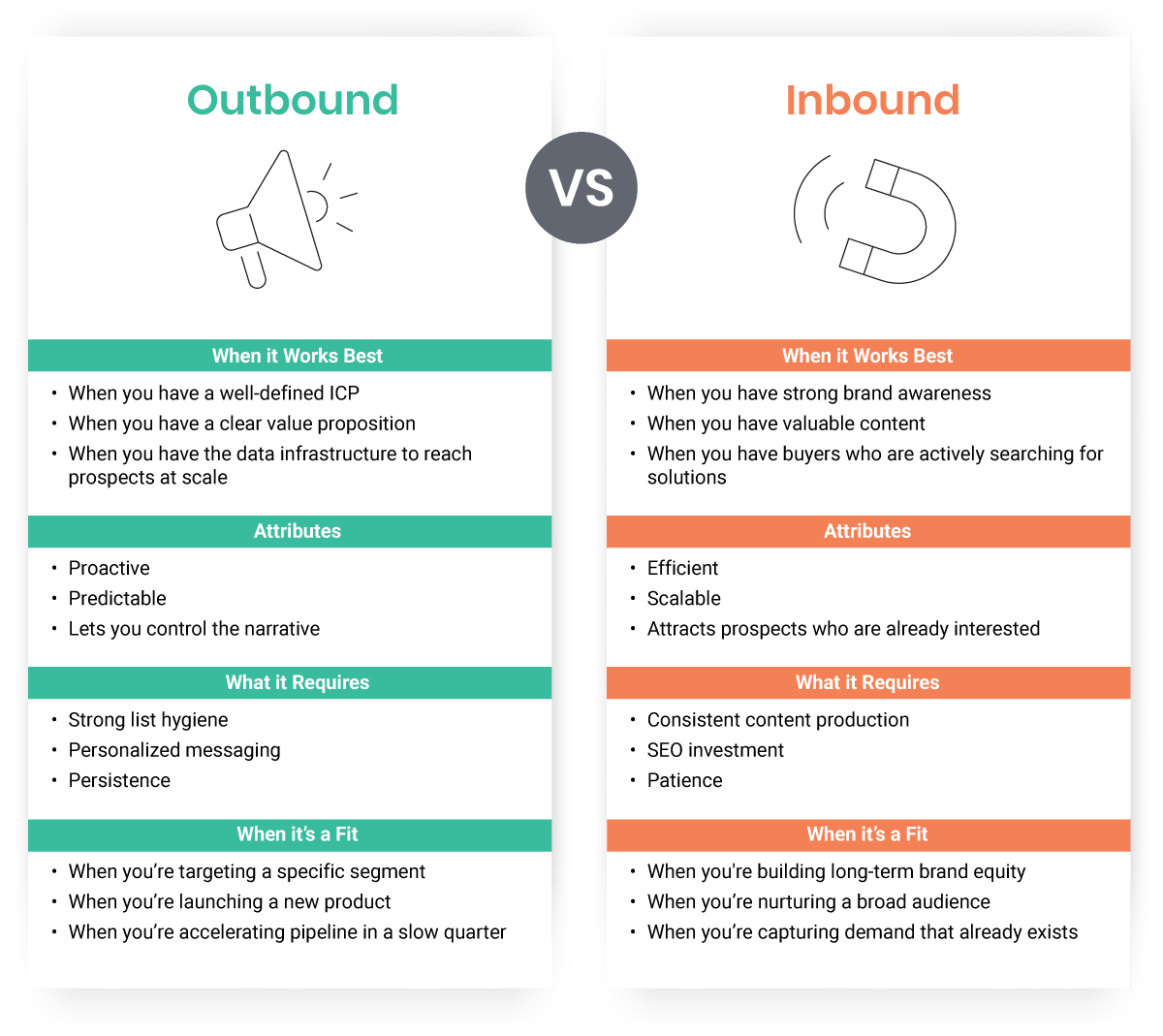
The best business prospecting strategies blend both. Use outbound to create demand and reach high-fit accounts who aren’t actively searching. Use inbound to capture demand and nurture prospects who are researching solutions. Let context, not ideology, drive your mix.
Pro Tip
Map your ICP segments to the buyer journey. For segments early in awareness, lean outbound. For segments actively evaluating, lean inbound. Adjust your mix as market conditions and buyer behavior evolve.
Next up, we’ll show you which B2B channels you should focus on.
Which B2B Channels Deserve Focus?
Not all channels are created equal. The right mix depends on your buyer, your message, and your resources. But some patterns hold across industries. Here’s what you should focus on and how to use them to your advantage:

It remains the workhorse of B2B prospecting. It’s scalable, measurable, and familiar to buyers. Use email for initial outreach, follow-ups, and nurture sequences, but only when you have clean data and relevant content.

This is the social channel that matters most for B2B. It’s where buyers research vendors, engage with content, and build professional networks. Use LinkedIn for warm outreach, relationship building, and account-based plays.

Phone calls
These still work, but only in the right context. Cold calling is tough, but warm calling—following up on email engagement or inbound interest—converts well. Use the phone for high-value accounts, complex sales, and situations where real-time conversation accelerates the deal.

Direct mail and gifting
These channels can break through the noise, especially for account-based strategies. Use them sparingly for high-priority accounts where you need to stand out.
Pro Tip
Test channel effectiveness by segment, not in aggregate. Your enterprise buyers might prefer phone and LinkedIn, while your mid-market buyers might respond better to email and content. Let data, not assumptions, guide your channel strategy.
Do You Need a Rigid Process?
The short answer is no. Process matters, but rigidity kills. You don’t have to make it your goal to script every interaction. Instead, create guardrails that ensure consistency without sacrificing adaptability.
A good prospecting process defines the non-negotiables:
- List quality standards
- Qualification criteria
- Outreach cadence
- Follow-up protocols
Essentially, it ensures that every rep is working from verified data, targeting the right accounts, and following a proven sequence. But it also leaves room for judgment, personalization, and creativity.
So, what does precision prospecting look like in action?
Precision Prospecting in Practice
Precision prospecting starts with three commitments: prioritize fit, act on intent, and ensure reachability.
- Prioritizing fit means building and maintaining a clean ICP. Define your ideal customer across firmographics, technographics, and behavioral attributes. Use that definition to filter your target list ruthlessly.
- Acting on intent means monitoring signals that indicate active interest. This could be website visits, content downloads, event attendance, or engagement with your outreach. Use intent data to prioritize accounts that are in-market now.
- Ensuring reachability means investing in data quality. Verify contact information before you reach out. Enrich records with accurate emails, phone numbers, and social profiles, and monitor deliverability and bounce rates.
Pro Tip
Run a quarterly precision audit. Review your list quality, intent coverage, and reachability metrics. Identify gaps and invest in the data, tools, or processes needed to close them.
Combining fit, intent, and reachability creates a prospecting engine that’s both efficient and effective, allowing you to spend less time chasing dead ends and more time engaging high-probability buyers.
Conclusion
It’s time to change how we think about business prospecting. In a world of noise, precision is your competitive advantage. When you prioritize fit, intent, and reachability, you connect with more of the right people, have more meaningful conversations, create more pipeline with less effort, and close deals faster.
Try Salesgenie® to see how we can help you target fit accounts, verify reachability, and act on intent with dependable data.
FAQs
Activity-based prospecting focuses on volume—more calls, emails, and outreach attempts. Precision-based prospecting prioritizes quality by targeting prospects who fit your ideal customer profile, show buying intent, and have accurate contact data. Precision approaches generate better results with less effort.
The three critical dimensions are fit (matches your ideal customer profile), intent (shows signs of active buying interest), and reachability (you have accurate, up-to-date contact information). When prospects check all three boxes, your outreach has a much higher probability of connecting and converting.
Key leading indicators include verified contact rate (should be above 80%), connect rate by persona, reply quality percentage, and positive outcome rate per 100 contacts. These metrics help identify targeting and messaging issues early before they impact pipeline generation.
High-volume approaches suffer from data decay (30% of contacts go stale each year), deliverability issues, prospect fatigue, and rep burnout. These factors create diminishing returns where increased activity doesn’t translate to better results, and can harm your sender reputation and team morale.
Focus on quality metrics like meetings held with ICP accounts, opportunity conversion rates, cost per opportunity, and pipeline created per rep hour. Review these metrics by segment and channel rather than in aggregate to identify where precision is working and where improvements are needed.