Upselling remains one of the most effective ways to grow revenue from existing customers, and the latest upselling statistics for 2026 show why this is the case. As acquisition costs stay high and retention becomes more valuable, businesses are paying closer attention to upsell conversion rate benchmarks, customer lifetime value (CLV), and the overall impact of upselling on revenue.
At its core, upselling is the practice of encouraging a customer to purchase a higher-value version of a product or service. That could mean upgrading to a premium plan, choosing a more advanced solution, or adding features that better match the customer’s needs. When approached strategically, upselling can improve the customer experience while also increasing average order value and long-term profitability.
The data below highlights what businesses need to know now, including upsell conversion rate benchmarks for 2026, how upselling influences retention and lifetime value, and where artificial intelligence (AI) and automation are making the biggest difference.
Upselling at a Glance (2026):
- The average upsell conversion rate is around 15–30%.
- Upselling can increase CLV by 20–40%.
- Businesses with automated upselling see up to 3x revenue lift.
- AI-driven recommendation engines improve upsell performance significantly.
Upselling Benchmarks for 2026
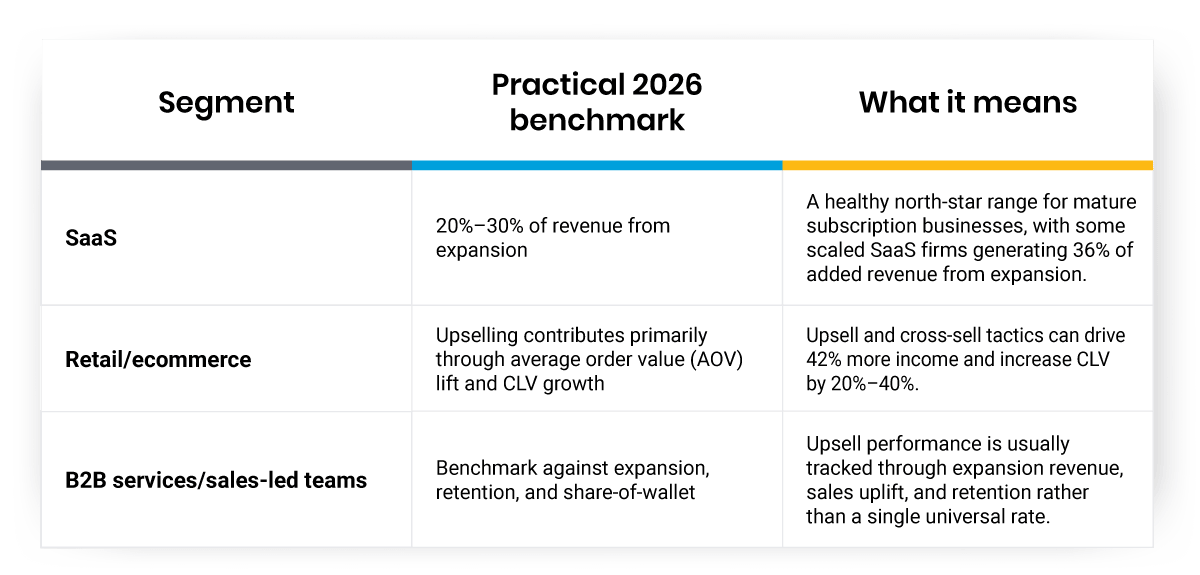
While upsell performance varies by business model, pricing, and sales cycle, the latest benchmarks point to a clear trend: upselling is becoming a more important growth lever across SaaS, retail, and B2B.
- In SaaS in particular, expansion revenue plays an outsized role as companies scale.
- In retail, benchmarks tend to look different because upsells are usually tied to average order value and post-purchase offers rather than recurring revenue.
- In B2B, benchmark data is often framed around account growth, retention, and expansion rather than a single “upsell rate.”
Below is a quick SaaS, retail, and B2B benchmark snapshot to further explain benchmarks in each of these industries.
Quick Benchmark Snapshot
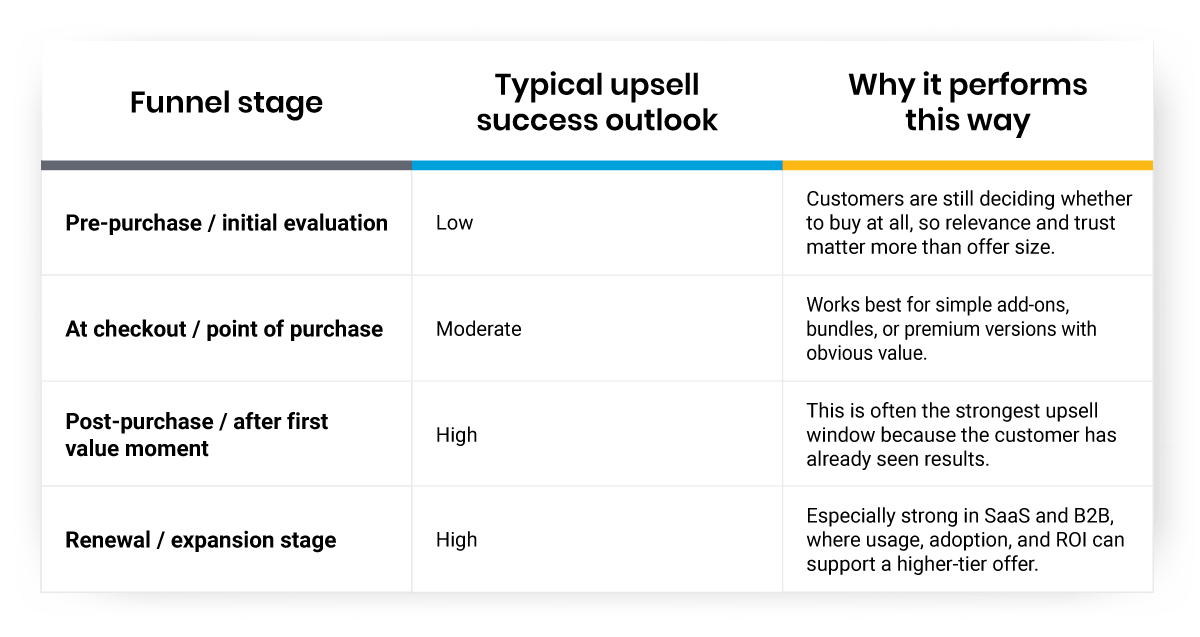
Typical Upsell Success Rates by Funnel Stage
The best upsell timing depends on when the customer has already experienced value. To help guide you, the table below shows how you can support a practical benchmark framework at every stage of the funnel.
Pro Tip
If you want to improve upsell timing, map offers to customer proof points. In B2B and SaaS, the strongest upsell motion often happens after a customer has already experienced measurable value.
Want better upsell opportunities? Use Salesgenie® business leads to identify the right accounts, segment buyers more precisely, and reach prospects with offers that match their stage in the funnel.
Why Upselling Matters Now
Upselling is becoming increasingly important because businesses are under pressure to grow revenue more efficiently. Instead of relying only on new customer acquisition, more companies are focusing on ways to increase value from existing customers, improve retention, and grow share of wallet. The statistics below help explain why.
- Companies that lead in customer experience generate 49% more cross-sell revenue and retain customers 22% better than laggards. The report shows that better customer experience creates more opportunities for expansion revenue. When customers trust a brand and have positive interactions, they are more likely to accept additional offers and stay longer. Businesses should treat upselling as part of the customer experience, not just a sales tactic.
- Experience-led growth strategies can increase cross-sell rates by 15% to 25%. This means relevant offers perform better when they are tied to the customer journey. Upselling is more effective when businesses use customer behavior, timing, and needs to shape the offer. A good next step is to align upsell efforts with lifecycle stages instead of using generic pitches.
- Businesses with strong growth strategies deliver 30% higher total returns to shareholders and nearly double the shareholder value of peers. Stronger growth strategies often create greater long-term business value. Upselling supports that momentum by increasing revenue from existing customers more efficiently. Businesses should view upselling as a strategic growth lever, not just a one-time win.
- Effective growth strategies can increase share of wallet by 5% to 10%. A higher share of wallet means customers spend more with your business instead of competitors. Even a modest increase can have a meaningful impact on revenue over time. Businesses can act on this by identifying unmet needs and recommending higher-value solutions that fit.
These statistics make one thing clear: businesses that invest in customer experience, relevance, and lifecycle-based selling are in a much stronger position to increase upsell revenue in 2026.
What Makes Upselling Effective
Successful upselling is not just about offering a more expensive option. It depends on timing, trust, and how well the offer matches what the customer wants. These statistics highlight the factors that make upselling more effective.
- Understanding customer goals is one of the top drivers of repeat sales and upsells, according to 42% of sales professionals. Customers are more likely to respond to an upsell when it clearly supports what they are trying to achieve. That matters because a relevant recommendation feels helpful instead of pushy. Businesses can act on this by asking better discovery questions, tracking customer pain points, and tailoring offers to specific goals.
- Trust and rapport are the most effective upsell and cross-sell strategies, according to 40% of sales professionals. A strong relationship makes customers more open to hearing about additional options. That matters because upselling often depends on credibility as much as product fit. Businesses can strengthen results by focusing on consultative selling, consistent communication, and delivering value before introducing an upgrade.
- Providing consistent value is a top driver of repeat sales and upsells, according to 39% of sales professionals. Customers are more willing to buy more when they already feel they are getting results. That matters because upselling works best when the original purchase experience has been positive. Businesses can improve performance by showing ROI clearly, following up after the sale, and making sure customers are using the product or service successfully.
- The best time to attempt an upsell is right after delivering value, according to 37% of sales professionals. Timing has a major influence on whether an upsell feels relevant. Right after a customer sees a win, they are often more receptive to an offer that promises even better results. Businesses can use this insight by identifying value moments, such as a successful onboarding, a completed project, or a measurable outcome, and aligning upsell outreach with those moments.
Pro Tip
Build a simple “value moment” trigger list for your sales team. That could include high product adoption, a successful campaign, contract renewal, or a service milestone.
Taken together, these stats show that effective upselling depends less on pressure and more on relevance, trust, and timing.
The Impact of Personalization and AI on Upselling
The best upsell offers feel well-timed, relevant, and genuinely useful instead of like sales pitches. This is why personalization matters so much, and why AI is becoming a bigger part of upselling strategy in 2026.
- 71% of consumers expect personalized interactions, and 76% get frustrated when they do not get them. Customer expectations are much higher now. Generic offers are easy to dismiss, while tailored recommendations are more likely to feel useful and timely. Businesses can respond by using purchase history, behavior signals, and customer context to shape upsell messaging.
- 73% of B2B buyers actively avoid sellers who send irrelevant outreach. Irrelevant upsell attempts do more than underperform. They can hurt trust and make future outreach less effective. Businesses should segment more precisely and align offers with the buyer’s role, industry, pain points, or stage in the journey.
- 93% of marketers say personalization improves leads or purchases. More personalized messaging often leads to stronger engagement and better conversion outcomes. That makes personalization a revenue driver, not just a marketing nice-to-have.
- Only one in four marketers are satisfied with how they use data to power personalized experiences. There is still a clear gap between knowing personalization matters and executing it well. That gap can lead to missed upsell opportunities. Businesses can improve results by cleaning up their data, connecting systems, and making insights easier for teams to access and use.
- 74% of customers find it frustrating to repeat their story to different agents. Disconnected customer experiences weaken personalization and make recommendations feel less relevant. When teams do not share context, upsell efforts can come across as out of touch. Businesses should unify customer data so each interaction feels more informed and consistent.
- AI-powered “next best experience” programs can increase revenue by 5% to 8% and reduce cost to serve by 20%–30%. This matters because AI can help teams decide what to offer, when to offer it, and which customers are most likely to respond. Instead of sending the same message to everyone, businesses can use AI to personalize recommendations and sequence outreach more effectively.
Businesses can put this into practice by testing tailored offers across email, sales outreach, and landing pages, and by strengthening customer records with data enhancement to support better personalization.
- Top-performing sales teams are 1.7x more likely to use AI agents than struggling teams. AI is showing up more often among teams that are already outperforming. In upselling, that can translate into faster identification of expansion opportunities, better prioritization, and more confidence around where reps should spend their time.
- Sales teams expect AI agents to reduce research time by 34% and content creation time by 36%. Less time spent researching and writing means more time to focus on the offer itself. That matters in upselling because speed only helps if the message still feels specific. AI can make it easier to put together outreach that is timely, relevant, and not obviously mass-produced.
Used well, AI makes personalization more scalable, helping upsell offers feel better timed, more relevant, and more in step with what the customer actually needs.
What Can Derail an Upsell
Customers do not separate the upsell from the experience that surrounds it. If support is slow, outreach feels irrelevant, or buying feels harder than it should, the upsell usually suffers too.
- More than half of customers will switch to a competitor after a single negative impression. A bad experience can shut down future sales opportunities fast. If a customer already feels frustrated or disappointed, they are far less likely to respond well to an upsell. Businesses should focus on fixing friction points first, especially in sales, onboarding, and support.
- 74% of consumers expect customer service to be available 24/7, and 88% expect faster responses than they did in previous years. Customer expectations are rising, and slow or limited support can make an upsell feel poorly timed. When people cannot get help quickly, trust drops and patience wears thin. Businesses can improve results by shortening response times and making support easier to access across channels.
- Customers are 2.4x more likely to stay loyal to a brand when their issues are resolved quickly. Fast problem-solving strengthens loyalty, and loyalty creates better conditions for upselling. Customers are more open to additional offers when they feel taken care of. Businesses should treat service speed as part of their upsell strategy, not as a separate function.
- 61% of B2B buyers would rather have a rep-free buying experience. Many buyers want more control and less friction in the purchase process. A traditional sales approach can backfire if it feels too intrusive or unnecessary. Businesses can respond by making upsell offers easier to explore through self-service options, clear pricing, and digital touchpoints.
Poor experiences do much more than hurt satisfaction. They make customers less open to upgrades, add-ons, and higher-value offers.
Upselling vs. Cross-Selling
Upselling and cross-selling are often grouped together, but they are not the same thing. Upselling encourages a customer to choose a higher-value version of what they were already considering, while cross-selling recommends a related product or service that complements the original purchase. In simple terms, upselling is about a better version of the same solution, while cross-selling is about an additional solution that adds value.
A quick example makes the difference easier to see. If a customer is considering a basic CRM plan and you recommend the premium plan with more automation, that is an upsell. If that same customer buys the CRM and you later recommend email marketing or data enrichment tools that work alongside it, that is a cross-sell.
When to Use Upselling vs. Cross-Selling
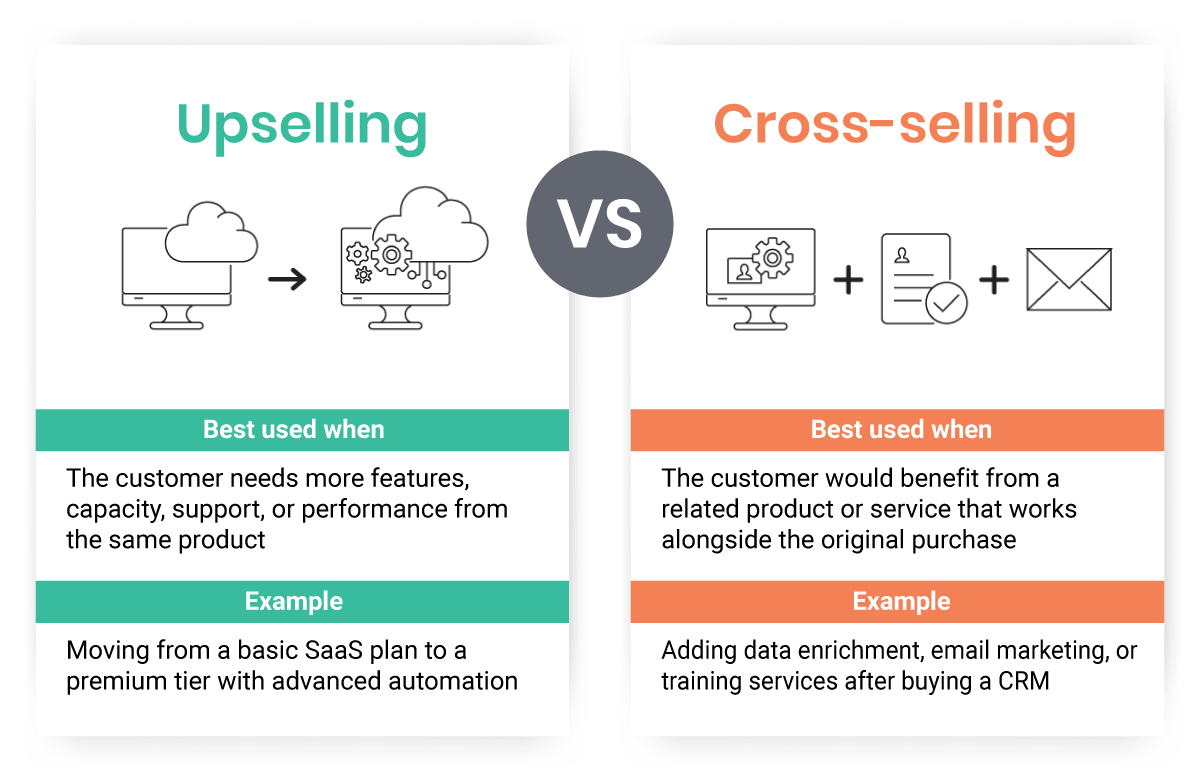
The difference is simple: upselling expands the original purchase, while cross-selling expands the overall solution.
Retention and CLV Impact
Upselling has a bigger business impact than a one-time revenue bump. Done well, it can increase CLV, improve retention, and make growth more efficient by generating more revenue from customers who already know and trust your business.
- One of the clearest benefits is its effect on CLV. When a customer upgrades, adds premium features, or expands their relationship with a business over time, the total value of that account grows.
- Upselling also supports retention because it often works best when the offer closely matches what the customer actually needs next. A relevant upgrade can deepen product adoption, improve the customer experience, and give buyers a stronger reason to stay.
- Another reason upselling matters is efficiency. Growing revenue from an existing customer is usually more cost-effective than acquiring a new one.
For many businesses, the above combination is what makes upselling so attractive. It can lift revenue, strengthen retention, and improve overall account value at the same time. Instead of relying only on net-new customer growth, you can use upselling to build more value from relationships you have already established.
Conclusion and Final Thoughts
For many businesses, the real value of upselling comes down to efficiency. The statistics throughout this article show how a well-timed, relevant upsell can support stronger conversion rates, higher CLV, better retention, and more sustainable revenue growth. As personalization, AI, and better data continue to shape sales and marketing strategies in 2026, you have more opportunities than ever to make upsell offers feel relevant, timely, and genuinely useful.
The bigger takeaway is that successful upselling comes down to understanding what your customers need next and connecting them with a higher-value solution that makes sense. If you get it right, you’re in a stronger position to build trust, deepen loyalty, and create more long-term value from your customer relationships.
Try Salesgenie today to increase your upsell opportunities with verified contact data and precision targeting.
FAQs
A solid benchmark for upselling in 2026 is often around 15% to 30%, though results vary by industry, offer type, and timing. SaaS and service-based businesses often land on the higher end when the upgrade is closely tied to customer needs.
In many businesses, upselling and expansion can account for a meaningful share of revenue, with SaaS benchmarks often putting 20% to 30% of new ARR or expansion revenue in that range, and best-in-class companies exceeding it. The exact contribution depends on the business model, customer base, and how mature the upsell program is.
Neither is universally better because they do different jobs: upselling works best when the customer needs a higher-value version of the same solution, while cross-selling works best when a related product adds value. In practice, upselling is often easier to convert when the next step is obvious, while cross-selling can be more effective later in the relationship once additional needs are clearer.
AI helps businesses personalize upsell offers more effectively by spotting intent signals, improving timing, and making recommendations more relevant at scale. Recent sales research also shows higher-performing teams are more likely to be using AI, which reinforces its growing role in revenue expansion.
Upsell success is often strongest in SaaS, software, and B2B services, where premium tiers, added seats, usage-based expansion, and feature upgrades are easier to tie to customer value. Ecommerce can also perform well, but upsells there tend to depend more heavily on timing, merchandising, and average order value strategies.