

User-generated content (UGC) has become one of the most influential forces in modern marketing and sales. From online reviews and customer testimonials to social media posts and product photos, user-generated content marketing shapes how buyers discover, evaluate, and choose brands. Research consistently shows that consumers place more trust in peer-generated content than in traditional advertising, making UGC a measurable driver of credibility and conversions. For businesses competing in crowded markets, understanding UGC marketing statistics is essential for building trust and improving performance.
This resource compiles the latest UGC statistics from established research firms, industry studies, and academic sources. Whether you’re refining your digital strategy or evaluating the role of reviews and social proof in your sales funnel, these statistics provide a clear, research-backed foundation for decision-making.
UGC statistics at a glance
- 90% of shoppers read reviews before purchasing
- 80% trust UGC more than ads
- UGC-enabled pages see 161% higher conversions
- Instagram posts with UGC generate 70% more engagement
- 92% of B2B buyers trust peer recommendations
What is User-Generated Content?
UGC is any content about a brand, product, or service that is created and shared by customers rather than the company itself. This includes:
- Online reviews
- Star ratings
- Testimonials
- Social media posts
- Blog comments
- Customer photos and videos
- Community forum discussions
Unlike branded marketing materials, UGC reflects real customer experiences, opinions, and feedback, making it a powerful form of social proof that influences how other buyers evaluate their options.
For sales and marketing teams, UGC helps build credibility while providing real-world insight into customer sentiment, common objections, and the language buyers use to describe their needs.
When paired with reliable consumer contact data solutions, businesses can align authentic customer proof with precise audience targeting, reinforcing trust at every stage of the buying journey.
UGC Adoption and Usage Statistics
UGC is a core pillar of user-generated content marketing strategies across industries. Adoption trends and UGC marketing statistics show that brands are increasing investment in customer-created reviews, visuals, and testimonials as part of broader digital growth initiatives.
The following statistics highlight how widely UGC is being adopted and how strongly marketers believe in its performance compared to traditional brand-created content.
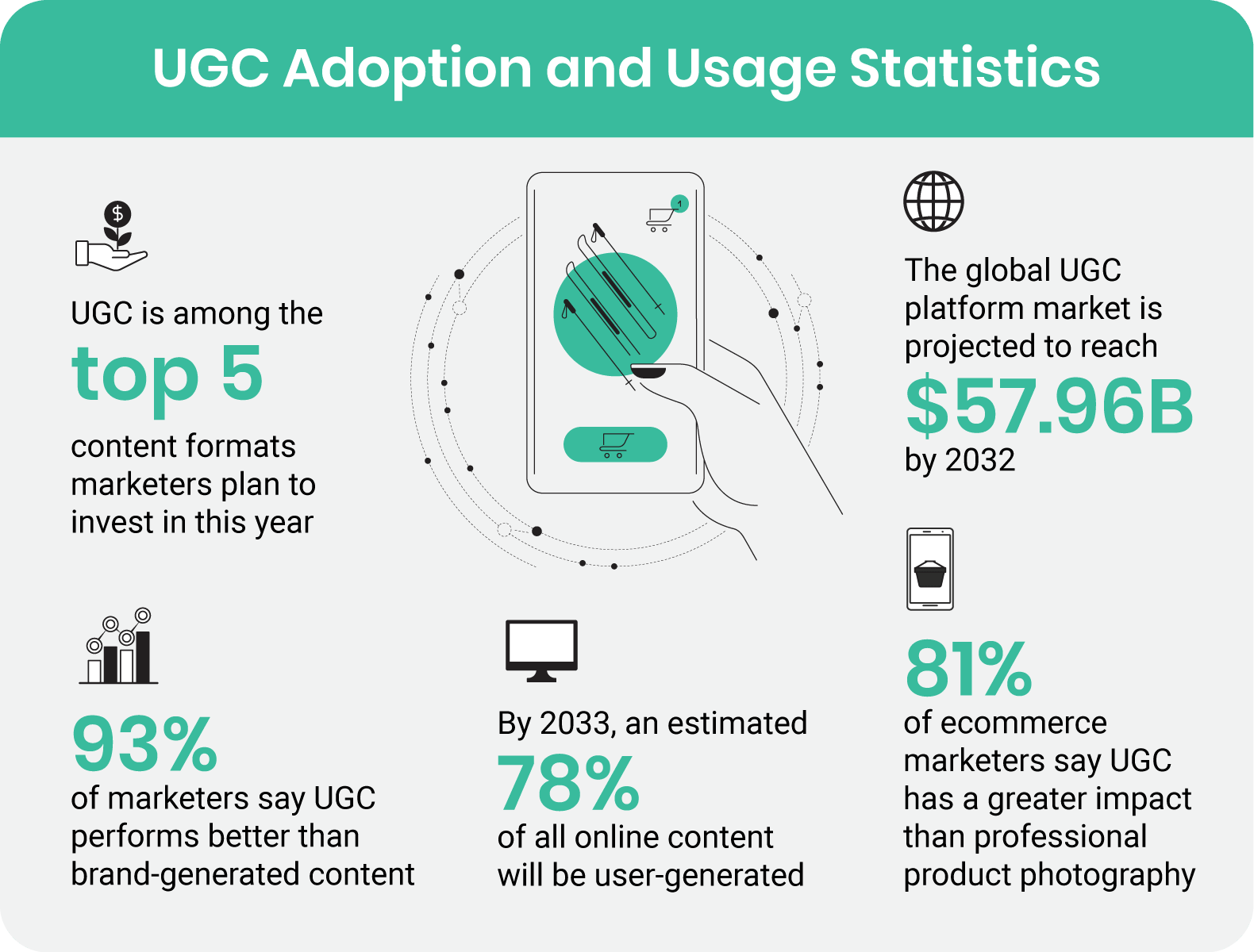
- UGC is among the top five content formats marketers plan to invest in this year. This signals that UGC is considered a strategic priority alongside video, influencer marketing, and short-form content in many marketing budgets (HubSpot).
- 93% of marketers say UGC performs better than brand-generated content. This overwhelming majority suggests that businesses consistently see stronger engagement, trust, or conversion outcomes when real customers create the message instead of the brand itself (TrueLoyal).
- The global UGC platform market is projected to reach $57.96 billion by 2032. This anticipated growth reflects rising demand for tools that collect, manage, moderate, and distribute customer-created content across digital channels (Shnoco).
- 81% of ecommerce marketers say UGC has a greater impact than professional product photography. For online retailers, authentic customer photos and reviews often resonate more than polished brand imagery, reinforcing the value of real-world social proof in purchase decisions (Nosto).
- By 2033, an estimated 78% of all online content will be user-generated. If accurate, this projection suggests that the digital ecosystem is increasingly driven by peer-created material, further solidifying UGC’s role in shaping brand perception and buyer behavior (Shnoco).
As investment increases and adoption expands, one question naturally follows: Why does UGC perform so well? The answer often comes down to trust. The next section explores how UGC influences consumer confidence, credibility, and buying behavior.
UGC and Consumer Trust Statistics (How Reviews Influence Buying Behavior)
Trust is one of the strongest drivers of purchase decisions, and UGC plays a central role in building that trust. Online review statistics and broader social proof statistics consistently show that buyers rely on peer validation to reduce risk before making a purchase.
The statistics below illustrate how deeply UGC influences consumer confidence and buying behavior.
- Nearly 90% of shoppers read online reviews before making a purchase decision. This highlights how reviews have become a standard step in the buying process, functioning as digital word-of-mouth that helps consumers reduce risk before committing (ElectroIQ).
- 80% of consumers trust UGC more than traditional advertising. This trust gap reinforces why peer-created content often resonates more strongly than polished brand campaigns (Edelman).
- 69% of adults share UGC on social media. UGC is both consumed and actively distributed, expanding its reach and amplifying peer influence across networks (Statista).
- 59% of buyers say they are influenced to purchase based on opinions from family, friends, customer reviews, and influencers. This demonstrates that purchase behavior is frequently shaped by trusted social circles and peer validation rather than direct brand messaging (Edelman).
But trust alone is not the end goal for most businesses. The next section explores how this widespread reliance on peer content translates into tangible performance metrics, including conversion lifts, revenue per visitor, and overall return on investment.
Micro Explainer
Why does user-generated content work?
User-generated content reduces uncertainty. When buyers see real experiences from other customers, it lowers perceived risk and increases confidence. Social proof taps into behavioral psychology, where people rely on peer validation to guide decisions.
UGC Conversion Rate and ROI Statistics
While consumer trust establishes credibility, measurable performance determines long-term marketing investment. UGC conversion rates, revenue per visitor, and engagement metrics provide clear evidence that customer review data and peer content directly influence buying behavior.
- User reviews drive 270% higher conversion rates for lower-priced items. Academic research shows that reviews significantly reduce purchase hesitation, particularly for everyday purchases where shoppers seek quick reassurance before buying (Northwestern University, Spiegel Research Center).
- UGC-enabled product pages generate 161% higher overall conversion rates than pages without UGC. Including ratings, reviews, or customer photos creates stronger purchase confidence, leading more visitors to complete transactions (Bazaarvoice).
- Having just 10 product reviews can increase conversion rates by approximately 45%. Even a small volume of customer feedback can meaningfully influence buying behavior, underscoring the importance of early review generation strategies (Bazaarvoice).
- Pages featuring UGC see up to a 308% increase in time on site when visitors engage with customer galleries or reviews. Increased time on site reflects deeper product evaluation and higher purchase intent, which often correlates with stronger sales outcomes (Marketing LTB).
The data makes the business case clear: UGC influences not only what buyers believe, but what they do. When you combine high-performing customer content with targeted prospect data, you can ensure that trust-building assets reach decision-makers who are most likely to convert, maximizing both engagement and revenue impact.
UGC Social Media Statistics (Engagement, Discovery, and Purchase Influence)
Social media has evolved from a distribution channel into a primary discovery engine for UGC marketing. Social proof statistics show that consumers actively search platforms for peer experiences, reviews, and customer-created content before making purchasing decisions.
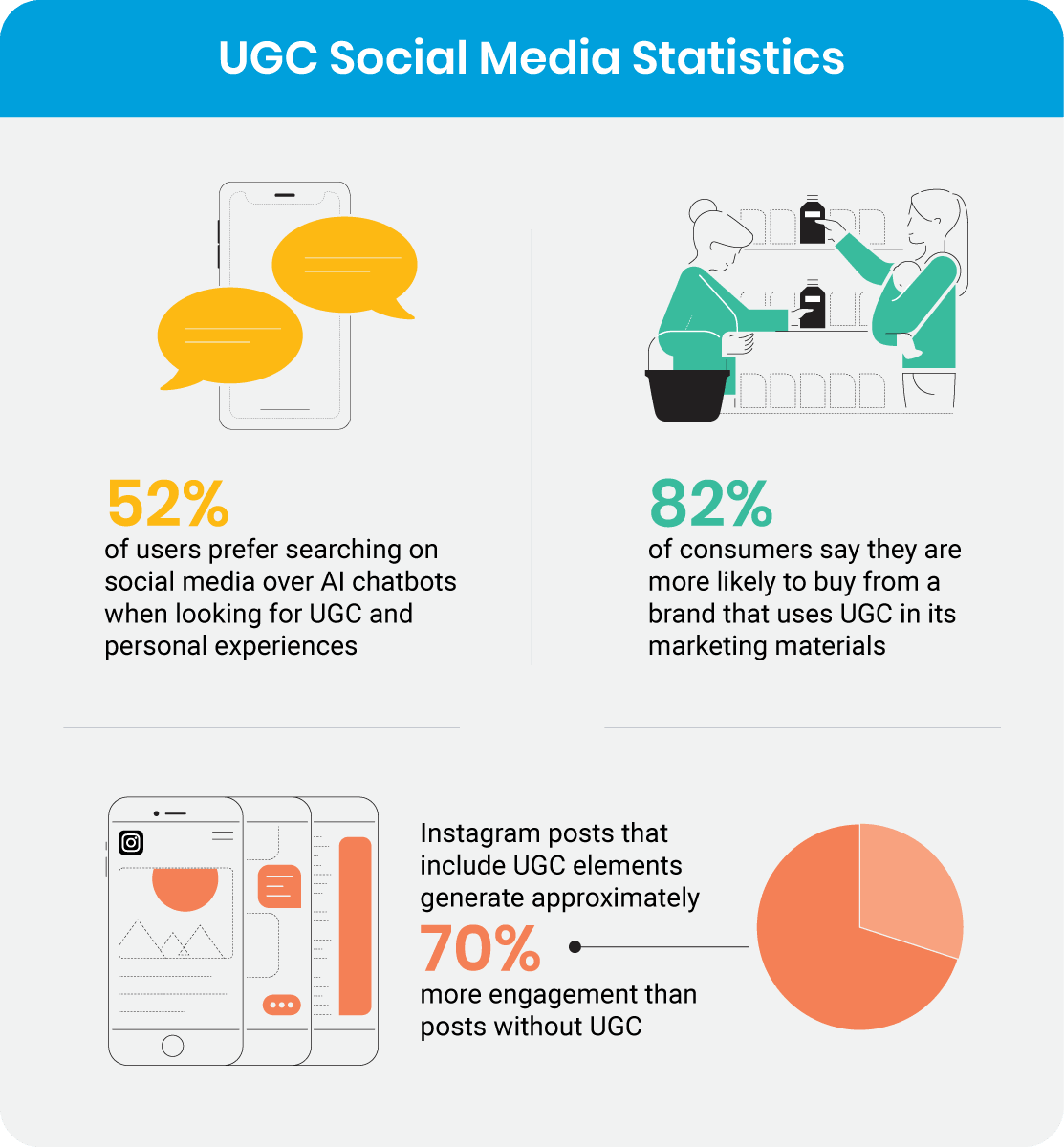
- 52% of users prefer searching on social media over AI chatbots when looking for UGC and personal experiences. This suggests that consumers value firsthand accounts and community discussions when evaluating brands, turning platforms like Instagram and TikTok into informal review hubs (Sprout Social).
- 82% of consumers say they are more likely to buy from a brand that uses UGC in its marketing materials. Featuring customer content in social campaigns appears to reinforce credibility, making brand messaging feel more relatable and trustworthy (EnTribe).
- Instagram posts that include UGC elements generate approximately 70% more engagement than posts without UGC. Higher engagement rates indicate that audiences respond more actively to real customer content than to polished, brand-produced visuals alone (Marketing LTB).
As social platforms continue to shape product discovery and brand perception, UGC becomes both a credibility signal and an engagement driver. This shift is particularly pronounced among younger audiences, where digital-native behaviors further elevate the influence of peer content.
How Gen Z Interacts with User-Generated Content
For Gen Z, UGC is central to the buying journey. As digital natives, this generation grew up navigating reviews, creator content, and peer commentary as primary sources of information. Their purchasing behavior reflects a strong preference for community validation and authentic storytelling over traditional advertising formats.
- 52% of Gen Z social media users say they trust information found on social platforms more than Google searches or AI chatbots. This suggests that peer conversations and real-time content carry more weight than algorithmic summaries when younger consumers research products (Sprout Social).
- 87% of Gen Z trusts online reviews more than advertisements. Compared to traditional brand messaging, review-based content provides the credibility and relatability Gen Z expects before making a purchase (Zabble).
- 80% of Gen Z relies on user-generated videos when making purchasing decisions. Short-form videos, product demos, and customer testimonials serve as experiential previews, helping reduce uncertainty before committing to a brand (Statista).
- Gen Z is three times more likely to recommend brands they feel a personal connection to. This highlights the importance of authenticity and emotional resonance, two qualities often reinforced through user-generated storytelling and community engagement (Worldmetrics).
A clear pattern is emerging: buyers expect authenticity and proof from other people before they commit. That expectation does not disappear in professional purchasing environments, which is why UGC plays an increasingly important role in B2B marketing as well.
UGC in B2B Marketing
B2B purchasing decisions are often described as rational, data-driven, and committee-based. However, B2B buyer behavior statistics reveal that peer reviews, testimonials, and third-party validation significantly influence vendor selection throughout the buying journey.
- 92% of B2B buyers trust peer recommendations and reviews more than branded content when making purchase decisions. In high-stakes purchases where budgets and reputations are on the line, third-party validation often outweighs vendor messaging (MarketScale).
- 64% of B2B buyers use reviews during the awareness stage, 68% during consideration, and 54% during the final decision stage. Rather than serving as a last-minute check, reviews influence buyers throughout the entire journey (B2B SaaS Reviews).
- 92% of B2B buyers are more likely to purchase after reading trusted reviews, and landing pages featuring testimonials can increase conversions by up to 34%. Customer validation supports credibility and measurably improves performance in B2B sales funnels (Shapo).
Professional buyers may operate within structured procurement processes, but they still seek evidence from their peers before committing. Pairing customer validation with accurate B2B prospect data and qualified business leads allows organizations to connect social proof with the stakeholders who influence final purchasing decisions.
Key Takeaways
Selecting the right CRM goes beyond feature lists. Put your focus on empowering your sales team to close deals faster, forecast with greater accuracy, and drive consistent growth. Whether you’re refining your shortlist or preparing for implementation, the action plan below outlines the steps that will help you move forward with clarity and momentum.
- UGC is a strategic priority for marketers.
Adoption rates, platform investment growth, and budget allocation trends show that it is embedded in modern marketing strategies. - Consumers trust peer content more than traditional advertising.
Reviews, testimonials, and social posts consistently influence purchase decisions because buyers view real customer experiences as more credible and authentic than branded messaging. - UGC directly improves conversion rates and revenue performance.
UGC conversion rates consistently outperform pages without customer review data, demonstrating measurable financial impact. - Social media has become a primary engine for UGC discovery and amplification.
Consumers actively seek and engage with peer content on social platforms, making authenticity a key driver of visibility and interaction. - The influence of UGC extends beyond B2C into B2B environments.
Even in complex professional purchasing decisions, buyers rely heavily on peer reviews and testimonials to validate vendors and reduce perceived risk.
Final Thoughts
UGC has evolved from a supplemental tactic into a measurable driver of trust, engagement, and revenue. Across consumer and B2B markets alike, buyers increasingly look to peer validation before making decisions.
For businesses looking to stay competitive, the opportunity is clear: actively collect, showcase, and amplify authentic customer voices. Pairing UGC with accurate audience data and targeted outreach strategies can help ensure those stories reach the right prospects at the right time.
Explore how Salesgenie® delivers accurate audience insights and targeted outreach tools that help turn trust into measurable revenue growth.
FAQs
UGC is any content created and shared by customers rather than a brand. This includes online reviews, ratings, testimonials, social media posts, photos, videos, and community discussions. In marketing, UGC serves as social proof that influences how buyers evaluate products and services.
UGC builds trust because it reflects real customer experiences rather than brand messaging. Research shows that nearly 90% of shoppers read reviews before purchasing, and 80% of consumers trust UGC more than traditional advertising. Peer validation reduces perceived risk and increases buyer confidence.
Yes, data consistently shows that UGC improves conversions. Product pages featuring UGC generate 161% higher conversion rates, and user reviews can drive 270% higher conversions for lower-priced items. Even having just 10 reviews can lift conversion rates by approximately 45%.
UGC significantly boosts engagement and purchase intent on social platforms. Instagram posts that include UGC elements generate about 70% more engagement, and 82% of consumers say they are more likely to buy from brands that incorporate UGC into marketing materials.
Yes. UGC plays a critical role in B2B decision-making. Studies show that 92% of B2B buyers trust peer recommendations more than branded content, and reviews influence buyers across the awareness, consideration, and decision stages. Testimonials can also increase B2B landing page conversions by up to 34%.