

Buying an email list is still one of the fastest ways to scale B2B outreach, but in 2026, speed alone is not enough. Success depends on whether your list is accurate, compliant, and built for the way modern inbox providers evaluate senders. With Gmail continuing stricter enforcement for non-compliant bulk senders and Yahoo emphasizing relevance, engagement, and active audiences, the quality of your data and how you use it matter just as much as the size of your list.
That is why buying email lists can work for B2B teams when done strategically. Email remains one of the highest-ROI channels, with Litmus reporting that many marketing leaders see returns between $10–$50 for every $1 spent on email. And for B2B services specifically, average email open rates are still strong at 39.48%, showing that email continues to be a high-value channel for reaching decision-makers.
In this guide, we’ll cover:
- The best email list providers in 2026
- When buying a list makes sense (and when it doesn’t)
- How to choose a compliant, high-quality data source
Whether your goal is to fill pipeline faster, expand into new markets, or support multichannel campaigns, the right list can accelerate outreach when paired with smart targeting and responsible sending.
Quick Answer
What is the best place to buy email lists?
The best email list providers in 2026 include:
- Salesgenie®: best for SMB-targeted U.S. data
- ZoomInfo: best for enterprise-level intent data
- Apollo.io: best for outbound teams
- Cognism: best for GDPR-compliant European data
The right provider depends on your target market, budget, and compliance needs.
Is Buying Email Lists a Good Idea in 2026?
Buying email lists can still be a smart move in 2026, but only under the right conditions. Ask yourself if your data is accurate, compliant, and aligned with a thoughtful outreach strategy.
When it works:
- You need fast market entry
- You have a clear ideal customer profile (ICP)
- You use compliant, verified data
When it doesn’t work:
- Lists are outdated or scraped
- You send bulk, generic emails
- You ignore compliance laws (GDPR, CAN-SPAM)
Key Insight
In 2026, success depends less on the act of buying email lists and more on the quality of the data and how you use it. A well-targeted, compliant list paired with careful segmentation and relevant messaging can accelerate outreach. A low-quality list paired with mass, untargeted sending can do the opposite.
Best Email List Providers in 2026 (Compared)
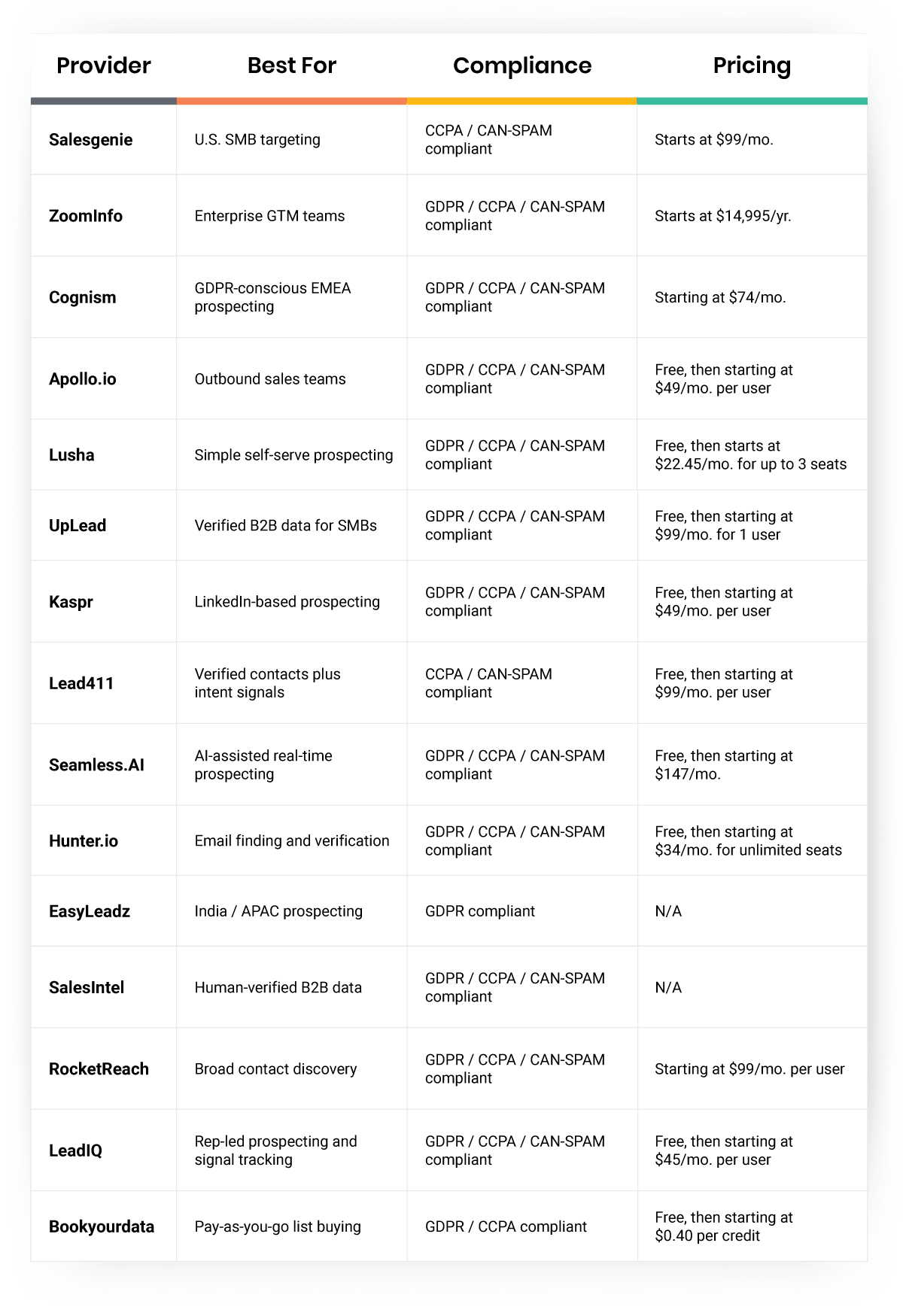
Top 15 Email List Providers in 2026
1Salesgenie
Salesgenie offers leads for email and direct mail, as well as access to a massive, regularly updated database of millions of U.S. businesses and consumers, along with built-in tools for lead generation, multi‑channel campaign management, and CRM-style tracking, all supported by expert marketing guidance.
Best For
- U.S.-based SMB targeting
- Teams that want data and prospecting tools in one platform
- Businesses running multichannel outreach
Pros
- Strong fit for U.S. business data
- Includes built-in prospecting tools
- Flexible options for different team sizes
Cons
- Best for U.S.-focused outreach
- Advanced needs may require a custom setup
- Less suited for enterprise intelligence use cases
Key Features
- Accurate and verified data
- Customizable lists
- CCPA and CAN-SPAM compliant
- Multiple data points
- Data accuracy guarantee
- Extensive search filters
- Intent data and integration with leading B2B tools and CRMs
Pricing
- Basic Plan: $99/mo. for 1 user license
- Pro Plan: $149/mo. for 1 user license
- Team Plan: $299/mo. for 5 user licenses
Ratings
- G2 rating: 4.4/5
- Capterra rating: 4/5
2ZoomInfo
ZoomInfo is a leading B2B go‑to‑market platform that provides sales, marketing, operations, IT, and talent teams with a vast, frequently updated database, including verified contact and company info, intent data, organizational profiles, and outreach tools.
Best For
- Enterprise prospecting and go-to-market teams
- Companies using intent data, automation, and deep integrations
- Organizations with complex account-based marketing (ABM) and RevOps needs
Pros
- Strong fit for enterprise GTM execution
- Combines contact data, intent signals, and activation tools
- Supports sales, marketing, and RevOps in one platform
Cons
- Best suited for enterprise budgets
- Contract and credit structure can add complexity
- May be more than needed for basic list buying
Key Features
- Accurate B2B data
- Company insights
- Advanced firmographics
- Contact tracker
Pricing
- Professional Plan: $14,995/yr.
- Advanced Plan: $24,995/yr.
- Elite Plan: $39,995/yr.
Ratings
- G2 rating: 4.5/5
- Capterra rating: 4.1/5
3Cognism
Cognism is a B2B sales intelligence platform that empowers revenue teams with highly accurate, phone-verified mobile numbers and business emails, backed by AI‑enriched intent signals and seamless CRM and extension integrations.
Best For
- GDPR-conscious prospecting in Europe and EMEA
- Teams that prioritize compliant outreach and strong mobile data
- Companies that want international sales intelligence
Pros
- Strong GDPR-focused positioning
- Known for high-quality mobile numbers
- Good fit for international prospecting
Cons
- More expensive than basic list providers
- May be too robust for smaller teams
- Less suited for simple low-cost list buying
Key Features
- Highly accurate data
- Advanced list-building capabilities
- Seamless CRM integration
Pricing
- Essential: $74/mo.
- Plus: $149/mo.
- Professional: $299/mo.
Ratings
- G2 rating: 4.6/5
- Capterra rating: 4.7/5
4Apollo.io
Apollo.io is an end‑to‑end, AI-powered B2B sales intelligence and engagement platform designed to help teams build pipeline, automate multi‑channel outreach (email, phone, LinkedIn), enrich data, and close deals all within a unified workflow.
Best For
- Outbound teams that want prospecting and engagement in one platform
- Startups and growing teams focused on pipeline generation
- Businesses seeking a lower-cost alternative to enterprise tools
Pros
- Combines data, list building, and outreach tools
- Strong fit for high-volume outbound
- Flexible pricing, including a free plan
Cons
- Data accuracy can vary by segment
- Usage limits may affect scaling
- Less ideal for teams wanting a premium data provider
Key Features
- Up-to-date contact database
- Advanced filtering
- Robust list creation and management
Pricing
- Free tier
- Basic: $49/mo. per user
- Professional: $79/mo. per user
- Organization: $199/mo. per user
Ratings
- G2 rating: 4.7/5
- Capterra rating: 4.6/5
5Lusha
Lusha is a self-service B2B sales intelligence platform offering access to an AI-verified global database of accurate contact details, enriched with buyer intent signals, seamless CRM and browser integrations, and automated prospecting tools to help teams efficiently identify, engage, and close decision-makers.
Best For
- Small to mid-sized teams that want simple prospecting
- Recruiters and reps who need quick contact lookups
- Businesses that value ease of use
Pros
- Easy to use and quick to set up
- Good for fast contact discovery and enrichment
- Works well with browser extensions and CRMs
Cons
- Less robust than full GTM platforms
- Credit limits can be restrictive
- Better for lightweight prospecting than complex outbound
Key Features
- Smart prospecting
- Accurate contact data
- Enrichment and CRM integration
Pricing
- Free tier
- Pro: $22.45/mo. for up to 3 seats
- Premium: $52.45/mo. for up to 5 seats
- Scale: custom seats, pricing varies
Ratings
- G2 rating: 4.3/5
- Capterra rating: 4.1/5
6UpLead
UpLead is a B2B lead generation and sales intelligence platform offering access to a database of over 160 million professionally verified business contacts, real-time email validation, intent data, technographic insights, and seamless CRM and API integrations.
Best For
- Teams that want verified B2B data and simple list building
- Businesses focused on accuracy and real-time email validation
- SMBs that want an accessible sales intelligence tool
Pros
- Strong focus on data accuracy and email verification
- Easy-to-use filtering and list-building tools
- Good fit for small and mid-sized teams
Cons
- Less comprehensive than larger enterprise platforms
- Advanced features may require a custom plan
- Better for prospecting than full outbound execution
Key Features
- Vast contact database
- 50+ filters
- Contact list creation and management
Pricing
- Free trial tier
- Essentials: $99/mo. for 1 user
- Plus: $199/mo. for 1 user
- Professional: custom users, pricing varies
Ratings
- G2 rating: 4.7/5
- Capterra rating: 4.6/5
7Kaspr
Kaspr is an all-in-one prospecting tool that uses a Chrome extension and web app to instantly retrieve real-time, GDPR‑compliant contact details from LinkedIn.
Best For
- Sales reps who prospect heavily on LinkedIn
- Teams that want fast contact capture through a Chrome extension
- Businesses focused on simple, rep-led outreach workflows
Pros
- Strong fit for LinkedIn-based prospecting
- Easy to use for quick contact discovery
- Supports fast list building from day-to-day sales activity
Cons
- More limited than full sales intelligence platforms
- Best experience depends heavily on LinkedIn-based workflows
- May not be ideal for teams needing broader database depth or advanced GTM features
Key Features
- Massive contact database
- LinkedIn Chrome extension for instant lead capture
- Efficient contact list building and management
Pricing
- Free tier
- Starter: $49/mo. per user
- Business: $79/mo. per user
- Enterprise: customer users, pricing varies
Ratings
- G2 rating: 4.4/5
- Capterra rating: 4.5/5
8Lead411
Lead411 is a B2B lead intelligence platform that delivers highly accurate, human- and SMTP-verified business emails and direct-dial numbers, enriched with real-time sales triggers and intent signals to help teams identify and engage high-potential prospects efficiently.
Best For
- Teams that want verified B2B contacts plus buying signals
- Sales organizations focused on trigger-based prospecting
- SMBs looking for data accuracy without a heavy enterprise platform
Pros
- Strong focus on verified emails and direct dials
- Useful intent and sales trigger data for prioritizing outreach
- Good fit for targeted list building and prospecting
Cons
- Less comprehensive than larger all-in-one GTM platforms
- Better suited for prospecting than full multichannel engagement
- Enterprise-scale teams may want deeper workflow and integration capabilities
Key Features
- Verified B2B contact database
- Trigger-based and intent-driven lead signals
- Robust list building
Pricing
- Free trial tier
- Basic Plus Unlimited: $99/mo. per user
- Enterprise Limited: custom users, pricing varies
Ratings
- G2 rating: 4.5/5
- Capterra rating: 4.7/5
9Seamless.AI
Seamless.AI is an AI-powered B2B lead generation and prospecting platform that provides real-time, verified contact and company data (emails, direct dials, job titles) through its search engine and Chrome extension, complemented by CRM integrations and tools that streamline outreach and pipeline building.
Best For
- Teams that want AI-assisted prospecting and real-time contact discovery
- Sales reps using Chrome-based workflows
- Businesses focused on fast list building and outbound prospecting
Pros
- Strong emphasis on real-time contact search
- Helpful for quick prospecting and lead discovery
- Chrome extension supports rep-led workflows
Cons
- Data quality can vary depending on the segment
- Pricing may be high for smaller teams
- Better for prospecting than full sales engagement or marketing workflows
Key Features
- AI-powered contact search
- Advanced filtering
- Chrome extension capture
Pricing
- Free tier
- Basic Plan: $147/mo.
- Pro Plan: custom
- Enterprise Plan: custom
Ratings
- G2 rating: 4.4/5
- Capterra rating: 4/5
10Hunter.io
Hunter is an all‑in‑one email outreach platform that enables users to discover and verify professional email addresses, perform bulk lookups, enrich contact data, and automate cold-email campaigns.
Best For
- Teams that need to find and verify professional email addresses
- Users running simple cold email or email lookup workflows
- Businesses that value email verification over full sales intelligence
Pros
- Strong email discovery and verification tools
- Easy to use for bulk lookups and enrichment
- Good fit for lightweight outreach workflows
Cons
- More limited than full B2B data platforms
- Focuses primarily on email rather than broader contact intelligence
- Less suited for teams needing deep firmographic, intent, or multichannel features
Key Features
- Robust email finding tools
- High-quality email verification
- Bulk searches and enrichment
Pricing
- Free tier
- Starter: $34/mo. for unlimited seats
- Growth: $104/mo. for unlimited seats
- Scale: $209/mo. for unlimited seats
Ratings
- G2 rating: 4.4/5
- Capterra rating: 4.6/5
11EasyLeadz
EasyLeadz is a B2B sales prospecting and data‑as‑a‑service (DaaS) platform that combines machine learning and human verification to provide real-time, GDPR-compliant business contact information for highly targeted lead generation and enrichment.
Best For
- Teams prospecting in India and Asia Pacific
- Users who want direct dials and contact enrichment
- Sales reps using lightweight, fast prospecting workflows
Pros
- Strong positioning in India-focused contact data
- Emphasizes real-time contact discovery and enrichment
- Useful for finding decision-maker phone numbers
Cons
- Less established for broad global prospecting than larger platforms
- Pricing is less transparent than some competitors
- Better for contact discovery than full end-to-end sales engagement
Key Features
- On-demand contact data
- Real-time prospecting tools
- Automated enrichment
Pricing
- N/A
Ratings
- G2 rating: 4.6/5
- Capterra rating: N/A
12SalesIntel
SalesIntel is a B2B sales intelligence platform offering human-verified contact and company data supported by patented verification processes, CRM integrations, and proactive pipeline-building tools to help revenue teams efficiently find, engage, and convert prospects.
Best For
- Teams that prioritize human-verified B2B data
- Organizations that want higher-confidence contact accuracy
- Revenue teams focused on targeted prospecting and pipeline building
Pros
- Helpful filtering and list-building capabilities
- Research-on-demand adds flexibility for niche targeting
- Good fit for teams that value data confidence over pure volume
Cons
- Pricing is not transparent
- May be less accessible for smaller teams with tighter budgets
- Better suited for prospecting than full outbound engagement workflows
Key Features
- Human-verified contact and company data
- Robust filtering and list building
- Dynamic lists and research-on-demand
Pricing
- N/A
Ratings
- G2 rating: 4.3/5
- Capterra rating: 4.3/5
13RocketReach
RocketReach is a B2B contact discovery platform that offers access to over 700 million verified professional email addresses and direct-dial numbers, powered by real-time verification, AI-driven search, intent data, and seamless browser and CRM integrations to streamline prospecting and outreach efforts.
Best For
- Teams that want large-scale contact discovery
- Users focused on finding verified professional emails and direct dials
- Businesses that need simple prospecting with broad database reach
Pros
- Large contact database for broad prospecting
- Strong search and list-building functionality
- Includes real-time email and phone verification
Cons
- Less comprehensive than full go-to-market platforms
- Per-user pricing can add up for larger teams
- Better for contact lookup than full multichannel sales execution
Key Features
- Contact database
- Advanced search and custom list building
- Real-time email and phone verification
Pricing
- Essentials: $99/mo. per user
- Pro: $165/mo. per user
- Ultimate: $300/mo. per user
Ratings
- G2 rating: 4.4/5
- Capterra rating: 4.1/5
14LeadIQ
LeadIQ is a B2B sales prospecting platform that combines a Chrome extension with a web app to help teams quickly discover verified contact information, monitor buying signals like job changes, and seamlessly push enriched leads into CRMs.
Best For
- Sales teams prospecting through LinkedIn and CRM workflows
- Reps who want fast lead capture and enrichment
- Organizations using signal-based prospecting to prioritize outreach
Pros
- Easy to use for day-to-day prospecting
- Strong fit for Chrome extension workflows
- Helpful buying signals, including job change tracking
Cons
- More limited than broader sales intelligence platforms
- Best suited for rep-led prospecting rather than full GTM execution
- Advanced needs may require a higher-tier or custom plan
Key Features
- Verified contact data
- Signal-based prospecting
- Dynamic lists and seamless workflow
Pricing
- Free tier
- Essential: $45/mo. per user
- Pro: $89/mo. per user
- Enterprise: custom users, pricing varies
Ratings
- G2 rating: 4.2/5
- Capterra rating: 4.4/5
15Bookyourdata
Bookyourdata is a B2B contact data platform that helps teams build targeted prospect lists with real-time verified business contacts, firmographic filters, and pay-as-you-go access to email and direct-dial data for flexible outbound prospecting.
Best For
- Teams that want pay-as-you-go list buying
- Businesses focused on verified B2B email data
- Outbound teams that need flexible, targeted prospecting
Pros
- Pay-as-you-go pricing with no subscription required
- Strong data accuracy positioning with real-time verification
- Includes broad filtering and export-ready contact data
Cons
- Not a full sales engagement platform
- Some niche segments may have lighter coverage
- Advanced filtering may take time to learn
Key Features
- Real-time email verification with a 97% accuracy guarantee
- 100+ data points, 100+ filters, and coverage across 200+ countries
- Pay-as-you-go credits, CRM export, and credits that never expire
Pricing
- Free tier
- Pay-as-you-go pack: Starts at $0.40 per credit
Ratings
- G2 rating: 4.9/5
- Capterra rating: 5/5
What are the Benefits of Buying an Email List?
Looking to jumpstart your outreach efforts without draining your resources? Buying an email list can be a smart, strategic move. By partnering with a trusted email list provider, you can streamline your lead generation process and improve the accuracy of your prospecting—saving both time and money. Key advantages include:
- Highly accurate contact data for better targeting
- Faster campaign launches with ready-to-use lists
- Significant time and cost savings for your marketing team
- Access to a broader, more qualified audience
How to Choose the Right Email List Provider
Choosing the right email list provider comes down to more than price or database size. In 2026, the best provider is the one that gives you accurate, compliant, and up-to-date data you can actually use to reach the right audience.
-
Data Accuracy
Start by looking at how the provider verifies its data. Accurate contact information helps you reduce bounce rates, protect sender reputation, and avoid wasting time on bad leads. A large database may sound impressive, but if the records are outdated or incomplete, size will not help your outreach perform better.
-
Compliance
Compliance should be a non-negotiable part of your decision. Make sure the provider is transparent about how it sources data and whether it supports regulations such as GDPR, CAN-SPAM, and CCPA. This is especially important if you are targeting contacts across different regions, where privacy requirements can vary.
-
Targeting Capabilities
The right provider should make it easy to build highly specific lists. Look for filtering options such as industry, company size, revenue, job title, geography, and other firmographic details. The more precise your targeting, the easier it is to reach decision-makers with relevant messaging instead of sending broad, generic campaigns.
-
Data Freshness
Fresh data is just as important as accurate data. Business contact information changes often, so choose a provider that regularly updates and verifies its records. A fresher database helps you improve deliverability, increase response potential, and keep your outreach aligned with real-world buyer changes.
Pro Tip
Do not choose an email list provider based on database size alone. A smaller, well-targeted list with fresh and verified data will usually outperform a larger list filled with outdated or low-fit contacts.
Key Factors to Consider When Buying an Email List
When you buy an email list, quality matters just as much as quantity. To ensure you’re getting accurate, up-to-date contact information that delivers real results, it’s essential to evaluate your options carefully. Here are the key factors to consider before you buy:
- Database depth and breadth: A robust list with extensive, well-segmented contacts increases your chances of reaching the right audience.
- Rich, multi-dimensional contact data: Go beyond just email addresses. Look for lists that include job titles, industries, company size, location, and more for smarter targeting.
- Strict compliance with data privacy laws: Ensure the provider adheres to regulations like CCPA and CAN-SPAM to protect your brand and avoid costly penalties.
- User-friendly access and management: A list is only as useful as it is accessible. Look for platforms that make it easy to search, sort, and deploy contacts quickly.
- Seamless CRM and marketing tool integrations: Integration with your existing systems saves time and keeps your campaigns running smoothly.
- Trusted provider reputation: Verified user reviews and testimonials can offer valuable insight into data quality, customer support, and overall satisfaction.
Pro Tip
Ask for a sample list before you buy. Reviewing a small data sample can help you validate targeting depth, field quality, and overall fit before committing to a larger investment.
Common Mistakes to Avoid When Buying Email Lists
Effective email outreach starts with quality data, and that means choosing the right provider. Before you invest in a platform, watch for red flags that could signal poor data quality, compliance risks, or limited functionality. Here are key warning signs to avoid:
- Outdated or unverified contact data: If the provider can’t guarantee accuracy, you risk high bounce rates and damaged sender reputation.
- No clear commitment to legal compliance: A lack of transparency around regulations like CAN-SPAM or CCPA puts your business at risk.
- Limited or no audience segmentation tools: Without the ability to filter by criteria like industry, role, or location, your targeting suffers.
- Overemphasis on bargain pricing: Rock-bottom prices often mean poor-quality data. If it seems too good to be true, it probably is.
- Vague data sourcing or questionable origins: If the provider can’t explain where their data comes from, it’s a major red flag for reliability and compliance.
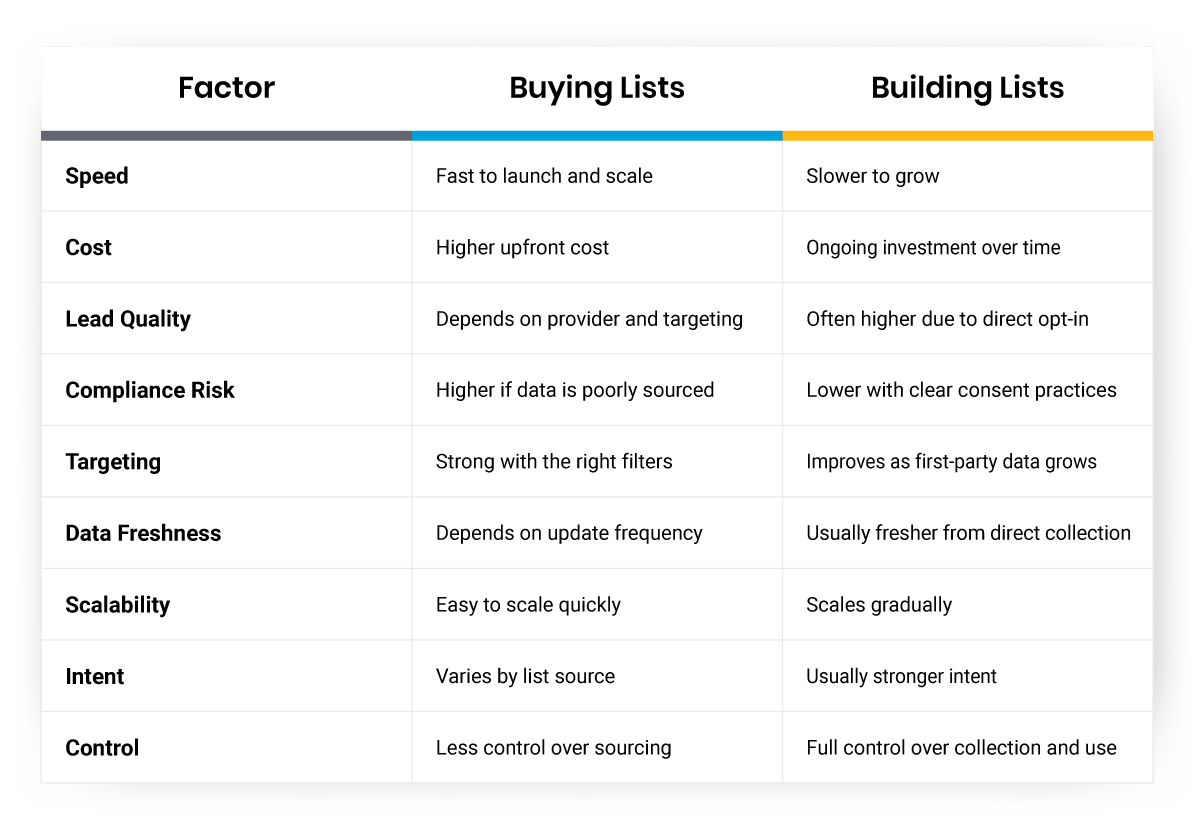
Buying vs. Building Email Lists
Key Insight
Most companies get the best results by using both strategies together. Buying lists helps you scale outbound faster, while building lists creates a stronger long-term pipeline of engaged contacts.
How to Maximize ROI from Purchased Email Lists
Choosing a reputable email list provider is half the battle when you purchase an email list. To truly get the most value from your investment, it’s essential to follow proven best practices that turn raw contact data into high-performing outreach. When executed strategically, these tactics can boost engagement, drive conversions, and deliver measurable ROI. Best practices to get the most from your email lists include:
- Segment your audience strategically: Tailor your messaging by industry, job role, behavior, or location to increase relevance and response rates.
- Personalize your content: Use dynamic fields and contextually relevant messaging to create authentic, one-to-one connections.
- Monitor performance and optimize regularly: Track open rates, click-throughs, and conversions to refine your campaigns over time.
- Maintain list hygiene: Regularly clean your database to remove inactive or invalid addresses and protect your sender reputation.
- Run A/B tests consistently: Experiment with subject lines, CTAs, and design elements to uncover what resonates best with your audience.
- Integrate across marketing channels: Combine email outreach with social, content, and paid campaigns to create a cohesive, omnichannel experience.
Pro Tip
Do not email your full purchased list at once. Start with a small, high-fit segment first to test deliverability, response quality, and conversion potential before scaling.
Email List Buying Trends in 2026
Email list buying in 2026 is shifting away from simple volume and toward smarter, more targeted prospecting. Now, the strongest providers are competing on how well they help businesses identify the right buyers, stay compliant, and connect data with modern sales workflows.
AI-Driven Prospect Targeting
AI is playing a bigger role in how teams evaluate and use purchased data. Instead of building broad lists based only on firmographics, companies are using AI to prioritize accounts, surface likely buyers, and improve targeting before outreach even begins. G2’s 2026 report on AI sales intelligence notes that leading platforms are increasingly focused on AI-guided account discovery, predictive scoring, and workflow-native prospecting.
Increased Focus on Compliance
Compliance has become a much bigger part of list-buying decisions. Providers and buyers both need to think beyond contact acquisition and focus on how data is sourced, verified, and used. Google continues to enforce bulk-sender requirements for anyone sending around 5,000 or more messages per day to personal Gmail accounts, including authentication, easy unsubscribe, and low spam complaint thresholds. That means compliance is now directly tied to deliverability, not just legal risk.
Shift Toward Intent-Based Data
Another major trend is the move from static contact lists to intent-based data. Businesses are eager to know which prospects may be researching solutions, changing vendors, or entering an active buying cycle. That is why more list providers now position intent data as a core value driver, especially for B2B teams trying to improve relevance and prioritize outreach more effectively.
Integration with Sales Automation Tools
Email list providers are also becoming more tightly connected to the rest of the sales stack. Teams increasingly expect list data to flow directly into CRMs, sequencing tools, and outbound automation platforms. This reduces manual work, speeds up campaign launch, and helps sales teams move faster from list selection to outreach. The trend is clear: purchased data is becoming part of a connected revenue workflow rather than a standalone spreadsheet export.
Get Verified Email Lists for Your Target Market
If you’re looking for a faster way to reach the right prospects, Salesgenie gives you:
- Verified business and contact data
- Powerful targeting filters
- Tools to build and launch outreach quickly
Conclusion
Whether you’re exploring providers for the first time or weighing your final options, there are plenty of solutions designed support your business needs. As you evaluate your choices, pay close attention to how each provider sources its data, the usability of their platform, and the features that support segmentation, compliance, and integration. These factors can make a significant difference in the success of your outreach strategy.
Above all, choose a partner that helps you move quickly, connect with the right contacts, and accelerate your growth. Before making your final decision, revisit the providers listed above—your ideal match is just a few clicks away.
FAQs
Yes, if you purchase an email list from a reputable provider, such as the ones listed above.
The cost of email lists varies, depending on how many people will access the lists and how much you’re willing to spend.
Yes. Once you have paid for access to a provider’s email lists, you can use them to cold email relevant contacts.
The provider you choose to go with entirely depends on your needs and how much your marketing budget allows for. For regularly updated, trustworthy data, choose Salesgenie.
Purchased email lists can be effective when the data is accurate, well-targeted, and used in a compliant outreach strategy. They tend to perform best for fast market entry and outbound prospecting, but poor-quality or outdated lists can quickly hurt results and deliverability.