
As we enter 2025, small- and medium-sized businesses (SMBs) face a harsh reality: relying solely on customer acquisition is no longer sustainable. With rising acquisition costs and increased competition, customer retention has become the key to profitable, long-term growth.
Acquiring a new customer can cost five times more than retaining an existing one. Even a 5% increase in retention can boost profits by 25% to 95%. Investing in your current customer base is one of the most cost-effective paths to sustainable growth.
In this comprehensive guide, you’ll discover how to:
- Calculate your customer retention rate (CRR) and benchmark your performance against industry standards
- Implement 12 proven retention tactics tailored to your specific business model
- Find the optimal balance between retention and acquisition for your growth stage
- Build a cost-effective tech stack to support your retention efforts
- Track the metrics that actually matter for SMB success
- Create a 90-day action plan to turn retention into your competitive advantage
Whether you’re a subscription-based startup, a transactional retailer, or a business-to-business (B2B) service provider, this guide will equip you with actionable strategies to reduce churn and increase customer lifetime value (CLV).
What is Customer Retention and Why it Matters for Small Businesses
Customer retention is your ability to keep existing customers engaged, satisfied, and continuing to buy from you over time. For SMBs with tight budgets and lean teams, retention is one of the most efficient drivers of long-term profitability.
The financial logic behind retention is compelling. Acquiring a new customer often costs far more than keeping one you already have, while loyal customers spend more, buy more often, and become strong advocates for your brand.
Retention also brings stability. A dependable base of repeat customers creates predictable revenue, makes forecasting easier, reduces pressure on acquisition, and helps protect margins during seasonal or economic fluctuations.
In short, retaining the customers you’ve already earned is one of the smartest, most sustainable paths to growth.
Why Customer Retention Is More Profitable Than Customer Acquisition
At its core, customer retention means keeping the customers you’ve already earned and reducing churn over time. For SMBs with limited resources, retention is often the most efficient path to sustainable growth.
The financial case for retention is strong. Acquiring a new customer can cost 5–25x more than retaining one, and when you factor in marketing, sales, onboarding, and conversion time, acquisition becomes even more expensive for SMBs.
Loyal customers add exponential value. They spend more, buy more frequently, and generate organic referrals that bring in new business at virtually no cost.
Retention also creates predictable revenue. A stable base of loyal customers improves forecasting, reduces the need to replace lost revenue, and gives you room to invest confidently in growth.
How to Calculate Customer Retention Rate (Plus 4 Key Metrics to Track)
Understanding your current retention performance starts with calculating your CRR. This foundational metric shows the percentage of customers you successfully kept over a given period.
The formula is straightforward:
Where E equals the number of customers at the end of the period, N represents new customers acquired during the period, and S is the number of customers at the start of the period.
While CRR provides a valuable snapshot, four additional metrics offer deeper insights:
- Churn rate represents the flip side of retention – the percentage of customers lost during a period. It’s calculated as 1 minus your retention rate. A churn rate above 10% annually signals serious retention challenges that require immediate attention.
- Repeat purchase rate measures the percentage of customers who make multiple purchases over their lifetime. This metric is particularly crucial for e-commerce and retail businesses, as it indicates whether customers find ongoing value in your offerings.
- Net Promoter Score (NPS) gauges customer loyalty by asking, “How likely are you to recommend us to a friend or colleague?” on a 0-10 scale. Your NPS equals the percentage of promoters (9-10 ratings) minus the percentage of detractors (0-6 ratings). Scores above 50 indicate strong customer advocacy.
- CLV calculates the total revenue a customer generates throughout their relationship with your business. Increasing retention directly impacts CLV, making this metric essential for understanding the long-term value of retention investments.
Real-World Example: Calculating Customer Retention Rate
Imagine a small subscription-based fitness studio tracking its customer base over a single quarter. At the start of the quarter, the studio has 200 active members.
During the quarter:
- It acquires 40 new members through referrals and seasonal promotions.
- By the end of the quarter, the studio has 210 total active members.
Using the CRR formula:
CRR = [(E – N) / S] × 100
CRR = [(210 – 40) / 200] × 100
CRR = (170 / 200) × 100
CRR = 85%
This means the fitness studio retained 85% of its starting customers during that period.
You can immediately see why this metric matters. Even though membership grew overall, the studio still lost customers it already had, highlighting opportunities to improve onboarding, engagement, or class offerings. Pairing CRR with the other metrics gives the studio a clearer picture of why customers leave, who stays, and where to invest in stronger retention efforts.
12 Customer Retention Strategies by Business Model
Effective retention strategies must align with how your customers naturally interact with your business. A subscription service requires different tactics than a retail store or consulting firm. Here are four proven strategies for each major business model.
Subscription Businesses (4 Strategies)

- Optimize your onboarding process to reduce early churn, which typically occurs within the first 30-90 days. Create a structured welcome sequence that guides new users to their first success milestone. Use progressive disclosure to introduce features gradually, celebrate early wins with personalized messages, and provide multiple support channels during this critical period.
- Implement proactive customer success monitoring by tracking usage patterns and engagement metrics. Set up automated alerts when customers show signs of declining activity, then reach out with helpful resources or personal check-ins. A simple “We noticed you haven’t logged in lately – how can we help?” message can prevent many cancellations.
- Offer flexible subscription options to accommodate changing customer needs. Allow customers to pause subscriptions during busy periods, downgrade to lower-tier plans instead of canceling, or switch to annual billing for discounts. The goal is providing value on their terms rather than forcing rigid commitments.
- Build community among subscribers through exclusive forums, user groups, virtual events, and user-generated content campaigns. When customers feel connected to other users and your brand, they’re significantly less likely to churn. Consider creating customer advisory boards or beta testing programs for your most engaged users.
Example: A meal-kit subscription service notices high churn within the first 60 days. After implementing a structured onboarding sequence with step-by-step cooking guides, welcome emails, and optional check-ins, early cancellations drop by 18% and customers begin exploring more advanced recipes over time.
Transactional Retailers (4 Strategies)

- Launch a points-based loyalty program with clear value propositions and achievable reward thresholds. Structure tiers that encourage increased spending, offer bonus point events during slow periods, and make redemption simple across all channels. Successful programs typically offer 5-10% back in value through points or perks.
- Personalize email marketing campaigns using purchase history, browsing behavior, and demographic data. Send targeted product recommendations, timely replenishment reminders for consumable goods, birthday discounts, and milestone celebrations. Segmented campaigns see around 101% higher click-through rates than non-segmented campaigns.
- Execute strategic seasonal promotions that drive repeat purchases without training customers to only buy on sale. Create exclusive offers for loyal customers, bundle complementary products, and use limited-time urgency to encourage action. Time promotions around natural buying cycles and inventory management needs.
- Master cross-selling and upselling techniques at key customer touchpoints. Suggest complementary products during checkout, include recommendations in order confirmation emails, and follow up post-purchase with related items. Use social proof and customer reviews to increase relevance and conversion rates.
Example: A boutique skincare retailer launches a loyalty program offering points for purchases, referrals, and social engagement. Within three months, repeat purchase rate climbs significantly as customers return to redeem points for deluxe samples and exclusive product drops.
B2B Service Providers (4 Strategies)
- Schedule regular business review meetings with clients to assess progress, identify new opportunities, and strengthen relationships. Prepare structured agendas covering performance metrics, upcoming challenges, and strategic planning. These touchpoints demonstrate ongoing value and often uncover expansion opportunities.
- Provide ongoing education and training programs that help clients maximize their investment in your services. Offer webinars, workshops, resource libraries, and certification programs. Position yourself as a trusted advisor who contributes to their success beyond your core service delivery.
- Assign dedicated account management for high-value clients who represent significant revenue or growth potential. Ensure consistent communication, rapid issue resolution, and proactive relationship building. Account managers should understand each client’s business goals and industry challenges.
- Create customized service offerings based on client feedback and usage patterns. Regularly survey customers about their evolving needs, analyze service utilization data, and adapt your offerings accordingly. Clients who feel heard and see their input reflected in your services are far more likely to remain loyal.
Example: A digital marketing agency conducts quarterly business reviews with its clients, walking through performance data and uncovering new opportunities. One review reveals a client’s interest in expanding into paid search, leading to an upsell and deeper long-term partnership.
Pro Tip
Before choosing any retention tactic, audit how your customers actually interact with your business. Focusing your efforts on the channels and touchpoints they use most ensures you invest in strategies that deliver measurable, long-term impact rather than spreading your resources too thin.
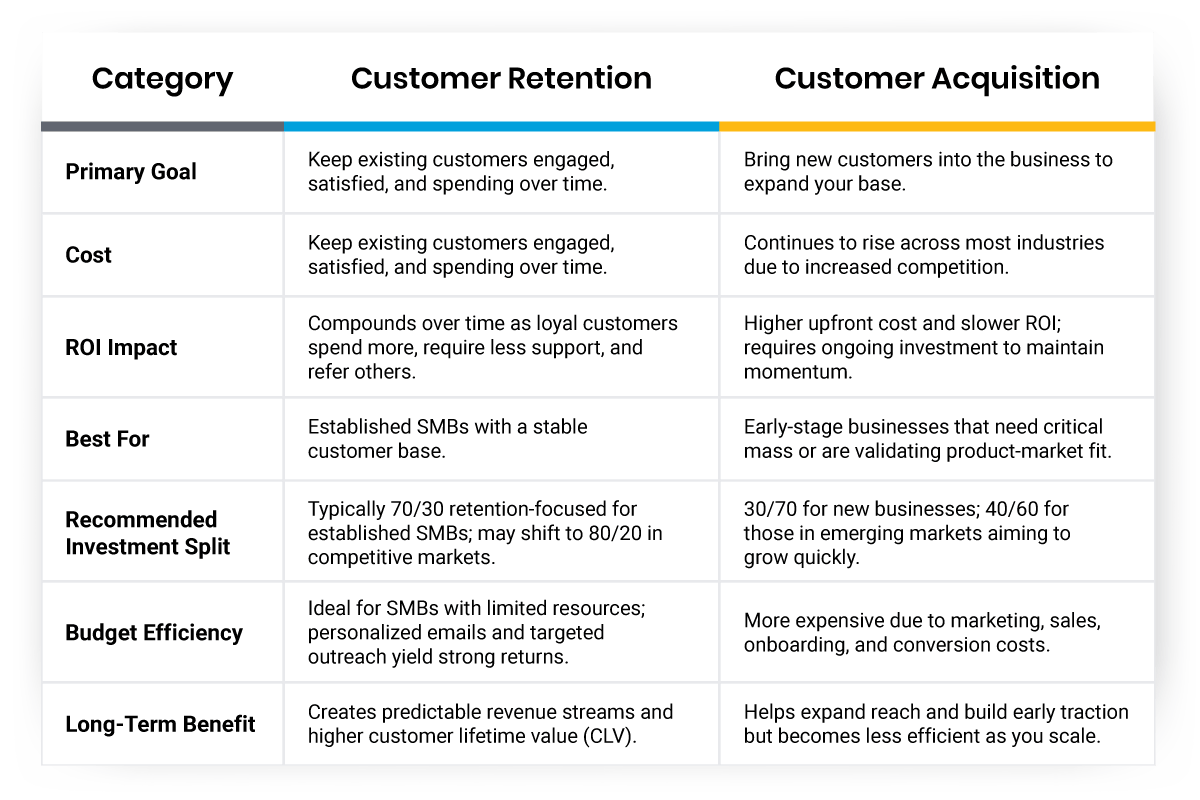
Customer Retention vs. Customer Acquisition: Finding the Right Balance
Building Your Customer Retention Tech Stack on a Budget
Effective retention doesn’t require expensive enterprise software. SMBs can build powerful retention capabilities using affordable, integrated tools that grow with their business.
Your foundation should include three essential components: a customer relationship management (CRM) system, email marketing platform, and customer feedback tool. Lead generation platforms like Salesgenie® can also enhance retention by enriching customer profiles with additional firmographic and contact data. These core systems handle the majority of retention activities while remaining budget-friendly for most SMBs.
CRM, Email Marketing Platform, Customer Feedback, and Lead Generation Tool Options
- CRMs: Modern CRMs like HubSpot, Pipedrive, or Zoho offer free or low-cost tiers that include contact management, deal tracking, and basic automation. These platforms centralize customer data, track interaction history, and trigger retention campaigns based on customer behavior. Many integrate directly with your website, e-commerce platform, and other business tools.
- Email Marketing Platforms: Services like Mailchimp, ConvertKit, or ActiveCampaign provide sophisticated segmentation, automation workflows, and performance analytics at reasonable monthly costs. Look for tools that integrate seamlessly with your CRM to ensure data consistency.
- Customer Feedback: Tools like Typeform, SurveyMonkey, or built-in CRM surveys help you understand satisfaction levels and identify at-risk accounts. Regular NPS surveys, post-purchase feedback requests, and annual satisfaction assessments provide early warning signals for potential churn.
- Lead generation platforms like Salesgenie support retention efforts by enriching existing customer profiles with additional demographic, firmographic, and contact data. Better customer understanding enables more targeted retention campaigns and helps identify expansion opportunities within existing accounts. When you know more about your customers’ businesses, industries, and decision-makers, you can craft more relevant retention messages and offers.
Customer Retention Metrics and KPIs that Actually Matter for SMBs
Rather than overwhelming yourself with dozens of metrics, focus on 3-5 core KPIs that directly impact your business objectives and are actionable for a small team:
- Start with your overall retention rate calculated monthly and quarterly. Monthly tracking helps you spot trends quickly, while quarterly analysis smooths out seasonal variations and provides better context for strategic decisions. Set realistic goals based on your industry benchmarks and current performance.
- Customer churn rate deserves equal attention to retention rate. Track both voluntary churn (customers who actively cancel) and involuntary churn (failed payments, expired contracts).
- NPS provides early warning signals for retention challenges. Customers who rate you 6 or below are at high risk of churning within 6-12 months. Create automated workflows to follow up with detractors immediately, addressing their concerns before they decide to leave. Track NPS trends by customer segment to identify specific problem areas.
- CLV helps you understand the long-term impact of retention investments. Calculate CLV by multiplying average purchase value by purchase frequency and customer lifespan. Use this metric to justify retention spending and identify your most valuable customer segments for targeted attention.
- Revenue retention rate measures whether existing customers are spending more, less, or the same amount over time. This metric is particularly valuable for subscription businesses and B2B companies with expansion opportunities.
- Simple reporting templates make metric tracking manageable for busy SMB owners. Create monthly dashboards showing retention rate, churn rate, NPS, and CLV trends.
Pro Tip
Zero in on a small set of KPIs that connect directly to your revenue and customer experience. Tracking just a handful of metrics consistently will give you more clarity and better results.
Common Customer Retention Mistakes (And How to Avoid Them)
Even well-intentioned retention marketing efforts can backfire when businesses make these common mistakes. Learning to avoid these pitfalls will save you time, money, and customer relationships.
- Poor Communication: Retention suffers when communication is inconsistent or unresponsive. Too many touchpoints can overwhelm your audience, while too few leave them feeling ignored. Most B2B relationships perform best with monthly outreach, while B2C customers often expect weekly or bi-weekly contact.
- Uninspired Loyalty Programs: Generic loyalty programs fail because they don’t align with actual customer preferences and behaviors. Before launching any loyalty initiative, survey your customers about what rewards they value most.
- Avoiding Smaller Accounts: Many SMBs focus retention efforts exclusively on high-value customers while neglecting smaller accounts. This approach misses significant opportunities because small customers often grow over time, refer others, and provide valuable feedback.
- Lack of Training: Employee training gaps undermine even the best retention strategies. Every team member who interacts with customers should understand retention principles and have tools to address common concerns. Create simple scripts for handling complaints, escalation procedures for complex issues, and incentives that reward retention-focused behaviors alongside sales metrics.
Creating a 90-Day Customer Retention Action Plan
Transform retention from a vague goal into concrete results with this structured 90-day implementation plan. Each phase builds on the previous one, creating momentum while delivering quick wins.
Weeks 1-2: Assessment and Foundation
Audit your current retention rate using the formula provided earlier in this guide. Calculate churn rates by customer segment, identify your top churn reasons through customer surveys or exit interviews, and benchmark your performance against industry standards. Set up basic tracking systems in your CRM and establish baseline metrics for measuring progress.
Weeks 3-6: Quick Wins Implementation
Launch a simple NPS survey to gauge current satisfaction levels, create basic customer segmentation based on purchase behavior or engagement levels, and implement one high-impact retention marketing tactic specific to your business model. For subscription businesses, this might be improving onboarding emails. Retailers could launch a basic points program, while service providers might schedule quarterly business reviews.
Weeks 7-10: Targeted Campaign Launch
Identify your highest-risk customer segment based on behavior patterns, engagement levels, or survey responses. Create a targeted retention campaign addressing their specific needs or concerns. This could include personalized offers, educational content series, or proactive outreach from your customer success team. Monitor campaign performance and adjust messaging based on initial results.
Weeks 11-12: Measurement and Optimization
Analyze results from your retention initiatives, comparing metrics to your baseline measurements. Calculate ROI on retention investments and identify which tactics generated the best results. Create a plan for scaling successful initiatives and eliminating ineffective ones. Document lessons learned and establish ongoing processes for continuous improvement.
Implementation Checklist:
- Set up retention rate tracking in your CRM system
- Survey customers to understand satisfaction and preferences
- Implement one business model-specific retention tactic
- Create at-risk customer identification criteria
- Launch targeted campaign for highest-risk segment
- Measure results and calculate retention ROI
- Document successful tactics for future scaling
- Establish monthly retention review meetings
Conclusion: Turning Customer Retention Into Your Competitive Advantage
Retention marketing is more than a tactic; it’s a long-term growth engine. Loyal customers spend more, stay longer, refer others, and help generate predictable revenue streams that support better planning and decision-making. By focusing on customers you already have, you reduce the cost and urgency of constant acquisition. Every retained customer lowers marketing, sales, and onboarding expenses, giving you more room to invest in higher-value relationships.
Retention is not a one-time effort. It requires consistent attention across customer service, product, marketing, and sales. The most successful SMBs treat it as a business-wide priority and look for small improvements that compound over time. As you put these strategies into action, keep your focus on progress, not perfection. Choose a few tactics that align with your business model and resources, track performance, and adjust as you go.
See how Salesgenie helps SMBs build stronger customer relationships through better data and streamlined outreach that turns retention from a challenge into a competitive advantage.
FAQs
Customer retention measures your ability to keep customers over time, while customer loyalty reflects how emotionally committed they are to your brand. Retention is about behavior; loyalty is about sentiment and willingness to recommend or repurchase.
Retaining a customer typically costs far less, often five to twenty-five times less, than acquiring a new one. Retention also delivers higher long-term ROI because loyal customers buy more frequently and generate cost-free referrals.
Customers often churn due to poor onboarding, lack of value, inconsistent communication, pricing concerns, or unresolved service issues. Even small frustrations can add up, making proactive engagement essential.
A strong retention program starts with understanding customer behavior, segmenting your audience, and identifying at-risk accounts. From there, implement targeted tactics, such as onboarding workflows, loyalty programs, or regular business reviews, and track key metrics to refine your approach.
Core indicators include customer retention rate (CRR), churn rate, repeat purchase rate, Net Promoter Score (NPS), customer lifetime value (CLV), and revenue retention. These KPIs reveal how many customers stay, how often they buy, and how much value they generate over time.
Small businesses can improve retention by personalizing communication, delivering consistent value, and engaging customers through loyalty programs, tailored offers, and proactive support. Even simple changes can significantly reduce churn.
Common errors include inconsistent communication, generic loyalty programs, ignoring smaller accounts, and undertrained staff who struggle to resolve issues effectively. These gaps weaken the customer experience and increase the risk of churn.