
Most marketing budgets are hemorrhaging money on Google Ads while overlooking a platform that delivers strong search engine advertising benefits and a more efficient path to return on investment (ROI). Microsoft Advertising and using the Bing search engine represents the biggest untapped opportunity in digital marketing today, yet most SMBs continue pouring resources into increasingly expensive Google campaigns. With less advertiser competition and exclusive LinkedIn targeting capabilities, the platform offers a strategic advantage that savvy businesses are leveraging to dominate their markets.
This guide reveals the complete framework for maximizing advertising on Bing. You’ll discover:
- When Microsoft Advertising outperforms Google Ads for lead generation
- How to leverage LinkedIn’s professional targeting for B2B campaigns
- Cost optimization strategies that reduce acquisition costs
- Advanced implementation tactics for seamless integration with your marketing stack
- ROI measurement frameworks tailored to SMB lead generation goals
Why Smart Marketers Are Shifting Budget to Microsoft Advertising
The digital advertising landscape has created a false choice between Google’s massive reach and everything else. But Microsoft Advertising’s billions of monthly PC searches represent a massive, underutilized audience of high-intent prospects actively seeking solutions.
The core advantage comes from reduced competition. While Google’s auctions are overcrowded, Microsoft Advertising provides a less saturated environment where ads secure stronger placement at significantly lower costs.
The audience itself is another differentiator. Bing users tend to be older, more professionally oriented, and more likely to convert, making it ideal for delivering high-intent search ads that align with B2B buying behavior.
Its LinkedIn integration further elevates search ad targeting options, enabling advertisers to reach prospects by job title, industry, and company size in a way no other search platform can match.
Microsoft Advertising: The Strategic Advantage
Advertising on Bing delivers fewer impressions, but the users you reach are typically more conversion-ready. For businesses prioritizing lead quality, Microsoft Advertising’s targeted environment amplifies search engine marketing benefits that Google alone can’t match.
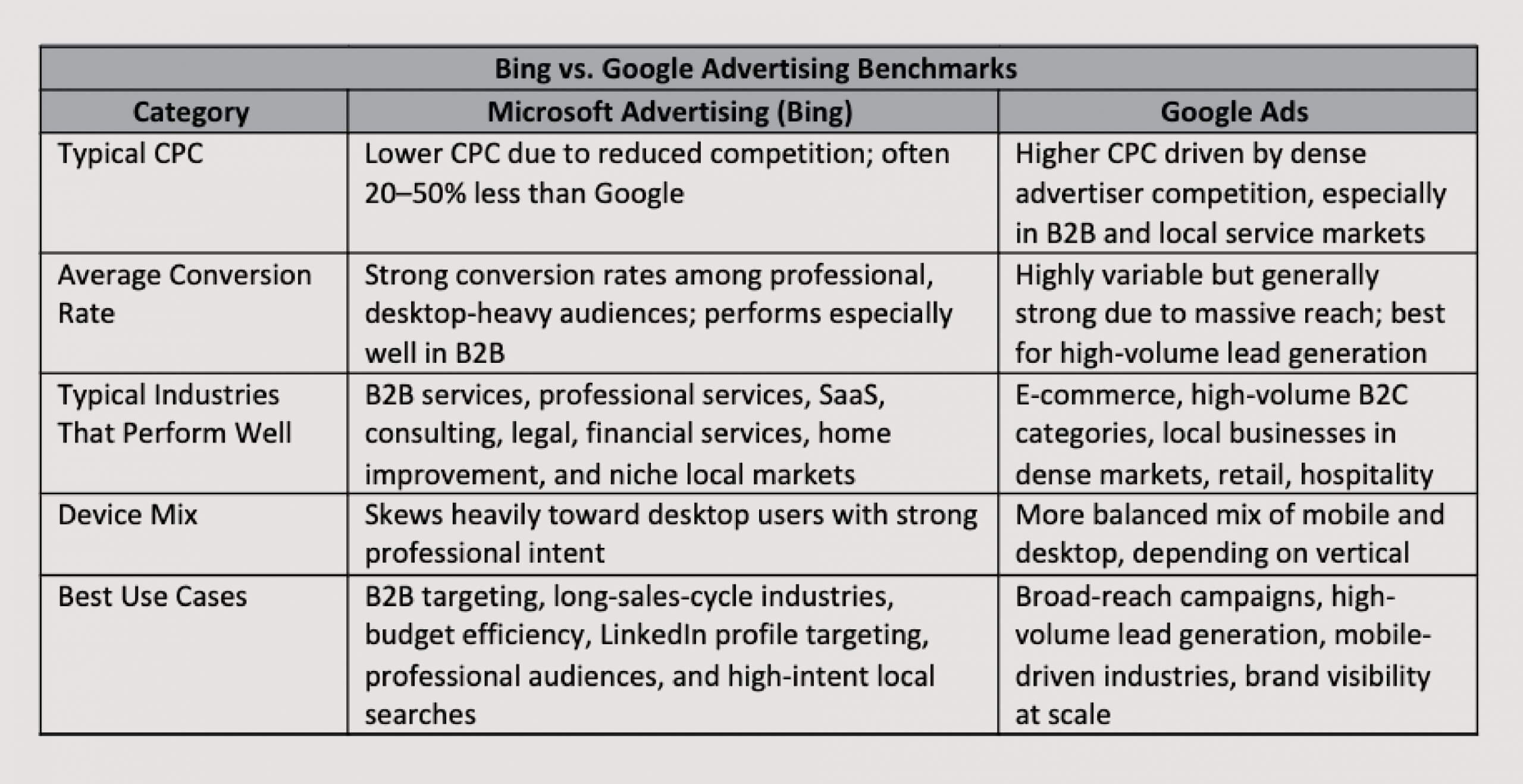
Below are some other examples of why Microsoft Advertising and Bing may provide a strategic benefit over Google:
- B2B campaigns targeting specific job functions benefit enormously from LinkedIn’s professional data integration. Software companies, professional services firms, and consultancies can target decision-makers with unprecedented precision.
- Local service businesses in competitive markets find Microsoft Advertising particularly effective. Lower competition means better ad positioning for location-based searches, often at 40-50% lower costs than Google equivalents.
- Budget-conscious campaigns requiring maximum lead volume per dollar consistently perform better on Microsoft Advertising. The platform’s lower cost structure allows for broader keyword coverage and extended campaign duration within the same budget constraints.
- Professional services with longer sales cycles see higher engagement rates on Microsoft Advertising, where the desktop-focused, professional audience aligns perfectly with complex B2B buying processes.
The LinkedIn Targeting Advantage You Can’t Get Anywhere Else

Access LinkedIn targeting through the “Professional Profile” option in campaign setup. Layer professional data onto traditional demographic targeting for maximum precision without over-narrowing your audience.

Start with broader professional categories before narrowing to specific job titles. Target “Marketing Director” across all industries before focusing on “Marketing Director at Technology Companies with 100-500 employees.”

Combine LinkedIn targeting with geographic and device targeting for optimal results. Desktop targeting often performs better for B2B campaigns, aligning with the professional, office-based nature of decision-making.

Test different professional targeting combinations systematically. Job function targeting may outperform specific titles in some industries, while company size filters might be more effective than industry targeting for certain services.
Bing Ads Cost Per Click: Understanding Your True Advertising Investment
Microsoft Advertising’s cost structure creates opportunities for strategic budget allocation that maximizes lead generation ROI, so it’s important to understand the platform’s pricing dynamics to enable smarter bidding and budget distribution decisions.
Generally, the lower competition environment means quality scores impact costs less dramatically than on Google, and seasonal cost fluctuations are less extreme advertising on Bing, providing more predictable budget planning.
Here’s how you can integrate cost optimization strategies that actually work:
- Implement dayparting strategies: Ensure these are aligned with your B2B audience’s professional schedules.
- Exact match keywords: The lower search volume is offset by higher intent and conversion rates, making precise matching more cost-effective. You can use these more aggressively than on Google
- Leverage automated bidding: Use this with strategic caution. Microsoft’s AI performs well for conversion-focused campaigns but requires sufficient historical data for optimal performance.
- Geographic targeting: For significant cost advantages, focus on metropolitan areas where your target audience concentrates, avoiding broad geographic targeting that dilutes performance.
How to Measure ROI and Identify the KPIs That Matter Most
Measuring return on investment (ROI) in Microsoft Advertising requires a structured approach that connects ad performance to real business outcomes. While generating clicks is essential, it’s also important to understand which of your campaigns produce qualified leads, revenue, and long-term customer value. With Microsoft Advertising’s strong alignment to professional, high-intent audiences, a clear measurement framework ensures your budget works as efficiently as possible.
Effective ROI analysis begins with accurate tracking. Universal Event Tracking (UET), CRM integration, and offline conversion imports give businesses full visibility into the customer journey. Once tracking is established, you can evaluate performance using a focused set of KPIs that reflect both lead quality and overall efficiency.
Below are the key KPIs you should prioritize:
- Cost Per Lead (CPL): A foundational metric that reveals how cost-efficient your campaigns are at driving actionable conversions. Because Bing typically offers lower CPCs and higher-intent audiences, CPL often outperforms Google in B2B and professional service industries.
- Conversion Rate (CVR): The percentage of users who complete your desired action. Desktop-heavy audiences on Microsoft Advertising tend to convert at higher rates due to more deliberate research behavior, making CVR a valuable indicator of lead quality.
- Lead Quality Score: Not all leads contribute equally to revenue. Evaluate quality using CRM-based scoring rules to determine which campaigns generate high-value prospects.
- Cost Per Acquisition (CPA): This metric tracks the total cost required to acquire a customer. CPA becomes more accurate when offline conversion data is connected, allowing you to distinguish between leads that convert quickly and those that require longer nurturing cycles.
- Return on Ad Spend (ROAS): A direct measure of revenue generated per advertising dollar. For businesses with defined product or service pricing, ROAS offers clear visibility into profitability across both short- and long-term cycles.
- Pipeline Contribution & Revenue Attribution: Once CRM integration is in place, you can track how Microsoft Advertising contributes to the sales pipeline. This is especially important for B2B organizations, where a single qualified lead may generate substantial lifetime value.
- Engagement KPIs (Click-Through Rate, Time on Site, Page Depth): These supporting metrics shed light on user intent and alignment between keyword strategies, ad messaging, and landing page content. For Microsoft Advertising’s professional audience, stronger engagement often correlates with higher revenue potential.
How to Set Up Microsoft Advertising: Your Implementation Roadmap
Successful Microsoft Advertising implementation requires strategic account architecture that supports both current campaigns and future scaling. Remember, the foundation you build determines long-term performance and optimization capabilities.
We’ve developed a roadmap for you to follow to set up advertising on Bing with ease and success.
- Account structure should mirror your business organization and customer journey. Separate campaigns by product lines, service offerings, or geographic markets to enable precise budget allocation and performance measurement.
- Integration planning is crucial from day one. Microsoft Advertising works best when connected to your customer relationship management (CRM), marketing automation platform, and analytics stack for comprehensive lead tracking and attribution.
- Organize your campaigns by business objective rather than keyword themes. Create separate campaigns for lead generation, brand awareness, and customer retention to enable objective-specific optimization.
- Structure ad groups around customer intent levels. Group high-intent, ready-to-buy keywords separately from research-phase terms to customize messaging and bidding strategies appropriately.
- Implement consistent naming conventions that include campaign type, target audience, and geographic focus. This enables easier reporting and optimization as your account scales.
- Mirror your website structure when it makes sense but prioritize conversion path optimization over perfect organizational symmetry. Guide users toward your strongest landing pages regardless of site architecture.
- Configure Universal Event Tracking (UET) before launching campaigns. Proper conversion tracking is essential for ROI measurement and automated bidding optimization.
- Integrate with your CRM system to track leads through the complete sales funnel. Microsoft Advertising’s offline conversion tracking enables revenue attribution for longer sales cycles.
- Set up goal tracking for multiple conversion types: form submissions, phone calls, email signups, and download completions. This provides comprehensive campaign performance visibility.
- Connect Google Analytics for additional insights and cross-platform comparison. Dual tracking systems provide backup data and deeper analytical capabilities.

Advanced Targeting and Optimization Tactics
Experienced marketers can separate themselves from the competition by going beyond the basics with advanced optimization tactic. Although they require ongoing attention, they manage to deliver exponential performance improvements. Suggested techniques include:
- Audience layering: Combines multiple targeting criteria for precision without over-restriction.
- Dynamic remarketing: Enables personalized ad experiences based on previous site interactions.
- Automated ad extensions: Enhance visibility and click-through rates without additional management overhead. Enable all relevant extensions and let Microsoft’s AI optimize their display.
- Dynamic search ads: Help capture long-tail traffic that manual keyword lists might miss. This is particularly effective for businesses with large product catalogs or service offerings.
- Responsive search ads: Enable message testing at scale. Provide multiple headlines and descriptions, then let the platform optimize combinations for maximum performance.
Integration Strategy: Combining Microsoft Advertising with Your Lead Generation Stack
Microsoft Advertising performs best when integrated within multi-platform search ads, allowing businesses to diversify risk, strengthen attribution, and reach the right prospects at the right stage of the funnel. With strategic integration you can multiply the platform’s effectiveness while providing comprehensive customer journey visibility. CRM integration also enables lead scoring and nurturing based on traffic source, allowing for customized follow-up sequences for Microsoft Advertising prospects.
The key is creating seamless data flow between platforms while maintaining the ability to measure Microsoft Advertising’s specific contribution to revenue generation and customer acquisition.
Your Next Steps with Microsoft Advertising
Microsoft Advertising represents a strategic opportunity that smart marketers are leveraging while their competitors remain focused solely on Google. The decision framework is straightforward: if you’re targeting business professionals, operating with budget constraints, or competing in saturated Google Ads markets, advertising on Bing deserves immediate attention.
Ready to transform your Microsoft Advertising clicks into qualified prospects? Salesgenie’s database of 25+ million verified business contacts provides the perfect complement to Microsoft Advertising’s precise targeting capabilities, enabling you to identify, reach, and convert your ideal customers with unprecedented efficiency—discover how this powerful combination can amplify your campaign ROI today.
FAQs
Google Ads offer massive reach and sophisticated automation, helping businesses capture high-volume search intent. When campaigns are optimized with strong targeting and relevant landing pages, this scale can translate into consistent conversion performance and predictable ROI.
Microsoft Advertising typically provides lower CPCs, higher-intent desktop audiences, and access to LinkedIn’s professional targeting data. This combination often results in stronger lead quality and more efficient budget use, especially for B2B and service-focused campaigns.
Bing users skew older, more educated, and more professionally oriented, giving advertisers access to decision-makers with stronger purchasing power. The platform’s desktop-heavy traffic also aligns well with research-driven buying behavior common in B2B markets.
Google delivers extensive keyword coverage, robust audience segments, and powerful intent signals across search and the broader Google ecosystem. These tools help advertisers reach users at every stage of the funnel with precision.
Lower CPCs allow budgets to stretch further, enabling more clicks, more tests, and broader keyword coverage without sacrificing efficiency. For SMBs, this often leads to better cost-per-lead and stronger overall ROI.
The platform’s LinkedIn integration, desktop-dominant audience, and reduced auction competition give advertisers a unique edge in targeting professional buyers. These factors often produce higher engagement and better conversion rates for B2B and service-based campaigns.
Use Google Ads for scale and volume while leveraging Microsoft Advertising for high-intent, cost-efficient leads. When combined, the two platforms provide stronger coverage across the funnel and more reliable budget diversification.
Many assume both platforms perform identically without accounting for audience behavior, device mix, or industry nuances. Others overlook proper tracking and attribution, limiting their ability to measure true ROI across channels.