

For a long time, B2B marketing teams chased a simple metric: more leads. More form fills, more webinar signups, more contacts added to the CRM. On paper, it looked like progress. Many of those leads never translated into meaningful sales conversations, let alone revenue.
Today’s demand generation and growth leaders are under pressure to prove marketing’s impact on revenue. That means the conversation has shifted from marketing-qualified leads (MQLs) to sales-qualified leads (SQLs), opportunity creation, and ultimately pipeline contribution.
This shift has fundamentally changed how organizations think about B2B lead generation strategies. Many companies now rely on a modern lead generation platform that combines accurate data, targeting tools, and outreach capabilities to identify real buyers earlier in the process. The goal is no longer just capturing attention. The goal is identifying real buyers, engaging them with relevant signals, and converting that interest into predictable B2B pipeline generation.
In this guide, we’ll break down the best B2B lead generation strategies being used by high-growth organizations today.
You’ll learn:
- Which lead generation tactics move prospects into pipeline
- How these tactics support a broader lead generation framework
- Where they fit within an end-to-end B2B lead generation framework designed to turn demand into revenue.
If you’re looking for a foundational overview of the topic, start with our guide to B2B lead generation.
Why Most B2B Lead Generation Strategies Fail
Many organizations invest heavily in lead generation yet still struggle to produce consistent pipeline. The issue usually isn’t effort or budget. More often, it’s how the strategy is designed. A surprising number of B2B programs still prioritize activity metrics instead of outcomes that sales teams care about.
We’ll cover some of the most common ways that lead generation strategies fail.
Over-Optimization for Lead Volume
A common trap in B2B lead generation strategies is optimizing for the easiest metric to increase: lead count.
Content downloads, webinar registrations, and gated reports can produce thousands of contacts. However, many teams struggle because those leads lack accurate information or buying intent. Using verified business contact data helps revenue teams focus outreach on decision-makers more likely to convert. Without that level of accuracy, teams often end up chasing contacts who were never a strong fit to begin with, such as students researching a topic, competitors gathering insights, or early-stage researchers who have no budget or buying authority.
The result is a familiar scenario across marketing teams: high MQL volume but weak pipeline impact.
Even in well-optimized funnels, the conversion gap remains significant. Industry benchmarks show the average MQL-to-SQL conversion rate is roughly 13%, meaning the majority of marketing leads never reach sales-ready status. That disconnect reveals why many traditional lead generation strategies for B2B fail to drive meaningful pipeline.
Generate Quality Leads That Convert
Channel-First Thinking Instead of Buyer-First Strategy
Another common issue is building a B2B lead generation strategy around channels rather than buyers.
Teams often ask questions like:
- Should we invest more in LinkedIn ads?
- Should we launch another webinar series?
- Should we scale outbound email?
The most effective B2B lead generation tactics start with buyer behavior: what triggers the search, where decision-makers gather information, and which signals indicate purchase intent. Once those patterns are understood, channels become tools rather than the strategy itself.
Lack of Marketing and Sales Alignment
Lead generation breaks down quickly when marketing and sales operate with different definitions of success.
Marketing may celebrate campaign performance and lead volume, while sales focuses on opportunity quality and deal velocity. Without shared goals tied to B2B pipeline generation, both teams optimize for different outcomes.
Organizations that succeed with lead generation programs treat pipeline as a shared responsibility. Marketing focuses on generating qualified demand and intent signals, while sales builds on that momentum with timely engagement and relationship-building.
No Clear Definition of MQL to SQL Conversion
Even when marketing produces qualified leads, many organizations lack a clear process for converting those leads into opportunities.
If the criteria for moving from MQL to SQL are vague, leads often sit untouched in the CRM. Opportunities that could have progressed quickly will stall at the top of the funnel.
A well-designed end-to-end B2B lead generation framework solves this by clearly defining qualification stages, handoff criteria, and engagement triggers between marketing and sales.
Understanding this distinction is also critical when evaluating the role of demand creation versus lead capture. If you want a deeper breakdown of how these disciplines work together, see our page on Demand Generation vs. Lead Generation.
The 6 B2B Lead Generation Strategies That Drive Pipeline
Not all B2B lead generation strategies are created equal. Some tactics produce large volumes of contacts but little sales traction. Others consistently move real buyers into conversations with your sales team.
The difference usually comes down to intent, alignment, and timing. The most effective strategies capture demand when buyers are actively researching solutions or create structured engagement with accounts that already fit your ideal customer profile.
Below are six B2B lead generation strategies that consistently drive SQLs and pipeline.
1High-Intent Inbound
What It Is
High-intent inbound focuses on capturing prospects who are already evaluating solutions. Instead of broad awareness content, this approach targets bottom-of-funnel search queries such as:
- “Best CRM for SMBs”
- “HubSpot vs Salesforce”
- “Lead generation software pricing”
Content formats typically include product comparisons, alternatives pages, demo landing pages, and buyer guides.
When It Works Best
This strategy works best when your target buyers actively research vendors online before speaking with sales. It’s particularly effective in SaaS, technology, and services markets where buyers evaluate multiple solutions.
Why It Drives SQL
High-intent inbound attracts prospects already deep in the buying process. When someone searches for comparisons or pricing information, they’re often close to shortlisting vendors. Many organizations combine high-intent search traffic with targeted prospect lists to identify and prioritize decision-makers already researching solutions.
That means inbound traffic from these searches converts into sales-qualified leads and B2B pipeline generation far more frequently than generic top-of-funnel downloads.
Common Mistake
Many companies invest heavily in awareness content but ignore bottom-of-funnel topics. As a result, they attract researchers instead of buyers.
High-performing lead generation strategies prioritize the content that captures prospects when they are ready to evaluate solutions.
Pro Tip
Build SEO content around comparison and alternative keywords. Pages like “Competitor vs Our Product” or “Best tools for [problem]” often convert at the highest rates in inbound lead generation programs.
2Intent-Driven Lead Generation
What It Is
Intent-driven lead generation uses behavioral signals, such as content consumption, keyword searches, and website activity, to identify companies actively researching solutions.
When It Works Best
This approach works best in markets where buyers conduct extensive research before reaching out to vendors.
Research from McKinsey shows that B2B buyers use an average of ten different channels when evaluating vendors, from websites and digital content to video meetings and in-person conversations.
Why It Drives SQLs
Instead of targeting broad audiences, intent-based programs prioritize companies already demonstrating buying signals. Platforms that provide buyer intent insights help sales teams identify prospects actively researching solutions and engage them at the right moment. Outreach becomes more relevant, better timed, and far more likely to convert into meaningful sales conversations.
Common Mistake
The biggest mistake is treating intent data as a simple lead list rather than a signal.
Intent insights should inform content delivery, outreach messaging, and sales prioritization rather than just generating more cold outreach.
Pro Tip
Align intent signals with content distribution and outbound messaging. When a target account shows interest in a topic, trigger targeted outreach that addresses the same problem they’re researching.
3Account-Based Lead Generation
What It Is
Account-based lead generation identifies high-value target accounts and focuses outreach on the entire buying committee.
When It Works Best
Account-based strategies work best in high-value B2B sales environments where:
- Multiple stakeholders are involved
- Deals have longer sales cycles
- Revenue per customer is significant
Why It Drives SQLs
Because account-based marketing (ABM) targets companies already aligned with your ideal customer profile, it filters out low-quality leads early.
The result is fewer leads but significantly higher conversion rates from lead to opportunity, making ABM one of the best B2B lead generation strategies for pipeline-focused teams.
Common Mistake
Many companies launch ABM campaigns without true sales alignment. If marketing targets accounts that your sales team doesn’t prioritize, the program quickly loses momentum.
Pro Tip
Start with ABM-lite by targeting a focused list of high-fit accounts using LinkedIn ads, intent signals, and coordinated outbound messaging before scaling into full ABM programs.
4Outbound and Content Alignment
What It Is
Instead of cold emails asking for a meeting, outreach provides valuable insights, research, or resources aligned with the prospect’s challenges.
Examples include sending:
- Industry benchmark reports
- Case studies relevant to the prospect’s market
- Thought leadership insights
When It Works Best
This strategy works well in markets where decision-makers receive high volumes of generic sales outreach.
Why It Drives SQLs
Content-backed outreach builds credibility and encourages prospects to engage. Teams that manage and track sales leads in a centralized system can prioritize outreach and follow up with prospects more effectively. Instead of pushing for immediate demos, the conversation begins around insights and value.
Common Mistake
A common mistake is using generic marketing content that isn’t relevant to the prospect’s specific challenges. Effective outbound requires personalization and contextual relevance.
Pro Tip
Equip sales teams with content playbooks mapped to specific buyer pain points. This allows reps to share relevant resources during outreach instead of sending generic messages.
5Product-Led / Self-Serve Qualification
What It Is
Product-led lead generation allows prospects to experience the product before speaking with sales. This can include free
trials, freemium tiers, interactive demos, or sandbox environments.
When It Works Best
Product-led approaches work best when the value of the product can be demonstrated quickly and independently.
Why It Drives SQLs
Prospects who actively explore the product demonstrate much stronger buying intent than someone who downloads a whitepaper.
Common Mistake
Some organizations launch free trials without a clear onboarding or qualification strategy. Without guidance, users may never reach the “aha moment” that reveals the product’s value.
Pro Tip
Track product usage signals such as feature activation, account expansion, or integration setup. These behaviors often indicate when a prospect is ready for a sales conversation.
6Partner and Co-Marketing-Led Lead Gen
What It Is
Partner-driven lead generation involves collaborating with complementary companies to reach shared audiences. Common formats include:
- Co-hosted webinars
- Joint research reports
- Marketplace integrations
- Referral partnerships
When It Works Best
This approach works best when partners serve the same audience but offer different solutions.
Why It Drives SQLs
Partner campaigns benefit from borrowed trust. When prospects already trust a partner brand, they are more likely to engage with a new solution introduced through that relationship.
Common Mistake
A frequent mistake is choosing partners based solely on brand recognition instead of audience overlap.
Pro Tip
Design partner campaigns around joint problem-solving content, such as industry research or practical guides, rather than promotional webinars.
Matching Strategies to Funnel Stage & ACV
Not every B2B lead generation strategy works equally well across every stage of the funnel. A tactic that shows early awareness may have little impact on late-stage pipeline creation. Likewise, the strategies that drive results for high-annual contract value (ACV) enterprise deals often look very different from those used for lower-ACV, high-velocity sales models.
Smart revenue teams therefore design lead generation strategies based on two key variables: where the buyer is in the funnel and the size of the deal being pursued. Aligning strategy with these factors helps marketing and sales focus on tactics that generate real opportunities instead of disconnected leads.
The table below shows how common B2B lead generation tactics align with funnel stage, deal size, and sales cycle complexity.
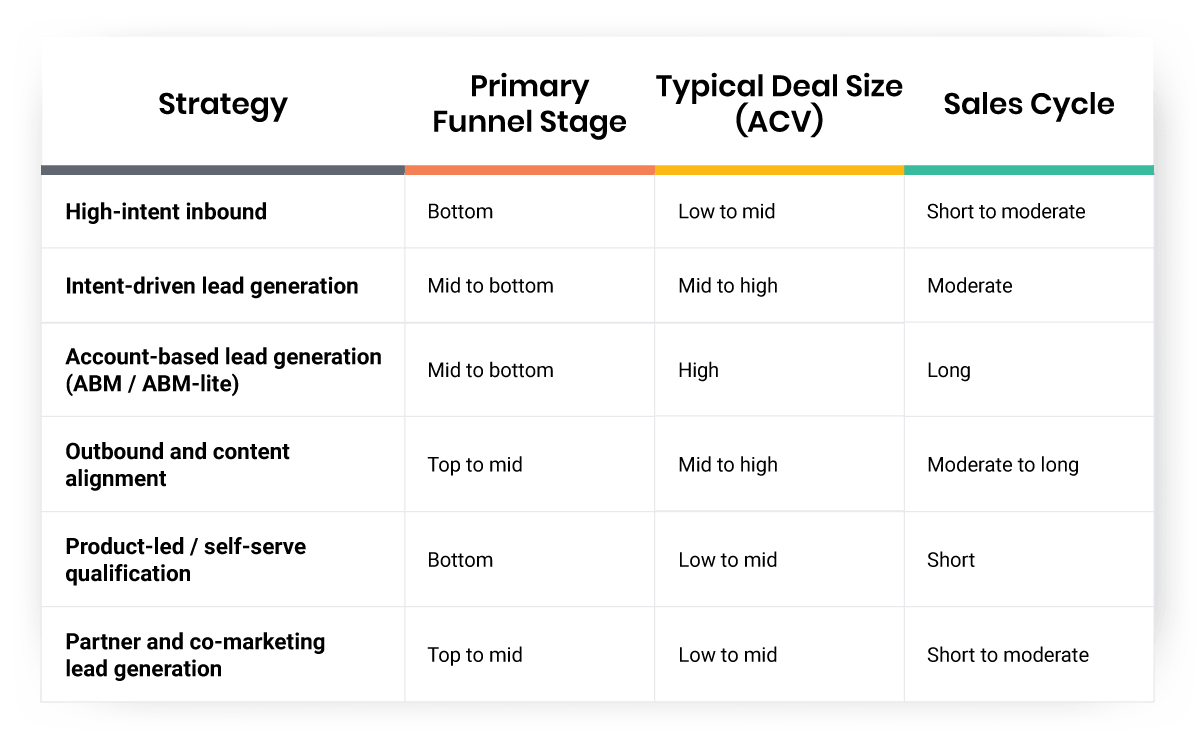
The key takeaway is that successful revenue marketing programs rarely rely on a single tactic. Instead, they combine multiple strategies designed for different stages of the buying journey. Many organizations rely on a structured lead generation system that combines data, targeting, automation, and CRM workflows to convert demand into pipeline. When these tactics are coordinated within an end-to-end B2B lead generation framework, marketing efforts are far more likely to convert demand into qualified opportunities and predictable pipeline.
For a deeper look at how these elements fit together, explore our guide to building an end-to-end B2B lead generation framework and see how it connects strategy, channels, and qualification into a cohesive pipeline engine.
How to Choose the Right Strategy for Your Business
Choosing the right B2B lead generation strategy isn’t about copying what other companies are doing. The strategies that drive real pipeline depend on how your business sells, who you sell to, and how complex the buying process is.
Demand generation leaders who consistently build pipeline start by aligning their lead generation strategies with four core factors: the maturity of their ideal customer profile (ICP), the sales model, the ACV, and the length of the sales cycle.
When those variables are clear, it becomes much easier to prioritize the best B2B lead generation strategies for your organization. Many teams adopt an all-in-one lead generation solution that helps them identify ideal prospects, launch outreach campaigns, and manage their pipeline from one platform.
ICP Maturity: Do You Know Exactly Who Your Best Customers Are?
Many companies launch lead generation strategies for B2B before fully defining their ICP. As a result, campaigns attract a wide range of prospects, many of whom will never become customers.
Organizations with a mature ICP have a clear understanding of:
- Which industries convert best
- What company sizes generate the most revenue
- Which roles typically participate in the buying process
With that insight, marketing teams can design B2B lead generation tactics that target high-fit accounts rather than broad audiences.
Sales Model: Is Your Growth Product-Led or Sales-Led?
Your sales model plays a major role in determining which lead generation strategies will drive results.
Product-led companies often rely on the following to generate pipeline:
- Inbound search
- Self-serve trials
- Product-led qualification
These approaches allow your prospects to experience the value of the product before engaging with sales.
Sales-led organizations, especially those selling complex solutions, typically depend more heavily on:
- Outbound outreach
- Account-based programs
- Targeted content engagement
Understanding this distinction helps align marketing activities with pipeline generation rather than disconnected lead capture.
Average Contract Value (ACV): How Much Revenue is Each Deal Worth?
ACV strongly influences which B2B lead generation strategies make sense for your organization.
Lower ACV offerings often require:
- Scalable inbound programs
- Product-led onboarding
- High-velocity funnels
In these cases, generating a larger volume of qualified leads is necessary to support revenue growth.
Higher ACV solutions, on the other hand, benefit from more focused targeting. When each deal represents significant revenue, strategies like ABM, intent data, and highly personalized outreach often produce stronger pipeline results than broad lead capture.
Sales Length Cycle: How Long Does It Take to Close a Deal?
The length of your sales cycle also determines which lead generation strategies will perform best.
Shorter sales cycles typically align with inbound and product-led approaches where buyers can quickly evaluate solutions.
Longer enterprise sales cycles require sustained engagement across multiple stakeholders. In these environments, coordinated B2B revenue marketing programs—combining outbound outreach, intent signals, and targeted content—help keep deals progressing through the pipeline.
Quick Win
Align your strategy with deal size.
If your average contract value is above $25K–$50K, stop optimizing exclusively for generic inbound leads.
High-value deals rarely come from broad top-of-funnel downloads alone. Instead, prioritize intent-driven targeting, account-based lead generation, and sales-aligned outreach to engage the accounts most likely to convert.]
When these factors are aligned, organizations can build a more effective end-to-end B2B lead generation framework that connects demand creation, qualification, and sales engagement into a single pipeline engine.
How to Measure Whether Your Strategy Is Driving Pipeline

Many marketing teams still evaluate performance using metrics like traffic, downloads, or raw lead volume. While those numbers can indicate campaign reach, they rarely reveal whether your B2B lead generation strategies are truly driving revenue.
Modern demand generation leaders measure success by how effectively marketing contributes to pipeline creation and sales outcomes. That means tracking metrics that connect marketing activity directly to opportunity creation and deal progression.
Below are four metrics that help determine whether your lead generation strategies are producing real pipeline impact.
Marketing-Influenced Pipeline (Pipeline Contribution)
Marketing-influenced pipeline measures how much pipeline marketing programs help create or accelerate. Instead of simply counting leads, this metric evaluates whether marketing activity contributes to opportunities entering the pipeline.
For example, if a prospect engages with content, attends a webinar, or responds to targeted outreach before becoming an opportunity, that activity can be tied to marketing influence.
This metric is critical for understanding how B2B pipeline generation efforts support overall revenue growth. It also helps leadership see the relationship between revenue marketing initiatives and closed deals.
SQL Rate
The SQL rate measures the percentage of marketing-qualified leads that progress to sales-qualified leads. This is one of the clearest indicators of whether your B2B lead generation tactics are attracting real buyers.
- A high SQL rate typically signals that campaigns are reaching the right audience with relevant messaging.
- A low SQL rate may indicate poor targeting, weak qualification criteria, or misalignment between marketing and sales.
For organizations focused on pipeline growth, improving the SQL rate often delivers greater impact than simply increasing lead volume.
Win Rate by Lead Source (Which Channels Generate Customers)
Another critical metric is win rate by source, which is how often opportunities from a specific channel ultimately become customers.
This analysis helps identify which lead generation strategies consistently produce high-value opportunities. For example, you may discover that:
- Inbound demo requests convert into customers at a high rate
- Partner referrals generate strong deal velocity
- Certain paid campaigns create leads but rarely close
Insights like these allow marketing teams to prioritize the best B2B lead generation strategies and reallocate budget toward channels that generate revenue rather than just activity.
Time-to-SQL (Lead Qualification Speed)
Time-to-SQL measures how long it takes for a lead to progress from initial engagement to becoming sales qualified.
Shorter time-to-SQL often indicates stronger intent and better qualification processes. Leads who move quickly through this stage are more likely to represent active buying opportunities.
Monitoring this metric also helps your team understand which lead generation B2B channels accelerate pipeline creation and which ones generate slower-moving prospects that require long-term nurturing.
When these metrics are tracked together, organizations gain a much clearer view of which B2B lead generation strategies contribute to pipeline and revenue.
Conclusion and Next Steps
As we’ve explored, the best lead generation strategies share a few common characteristics. They prioritize:
- Buyer intent
- Alignment between marketing and sales engagement
- Matching the right tactics to the stage of the funnel and the complexity of the deal
Whether that means capturing high-intent inbound searches, leveraging intent signals, running account-based programs, or aligning outbound with valuable content, the goal is always the same: predictable pipeline generation. Many organizations use platforms that help them find new prospects and build targeted lead lists to accelerate this process.
The key is treating these approaches not as isolated lead generation tactics, but as part of a coordinated revenue system. When organizations connect demand creation, qualification, and sales engagement into a unified process, marketing becomes a true driver of B2B revenue marketing performance.
If you want to explore the broader fundamentals behind these approaches, start with our guide to B2B lead generation, which breaks down the full landscape of modern lead generation in B2B markets.
You can also dive deeper into the strategic structure behind these tactics in our article on building an end-to-end B2B lead generation framework, where we outline how high-performing teams turn demand into scalable pipeline.
If you’re ready to turn strategy into pipeline, you can explore Salesgenie® for free and start identifying qualified prospects using verified business and consumer data
FAQs
The best lead generation strategies focus on attracting buyers with real purchase intent rather than generating large volumes of unqualified leads. High-performing approaches include high-intent inbound SEO, intent-driven targeting, ABM, outbound combined with relevant content, product-led trials, and partner or co-marketing programs. These strategies consistently support B2B pipeline generation rather than just MQL growth.
Strategies that capture or identify buyer intent tend to generate the most SQLs. High-intent search content, demo requests, intent data targeting, account-based campaigns, and product-led experiences often convert into SQLs faster because they engage prospects already evaluating solutions.
B2B companies generate high-quality leads by targeting a clearly defined ICP, using intent signals to identify active buyers, and aligning marketing campaigns with sales outreach. Combining multiple lead generation strategies for B2B, such as inbound SEO, ABM, and content-supported outbound, helps attract prospects more likely to become pipeline opportunities.
Lead generation focuses on attracting and capturing potential prospects, often measured by lead volume. Pipeline generation, on the other hand, focuses on creating sales opportunities and qualified deals. Modern B2B revenue marketing programs prioritize pipeline generation because it directly connects marketing efforts to revenue outcomes.
The timeline depends on the strategy and sales cycle. Inbound SEO and content-driven B2B lead generation tactics may take several months to build momentum, while outbound campaigns, intent targeting, and partner programs can generate pipeline opportunities more quickly.
The most important metrics for evaluating B2B lead generation strategies include marketing-influenced pipeline, SQL rate, win rate by lead source, and time-to-SQL. These metrics show whether your lead generation B2B programs are producing real opportunities and contributing to revenue growth.