

B2B lead generation is no longer about collecting as many form fills as possible and handing a spreadsheet to sales. Because buyer behavior has changed, you must identify the right accounts, engage decision-makers across multiple touchpoints, qualify intent with real data, and drive measurable pipeline growth to succeed. In other words, it’s revenue-first.
According to a recent Salesforce study, B2B buyers expect personalized engagement and for sales reps to anticipate their needs. These days, decision-makers conduct independent research, compare vendors anonymously, and expect personalized outreach. If your teams are still optimizing for downloads instead of buying intent, you’ll fall behind your competitors.
This guide will teach you about:
- Proven B2B lead generation strategies that attract and qualify high-intent prospects
- The best-performing channels for reaching decision-makers at the right stage
- Tools that move leads from marketing-qualified leads (MQLs) to sales-qualified leads (SQLs) to pipeline contribution
- Measurement frameworks that tie lead generation directly to revenue performance
Quick Win
Why Most B2B Leads Don’t Convert
Up to 80% of B2B leads never convert to sales.
The most common reasons include:
- Poor qualification criteria
- Misaligned marketing-to-sales handoffs
- Channel mismatch (high volume, low intent sources)
- Incomplete or inaccurate data
- Lack of follow-up speed
Fixing these issues often increases conversion rates faster than generating more leads.
What is B2B Lead Generation (And Why It Needs a Rethink)
B2B lead generation is the process of identifying and attracting businesses that are likely to become customers. But the way many companies generate leads today looks dramatically different from how it worked even five years ago.
The traditional model focused on volume, capturing as many contacts as possible, and pushing them into email nurture sequences. Today’s model focuses on qualification, intent, and revenue contribution. It prioritizes buying readiness over raw lead counts and aligns marketing efforts directly with B2B pipeline growth.
To understand why a rethink is necessary, let’s break down the shift.
Traditional Definition vs. Modern Reality
Traditionally, B2B lead generation strategies revolved around simple conversion mechanics:
- Gated PDFs and white papers
- Webinar registrations
- Trade show badge scans
- Purchased email lists
- Static landing page form fills
The goal was straightforward: collect contact information and pass those leads to sales. The problem? A form fill does not equal buying intent.
Today’s approach considers:
- Intent signals (content consumption, search behavior, third-party activity)
- Buying committee engagement, not just one contact
- Depth of interaction across multiple touchpoints
- Fit, timing, and readiness
The Evolution of B2B Buying Behavior
B2B buying is no longer a straight path. It’s dynamic and self-directed.
Modern buyers typically:
- Do their own research and educate themselves before talking to sales
- Have non-linear buying journeys
- Involve more stakeholders in the decision-making process
- Conduct AI-assisted research to compare vendors, summarize options, and speed up evaluation
Statistic
B2B buyers spend only 17% of their time meeting with vendors during the buying journey.
Lead Generation vs. Demand Generation vs. Revenue Marketing
While they’re closely connected, B2B lead generation, B2B demand generation, and revenue marketing serve different purposes within the growth engine. Understanding how they work together is critical for sustaining your company’s pipeline growth.
Quick definitions:
- B2B lead generation: The process of identifying and attracting businesses that are likely to become customers.
- B2B demand generation: The strategy of creating awareness, interest, and education before buyers are actively looking to purchase.
- Revenue marketing: A data-driven approach that aligns marketing with sales to drive measurable revenue and pipeline impact.
Here’s where each one fits within the funnel:
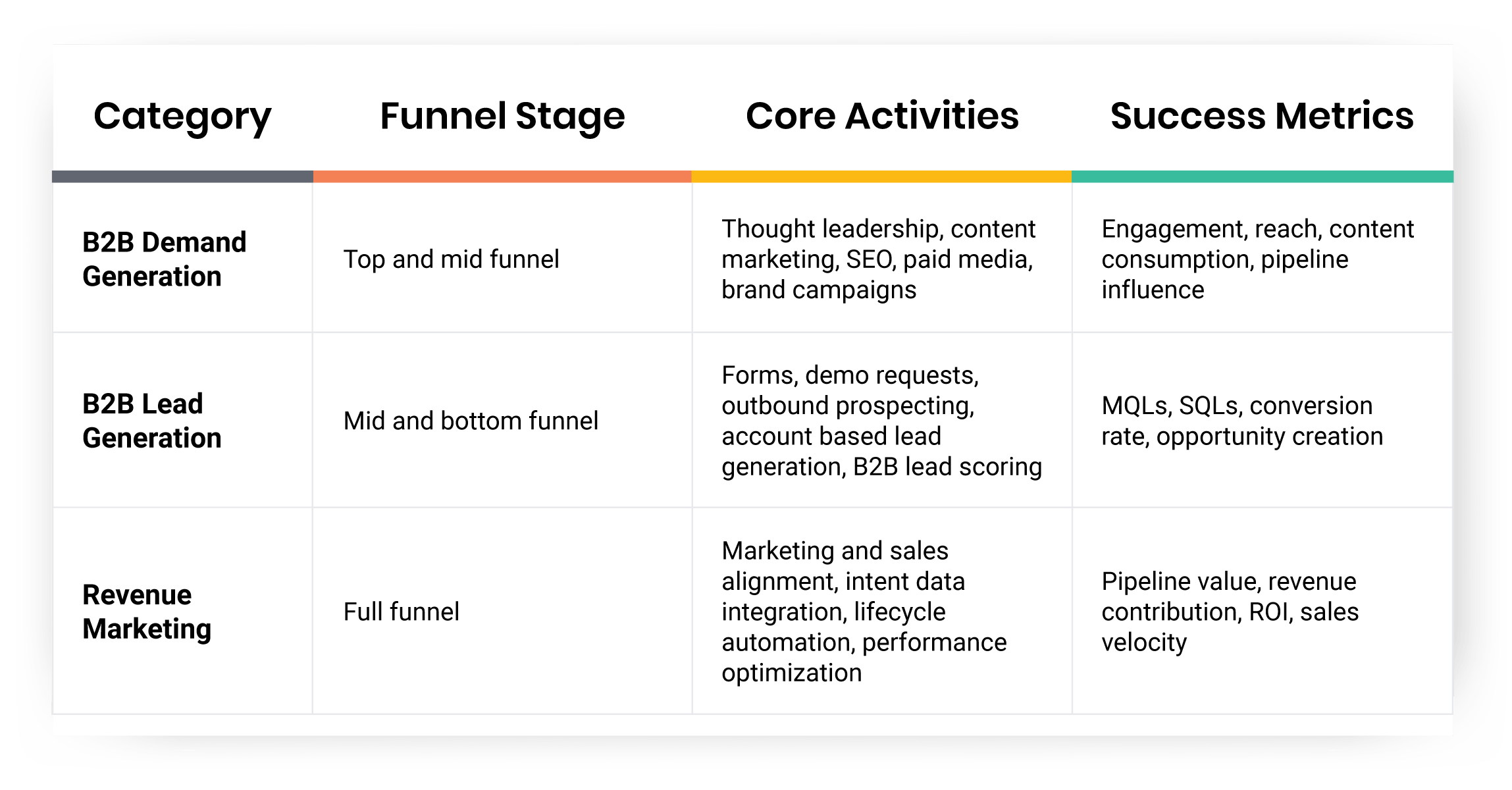
Many companies focus heavily on how to generate B2B leads but overlook demand creation. That’s where quality issues begin.
When demand generation is weak:
- Prospects don’t understand your value proposition
- Buyers download content without real urgency
- Pipeline stalls
Now that we’ve established the key definitions, we’ll walk through the lead lifecycle.
Understanding the B2B Lead Lifecycle (MQL to Revenue)
If you want predictable B2B pipeline growth, you need to fully understand the lead lifecycle.
The B2B lead lifecycle maps how an anonymous visitor becomes revenue. It clarifies ownership, qualification criteria, and performance measurement at every stage. It also creates alignment around the critical transition from MQL to SQL, where many pipelines break down.
Next, we’ll define each core lead stage.
Key Lead Stages Explained
Visitor
- Definition: A visitor is an anonymous individual who interacts with your website, ads, or digital content but has not provided identifying information.
- What it means: Visitors are the starting point of B2B demand generation. At this stage, they may be researching a problem, comparing vendors, or gathering insights. You may track behavior through analytics, but you don’t yet know who they are.
- Primary goal: Convert engagement into identifiable contact information or account-level insight.
Lead
- Definition: A lead is a known contact who has shared identifying information (e.g., filled out a form, subscribed, requested information).
- What it means: This is the entry point for most traditional B2B lead generation strategies. However, not all leads are equal. A downloaded PDF does not automatically indicate buying readiness.
- Primary goal: Qualify fit and engagement to determine next steps.
MQL
- Definition: An MQL is a lead that meets predefined marketing criteria indicating potential sales readiness.
- What it means: An MQL has shown more engagement than a standard lead but is not yet validated by sales. MQL status is typically determined using B2B lead scoring, which evaluates:
- Demographic/firmographic fit
- Behavioral engagement
- Content consumption
- Early intent signals
- Primary goal: Assess whether the lead should be passed to sales for deeper qualification.
SQL
- Definition: An SQL is a lead that sales has reviewed and confirmed as a viable opportunity based on need, authority, timing, and budget.
- What it means: The transition from MQL to SQL is one of the most important points in the lifecycle. This is where marketing qualification meets sales validation. An SQL typically demonstrates:
- Clear business need
- Decision-making influence
- Purchase timeline
- Alignment with your ideal customer profile (ICP)
- Primary goal: Convert into a formal opportunity.
Opportunity
- Definition: An opportunity is a qualified prospect that has entered the active sales pipeline with a defined potential deal value.
- What it means: At this stage, the account is in structured sales conversations. Budget, scope, and timelines are actively discussed. Pipeline forecasting begins here. This stage directly impacts measurable B2B pipeline growth and revenue projections.
- Primary goal: Advance through sales stages toward close.
Customer
- Definition: A customer is a closed-won opportunity, a company that has purchased your product or service.
- What it means: Revenue is realized at this stage, but the lifecycle doesn’t end here. Strong revenue marketing continues through retention, expansion, upsell, and advocacy. Customers can also re-enter the pipeline for:
- Cross-sell
- Upsell
- Renewal
- Expansion
- Primary goal: Drive retention, lifetime value, and advocacy.
What Makes a Qualified Lead in B2B?
In modern B2B lead generation, qualification goes far beyond a downloaded asset or a completed form. A truly qualified lead reflects alignment between your ICP, demonstrated buying intent, and realistic sales readiness. Without clear qualification criteria, the gap between MQL vs. SQL widens and pipeline quality suffers.
Here are the core factors that define a qualified B2B lead:
- Fit (firmographic and technographic): The lead matches your ICP based on company size, industry, revenue, geography, and technology stack.
- Intent (behavioral signals): The lead shows measurable engagement that suggests active research or vendor evaluation.
- Timing (buying stage): The lead is at the right stage in the buying journey.
- Authority and buying group signals: The contact has decision-making influence or is part of a broader buying committee.
Pro Tip
Optimize for lead velocity and conversion to SQL instead of lead volume.
Sales and Marketing Alignment (The Hidden Multiplier)
You can invest in the best B2B lead generation tools, optimize every channel, and refine your targeting, but if sales and marketing aren’t aligned, pipeline performance will stall. Alignment is the multiplier that turns lead volume into revenue impact. Without it, even strong B2B lead generation strategies underdeliver.
Here’s what true alignment requires:
- Shared definitions: Marketing and sales must agree on what qualifies as a lead, an MQL, and an SQL. Clear criteria for MQL vs. SQL prevent premature handoffs and reduce friction. When both teams use the same language and qualification standards, pipeline reporting becomes credible and conversion rates improve.
- Service level agreements (SLAs): SLAs define expectations on both sides, like when marketing passes a lead, how quickly sales must respond, and what follow-up steps are required. Speed-to-lead and follow-up consistency directly impact conversion from MQL to SQL and ultimately affect B2B pipeline growth.
- Feedback loops: Sales must provide structured feedback on lead quality, close rates, objections, and deal outcomes. Marketing then uses this data to refine targeting, messaging, B2B lead scoring, and channel mix. Without feedback loops, optimization becomes guesswork.
So, why do lead gen programs fail here? Many programs focus heavily on how to generate B2B leads but neglect the handoff process. Misaligned definitions, slow follow-up, and poor communication contribute to wasted opportunities and low-quality pipeline.
Next up, we’ll dive into the B2B lead generation strategies that you can start using.
Which B2B Lead Generation Strategies Drive Qualified Pipeline Today?
Effective B2B lead generation is no longer about relying on a single channel or tactic. High-performing organizations build diversified strategies that combine inbound attraction, outbound precision, account targeting, and data-driven qualification.
Below, we break down the core lead generation strategies that can help you consistently drive qualified pipeline growth in today’s buying environment.
Inbound Lead Generation
When executed strategically, inbound remains one of the most sustainable and scalable B2B lead generation techniques. Inbound lead generation is best for mid-to-top-funnel and long-term pipeline content.

SEO-driven content
Search-optimized blog posts, landing pages, and resource hubs designed to rank for high-intent keywords.

Thought leadership
Original insights, industry analysis, and expert commentary that position your brand as a trusted authority.

Educational assets
Guides, webinars, reports, and frameworks that help prospects understand their problem and evaluate potential solutions

Use cases and pain-point content
Real-world examples, case studies, and scenario-driven content that directly address buyer challenges.
Outbound and Sales-Led Lead Generation
While inbound attracts buyers who are already searching, outbound proactively identifies and engages high-value accounts. Outbound and sales-led lead generation is best for high annual contract value (ACV) marketing and enterprise deals.
Below are outbound strategies that can help you reach high-fit accounts faster.

Cold email
Send strategic, personalized emails to targeted prospects based on firmographic fit and intent signals.

LinkedIn outreach
Use LinkedIn to contact decision-makers through connection requests, personalized messages, and content engagement.

ABM-lite motions
Employ a focused version of account-based lead generation that targets a defined list of high-fit accounts without requiring a full enterprise account-based marketing (ABM) program.

Sales Development Representative (SDR) and marketing collaboration
Ensure that SDRs and marketing teams work in sync.
ABM Lead Generation
Traditional B2B lead generation often starts with individuals. ABM flips that model and starts with companies. In fact, according to a study by Momentum and ITSMA, ABM strategies have helped up to 84% of companies with pipeline growth.
Core components of ABM lead generation include:
- Target account selection: This involves analyzing firmographic fit (industry, revenue, size), technographic data (existing tools or platforms), historical performance, and predictive signals.
- Buying group engagement: ABM focuses on engaging the entire buying committee instead of a single contact. That includes economic buyers, technical evaluators, end users, and executive sponsors.
- Personalized content and ads: ABM relies on tailored messaging aligned to specific accounts or industries. This can include personalized landing pages, customized email sequences, account-specific ad campaigns, and role-based messaging.
Product-Led and Self-Serve Lead Gen
As B2B buying becomes more independent and research-driven, many companies are shifting toward product-led growth models to reduce friction, demonstrate value early, and qualify based on real behavior.
Try implementing these strategies:

Free trials
Offering time-limited access to your product allows prospects to evaluate functionality in their own environment.

Freemium models
A freemium approach provides ongoing access to a limited version of the product, encouraging adoption and internal sharing.

Usage-based qualification
Metrics such as feature usage, frequency, team invitations, and integration activity signal stronger buying intent and can help you determine prospect readiness.
Intent-Driven Lead Generation
Not all engagement signals are equal. Modern B2B lead generation strategies increasingly rely on intent data to separate casual interest from active buying behavior. Instead of waiting for a form submission, intent-driven models identify which accounts are researching solutions, comparing vendors, or entering evaluation mode.
Core components include:
- First-party intent: Behavioral signals captured on your own digital properties. This includes repeat website visits, high-value page views (pricing, product comparisons), demo requests, webinar attendance, and engagement with sales emails.
- Third-party intent: Behavioral insights gathered from external networks, publishers, or data providers that show which companies are researching relevant topics across the web. Third-party B2B intent data helps identify in-market accounts before they visit your website, enabling proactive outreach and stronger ABM lead generation efforts.
- Predictive signals: Machine learning models that analyze historical deal data to identify patterns among closed-won customers. Predictive scoring evaluates firmographics, technographics, engagement levels, and buying signals to forecast which accounts are most likely to convert.
- Content consumption patterns: The type, depth, and sequence of content engagement often reveal buying stage. For example, trend-focused blog posts signal early awareness, while product comparison guides and ROI calculators indicate evaluation.
In the next section, we’ll explore which B2B lead generation channels will best suit your specific needs.
Best B2B Lead Generation Channels (What to Use and When)
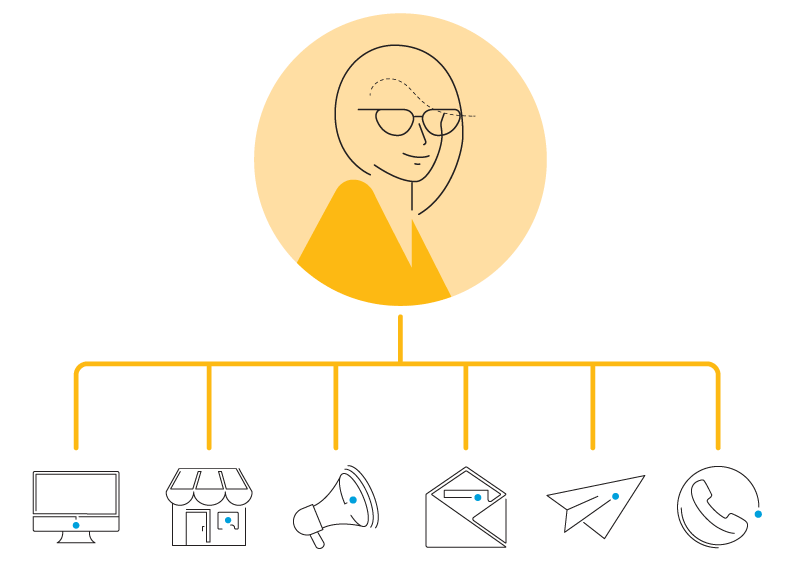
Not every channel works equally well at every stage of the buying journey. The most effective lead generation strategies align channels with buyer intent, funnel stage, and revenue goals. The key is knowing which strategies to use and the best time to use them.
Below, we break down common lead generation channels and how they support demand, qualification, and pipeline growth.
Content Marketing
Content marketing is one of the most scalable and sustainable B2B lead generation channels. When mapped correctly to search intent and buyer stage, content attracts, educates, qualifies, and converts prospects throughout the funnel.
Here’s how different content types can support lead generation efforts:
- Blogs, guides, and pillar pages: These assets drive organic visibility and support early-stage demand generation.
- Comparison pages: These pages often signal strong commercial intent and are powerful for improving conversion rates.
- Bottom–of-funnel (BOFU) content (pricing, demos, alternatives): BOFU assets are designed for decision-ready prospects.
SEO and Organic Search
Search remains one of the highest-intent B2B lead generation channels available. When prospects search for solutions, comparisons, or pricing, they’re often deep into evaluation. That makes SEO both a great traffic strategy and revenue driver.
Key components include:
- High-intent keywords: Ranking for high-intent queries increases the likelihood of attracting SQL-ready traffic.
- Topic clusters: Organizing content into interconnected pillar pages and supporting articles builds authority and improves search visibility.
- Programmatic SEO: Creating scalable, template-driven pages can expand reach across long-tail queries.
- Content for AI answers: Clear definitions, comparison tables, short “Quick Answer” sections, and structured headings increase visibility in AI summaries and featured snippets.
Quick Win
For the highest SQL intent, create mid-to-bottom funnel pages like “comparisons” and “alternatives”.
Paid Media
While SEO and content build long-term equity, paid channels allow you to capture high-intent demand immediately and amplify targeted outreach. When aligned with strong qualification criteria and clear B2B lead scoring, paid media can accelerate movement from MQL to SQL and directly support pipeline growth.
Key paid media channels include:
- Google search ads: One of the highest-intent lead generation channels, search ads target prospects actively looking for solutions, potentially driving strong SQL conversion rates.
- LinkedIn ads: LinkedIn allows more precise targeting by role, seniority, company size, industry, and account list, making it especially effective for account-based lead generation.
- Retargeting: Retargeting re-engages visitors who previously interacted with your website, ads, or content, often delivering higher conversion rates than cold traffic.
- Intent-based advertising: Using intent data, marketers can serve ads specifically to accounts actively researching relevant topics across third-party platforms, ultimately improving efficiency.
Email Marketing and Lead Nurturing
Email remains one of the most effective lead generation channels for B2B because it nurtures and qualifies existing interest. When structured around behavior and buying stage, email becomes a powerful bridge between MQL and SQL.
Key components include:
- Behavioral triggers: Automated emails triggered by specific actions signal relevance and timeliness, often outperforming generic campaigns due to directly responding to a prospect’s intent.
- Role-based personalization: Personalizing by role increases engagement and supports more accurate lead scoring.
- Buying-stage segmentation: Segmenting by buying stage improves relevance and accelerates movement toward SQL.
Social and Community
Social media is often underestimated as a B2B lead generation channel, but its influence on buyer perception and pipeline creation is significant, especially in research-heavy, committee-driven sales cycles. While social media doesn’t always generate direct form fills, it shapes trust, credibility, and brand familiarity long before a demo request.
Key elements include:
- LinkedIn organic: Posting educational insights, industry commentary, and use-case breakdowns builds authority and keeps your brand visible during self-serve research. Consistent engagement also supports outbound efforts by warming up target accounts before direct outreach.
- Founder-led content: Content shared directly by founders or executives often outperforms brand pages in reach and engagement. Personal profiles create authenticity and trust, which can influence buying committees evaluating multiple vendors.
- Dark social impact: Content sharing via Slack, email forwards, and direct messages, also called “dark social interactions”, are difficult to track yet highly influential. It increases the likelihood that your brand enters internal buying discussions, even if attribution data doesn’t fully capture it.
Webinars, Events, and Virtual Experiences
Live and virtual are powerful lead generation channels because they create real-time engagement. Unlike static content, events allow prospects to interact, ask questions, and evaluate expertise directly. When aligned with clear qualification criteria, webinars and events can generate high-intent leads and accelerate movement toward SQL.
To maximize impact, focus on the following approaches:
- Co-marketing: Partnering with complementary brands expands reach, introduces your solution to new audiences, increases credibility, and drives higher registration rates.
- Product-led demos: Live demonstrations that showcase real use cases and workflows attract prospects closer to purchase, leading to stronger intent signals.
- Educational series: Multi-session webinar series or themed event tracks build sustained engagement to help you identify buying-stage progression based on attendance patterns and participation depth.
To put these strategies into practice, the right tools and technology can improve execution and measurement.
B2B Lead Generation Tools and Tech Stack
To streamline your strategy, lead generation tools should be able to help you automate tasks, improve qualification accuracy, accelerate handoffs, and connect marketing activity directly to revenue outcomes. A well-structured tech stack supports every stage of the lifecycle, from first interaction to closed-won customer.
Below, we break down the core tool categories that enable scalable, measurable B2B pipeline growth, starting with how leads are captured and converted.
Lead Capture and Conversion
The first step in any lead generation strategy is turning anonymous traffic into known prospects. Lead capture tools determine how effectively you convert interest into identifiable, actionable leads.
Key components include:
- Forms: Landing page and embedded forms remain foundational for capturing contact data. Optimized forms balance information collection with friction reduction, while progressive profiling improves data quality without sacrificing conversion rates.
- Chatbots: Website chatbots provide real-time engagement, answer common questions, and route prospects to appropriate resources. When connected to customer relationship management (CRM) and automation platforms, chatbots can qualify visitors based on company fit and intent signals.
- Conversational Marketing: More advanced than static chat, conversational marketing tools enable dynamic, personalized interactions. These tools can schedule meetings, segment visitors, and tailor messaging based on role or buying stage.
- Interactive Content: ROI calculators, assessments, quizzes, and configurators can increase engagement while capturing high-value data. Interactive experiences often reveal stronger buying intent than static downloads and can feed directly into B2B lead scoring
Marketing Automation Platforms
Marketing automation platforms are the engine behind scalable B2B lead generation. They connect lead capture, nurturing, scoring, and lifecycle tracking into a single system. Without automation, it’s nearly impossible to manage segmentation, behavioral triggers, and MQL-to-SQL transitions at scale.
Here are four widely used marketing automation platforms:
- HubSpot: A popular all-in-one platform combining CRM, marketing automation, content management, and sales tools. HubSpot is known for ease of use, strong inbound capabilities, and integrated reporting. It’s often favored by growing teams looking to align B2B lead generation strategies with sales execution.
- Marketo (Adobe Marketo Engage): A robust, enterprise-focused automation platform with advanced segmentation, personalization, and analytics capabilities. Marketo excels in complex lifecycle management, detailed lead scoring, and multi-channel orchestration.
- Pardot (Marketing Cloud Account Engagement): Built for Salesforce users, Pardot integrates tightly with Salesforce CRM. It supports automated nurturing, ROI reporting, and alignment between marketing and sales teams, making it well suited for organizations prioritizing pipeline attribution and forecasting.
- customer.io: A flexible automation platform focused on behavioral messaging across email, push, and in-app channels. It’s often used by product-led organizations that want to combine usage data with lifecycle communication to improve qualification and engagement timing.
CRM and Sales Intelligence
If marketing automation manages engagement, the CRM is where revenue lives. CRM and sales intelligence tools track interactions, manage opportunities, enrich contact data, and provide visibility into pipeline growth. Without a strong CRM foundation, even the best lead generation strategies struggle to convert into measurable revenue.
Below are some commonly used CRM and sales intelligence platforms:
- Salesgenie®: A prospecting and business data platform designed to help sales and marketing teams identify targeted business contacts. Salesgenie supports segmentation by industry, geography, and company attributes, helping teams focus on high-fit accounts.
- Salesforce: One of the most established enterprise CRMs, Salesforce provides deep customization, opportunity tracking, pipeline reporting, and integration across marketing and sales tools. It’s commonly used to manage lifecycle stages from MQL to SQL to closed-won.
- HubSpot CRM: A user-friendly CRM often paired with HubSpot’s marketing automation tools. It supports contact management, deal tracking, and sales automation, making it popular among growing B2B teams looking for integrated lifecycle visibility.
- ZoomInfo: A B2B data and sales intelligence platform that provides firmographic, technographic, and contact-level insights. ZoomInfo helps sales teams identify target accounts, validate data accuracy, and leverage B2B intent data to prioritize outreach.
- Apollo: A sales intelligence and engagement platform combining contact data, sequencing tools, and analytics. Apollo supports outbound prospecting, enrichment, and performance tracking within lead generation channels.
- Clearbit: A data enrichment platform that enhances contact and account records with firmographic and technographic details. Clearbit improves segmentation accuracy and strengthens lead scoring models by filling data gaps automatically.
Learn more: Best CRMs for B2B Sales Teams in 2026
Intent and Data Enrichment Tools
Intent and enrichment platforms help answer one critical question in modern B2B lead generation: “Who is actually in-market right now?” Instead of waiting for a form fill, these tools surface behavioral signals across the web and enhance your existing CRM data to improve prioritization and qualification.
Here are some popular intent and enrichment platforms to explore:
- Bombora: Bombora provides third-party B2B intent data based on content consumption across a large publisher network. It identifies companies showing increased research activity around specific topics, helping marketing and sales prioritize accounts demonstrating active interest.
- 6sense: A predictive revenue platform that combines intent data, AI-driven modeling, and account analytics. 6sense helps teams identify buying stage, prioritize accounts, and orchestrate targeted campaigns. It’s often used to support advanced revenue marketing and enterprise ABM strategies.
- Demandbase: An account-based marketing platform that integrates firmographic data, intent signals, and advertising capabilities. Demandbase enables targeted engagement of high-value accounts and supports full-funnel visibility from awareness to opportunity creation.
- G2 Buyer Intent: G2 provides intent insights based on user activity across its review platform. When companies research specific categories, competitors, or solution comparisons on G2, those signals can indicate late-stage evaluation behavior.
Pro Tip
While these tools can be immensely helpful, they don’t fix lead quality. Only your strategy and scoring models can.
Next, we’ll take a look at best practices for lead scoring, qualification, and routing.
Lead Scoring, Qualification and Routing Best Practices
Generating leads is only half the equation. The real impact of B2B lead generation depends on how effectively those leads are scored, qualified, and routed to sales. Without structured scoring and clear routing logic, high-intent prospects get delayed follow-up, while low-fit contacts consume sales time.
Below, we break down the models that make pipeline growth possible.
Lead Scoring Models
Simply put, lead scoring assigns value to prospects based on fit and engagement. A well-designed scoring model helps determine when a lead is ready to move from marketing ownership to sales review.
Core scoring approaches include:
- Explicit vs. implicit scoring: Explicit scoring evaluates who the lead is—firmographic and demographic data such as company size, industry, job title, and seniority. Implicit scoring evaluates what the lead does—website visits, content downloads, email engagement, demo requests, and other behavioral signals.
- Behavioral weighting: Not all actions carry equal value. Visiting a blog post should not score the same as viewing pricing or requesting a demo. Behavioral weighting assigns higher scores to high-intent activities and lower scores to early-stage engagement.
- AI-assisted scoring: Advanced platforms use machine learning to analyze historical deal data and identify patterns among closed-won opportunities. AI-assisted models continuously refine scoring thresholds based on real outcomes, improving prediction accuracy and reducing manual bias.
MQL to SQL Handoff
The transition from MQL to SQL is one of the most critical points in the B2B lead lifecycle. Even strong lead generation strategies can underperform if handoffs are slow, unclear, or inconsistent. This stage determines whether marketing-driven interest turns into active pipeline or stalls in limbo.
To optimize MQL-to-SQL conversion, focus on the following best practices:
- Routing logic: Leads should be assigned automatically based on predefined criteria such as territory, industry, company size, or account ownership.
- Speed-to-lead benchmarks: Response time directly impacts qualification outcomes. The faster a sales SDR engages a qualified lead, the higher the likelihood of conversion.
- SDR enablement: Sales teams need context to convert effectively. Marketing should pass along engagement history, content consumption patterns, firmographic data, and intent data signals.
Statistic
Leads contacted within five minutes are dramatically more likely to engage. In fact, waiting just 30 minutes instead of five makes you 100 times less likely to reach the lead.
Wondering if your lead generation strategy is working? The next section discusses important metrics you should consider.
How to Measure B2B Lead Generation Success (Metrics That Matter)
Measuring the wrong things can be just as dangerous as measuring nothing at all, and in modern B2B lead generation, success isn’t defined by volume alone. The difference between high-performing and underperforming teams often comes down to which metrics they prioritize.
Below, we separate surface-level indicators from the metrics that truly drive B2B pipeline growth.
Vanity Metrics vs. Revenue Metrics
Not all performance indicators carry equal weight. Some metrics look impressive in dashboards but have little correlation to revenue outcomes. Others directly reflect qualification quality and sales impact.
Here’s how to tell the difference:
- Leads vs. pipeline: Total leads generated can indicate campaign reach, but pipeline value shows actual revenue potential. A high lead count with low opportunity creation signals weak qualification.
- CTR vs. conversion rate: Click-through rate (CTR) measures ad or email engagement, but it doesn’t guarantee meaningful action. Conversion rate, such as demo requests or booked meetings, better reflects buying intent.
- MQLs vs. SQLs: MQLs represent initial qualification, but SQLs reflect validated opportunity potential. If MQL volume rises while SQL conversion remains flat, there’s a disconnect in scoring or targeting.
KPIs for Demand Gen Leaders
Demand generation leaders are increasingly measured on revenue contribution, so your tactics must demonstrate impact on pipeline creation, deal progression, and customer acquisition efficiency.
The following KPIs connect marketing efforts directly to business outcomes:
- Cost per SQL: This measures how much it costs to generate an SQL, not just a lead or MQL. Because SQLs reflect validated opportunity potential, cost per SQL is a stronger indicator of quality and efficiency within your lead generation strategies.
- Pipeline influenced: Pipeline influenced tracks the total value of opportunities where marketing contributed to engagement or progression. This metric highlights marketing’s role across the full buyer journey and supports a broader revenue marketing view of impact.
- Pipeline velocity: Pipeline velocity measures how quickly opportunities move from initial engagement to closed-won. It accounts for deal size, win rate, and sales cycle length. Faster velocity indicates strong alignment, better qualification, and effective MQL-to-SQL handoffs.
- Customer acquisition cost (CAC) payback period: CAC payback calculates how long it takes to recover the cost of acquiring a new customer. This metric combines marketing and sales investment with revenue outcomes, offering leadership a clear view of acquisition efficiency and growth sustainability.
Attribution and Reporting Models
In complex B2B sales cycles, a single touchpoint rarely drives a deal. Buyers interact with multiple lead generation channels, such as content, ads, webinars, outbound outreach, before becoming an opportunity. Attribution models help determine which efforts contribute to pipeline creation and revenue.
Key attribution approaches include:
- First-touch attribution: This model gives 100% credit to the first interaction that introduced the lead to your brand. It’s useful for understanding which channels drive initial awareness and fuel B2B demand generation, but it overlooks the influence of later-stage engagement.
- Multi-touch attribution: Multi-touch models distribute credit across several interactions in the buyer journey. This approach provides a more accurate picture of how different lead generation strategies work together to create opportunities.
- Revenue attribution: Revenue attribution connects marketing and sales activities directly to closed-won deals. Instead of focusing only on lead creation, it measures how campaigns influence pipeline value and revenue outcomes. This model supports a true revenue marketing framework by aligning reporting with financial impact.
Of course, no lead generation strategy is perfect. Let’s explore common challenges and how you can properly address them.
Common B2B Lead Generation Challenges (And How to Fix Them)
Even well-funded, well-staffed teams struggle with B2B lead generation. Common challenges include alignment, qualification, and measurement issues that cause performance to stall.
Below are the most common issues in lead generation strategies, along with practical ways to correct them.
Low-Quality Leads
The problem: You’re generating volume, but conversion to SQL and opportunity is weak.
Why it happens: Targeting is too broad, scoring thresholds are too low, or campaigns prioritize traffic over intent.
How to fix it: Refine your ICP, strengthen lead scoring with behavioral weighting, and incorporate intent data to prioritize in-market accounts. Shift optimization from cost per lead (CPL) to cost per SQL.
Sales Rejecting MQLs
The problem: Marketing passes leads, but sales doesn’t accept or follow up consistently.
Why it happens: There are no shared MQL vs. SQL definitions, or qualification criteria lack real buying signals.
How to fix it: Create shared definitions, establish SLAs, and implement structured feedback loops. Align scoring criteria with real closed-won data to ensure MQLs reflect sales-ready opportunities.
High CPL
The problem: Paid channels are driving up acquisition costs without improving pipeline value.
Why it happens: Campaigns focus on top-of-funnel reach instead of high-intent segments.
How to fix it: Shift budget toward high-intent keywords, retargeting audiences, and account-based targeting. Measure cost per SQL and pipeline generated to evaluate efficiency accurately.
Long Sales Cycles
The problem: Deals take too long to close, slowing pipeline growth.
Why it happens: Leads are handed off too early, buying committees aren’t fully engaged, or educational gaps remain unresolved.
How to fix it: Improve qualification before handoff, track buying group engagement, and use stage-specific content to accelerate evaluation. Product-led demos and intent-based prioritization can also reduce delays.
Attribution Confusion
The problem: Teams disagree on which channels are driving revenue.
Why it happens: Overreliance on first-touch attribution or disconnected reporting systems.
How to fix it: Implement multi-touch or revenue attribution models that reflect the full buyer journey. Integrate CRM and marketing automation data to create shared visibility across teams.
So, where does B2B lead generation go from here?
What Does the Future of B2B Lead Generation Look Like?
B2B lead generation is becoming more intelligent, more automated, and more predictive. As buying journeys grow more complex and data volumes expand, manual qualification and broad targeting are no longer enough. The future belongs to teams that use AI and predictive technology to identify intent earlier, personalize engagement at scale, and optimize pipeline performance in real time.
Below, we explore how artificial intelligence is reshaping current lead generation strategies.
AI and Predictive Lead Generation
Artificial intelligence is moving lead generation from reactive to proactive. Instead of waiting for a form fill, AI analyzes behavioral signals, historical deal data, and engagement patterns to predict which accounts are most likely to convert.
Key advancements include:
- AI scoring: Traditional lead scoring relies on static rules and manually assigned weights, but AI-driven scoring models continuously analyze historical opportunity data to identify patterns among closed-won deals. These models adapt over time, improving MQL-to-SQL accuracy and prioritizing leads with the highest revenue potential.
- AI personalization: AI enables dynamic content and messaging tailored to role, industry, company size, and buying stage. Instead of one-size-fits-all nurture campaigns, AI-powered personalization adjusts subject lines, recommendations, landing page content, and offers in real time.
- Conversational AI: Advanced chatbots and virtual assistants can qualify visitors, answer complex product questions, schedule meetings, and route leads automatically. Unlike static forms, conversational AI captures intent signals during real-time interactions and supports faster movement into the sales pipeline.
Privacy-First Lead Generation
As data regulations tighten and third-party tracking declines, lead generation is entering a privacy-first era. Marketers can no longer rely on unlimited tracking, third-party cookies, or opaque data collection practices. The future of sustainable lead generation strategies will be built on transparency, consent, and high-quality first-party data.
Key shifts shaping this evolution include:
- Cookie deprecation: With third-party cookies being phased out, cross-site tracking and audience targeting are becoming more limited. This change forces marketers to rethink retargeting strategies and dependency on anonymous behavioral tracking. As a result, stronger emphasis is placed on direct engagement, contextual targeting, and owned-channel relationships.
- First-party data: First-party data is becoming increasingly valuable. Unlike third-party data, it is consent-based and highly reliable. Investing in better data capture, enrichment, and lifecycle tracking strengthens both lead scoring and long-term pipeline visibility.
- Trust-led marketing: Privacy-first environments reward brands that prioritize transparency and value exchange. Clear data usage policies, relevant content, and meaningful personalization build credibility. In complex buying decisions, trust significantly influences buying committees and long sales cycles.
Buying Group and Revenue-Centric Models
The future of lead generation is moving beyond individual contacts and even beyond marketing-owned metrics. The shift that defines this model is from leads to accounts to revenue teams.
Traditional lead generation focused on individuals filling out forms, but current strategies prioritize accounts as the core unit of measurement, recognizing that six to ten stakeholders often influence purchase decisions. This shift supports account-based lead generation, where engagement is tracked across multiple roles within a company instead of a single contact.
At the same time, organizations are evolving from separate marketing and sales departments into integrated revenue teams. These teams share pipeline goals, qualification standards, and performance metrics. Instead of measuring marketing by MQL volume and sales by closed deals, revenue-centric models align both around opportunity creation and pipeline growth.
Actionable B2B Lead Generation Playbook (Step-by-Step)
The most effective B2B lead generation strategies follow a structured, repeatable framework that connects targeting, content, channels, and measurement to revenue outcomes.
Below is a practical, step-by-step playbook you can use to build (or refine) a scalable, revenue-focused B2B lead generation engine.
Define Your ICP and Buying Groups
Start with clarity. Your ICP defines which companies are the best fit based on firmographics (industry, revenue, size), technographics (technology stack), and strategic alignment. But in modern B2B environments, defining the company isn’t enough. You also need to map the buying group.
Identify:
- Economic buyers
- Technical evaluators
- End users
- Executive sponsors
This foundation strengthens account-based lead generation, improves targeting precision, and ensures your lead scoring model reflects real decision-making dynamics.
Need help creating your ICP? Use our downloadable ICP worksheet to get started.
Map Intent to Content
Not all content serves the same purpose, so map buyer intent signals to the appropriate content type:
- Early-stage research: Educational blogs and guides
- Mid-stage evaluation: Comparison pages and case studies
- Late-stage decision: Pricing pages, demos, ROI calculators
Following this alignment supports both demand generation and qualification.
Choose Channels by Funnel Stage
Different lead generation channels perform better at different stages of the buyer journey:
- Top of funnel: SEO, thought leadership, LinkedIn organic
- Mid funnel: Retargeting, webinars, email nurturing
- Bottom of funnel: Google Search ads, demo campaigns, ABM outreach
Instead of spreading budget evenly, allocate resources based on where each channel drives the strongest pipeline impact.
Align Sales and Marketing
Even strong campaigns fail without alignment, so you should establish the following:
- Shared MQL vs. SQL definitions
- Clear routing logic and SLAs
- Feedback loops between SDRs and marketing
You can reduce friction, improve conversion rates, and ensure lead generation translates into measurable pipeline growth with this alignment.
Measure What Converts to Revenue
Finally, shift your focus from activity metrics to revenue metrics by tracking:
- Cost per SQL
- MQL-to-SQL conversion rate
- Opportunity creation rate
- Pipeline value generated
- Revenue attribution
When reporting centers on pipeline and revenue, your strategy becomes accountable and scalable.
Key Takeaways
Successful B2B lead generation depends on more than filling the funnel. To drive qualified pipeline and measurable revenue impact, your strategy should prioritize lead quality, cross-functional alignment, and the right mix of channels, tools, and performance metrics.
With that said, let’s review the key points we’ve discussed in this article:
- B2B lead generation is most effective when it focuses on revenue impact, not just lead volume. A large number of contacts means little if they never convert into qualified opportunities or pipeline.
- High-quality leads come from the right mix of ICP fit, buying intent, timing, and buying-group engagement, not just a single form fill or content download.
- The strongest B2B lead generation strategies combine inbound, outbound, ABM, and intent-driven tactics to reach decision-makers across multiple touchpoints.
- Sales and marketing alignment is essential for improving MQL-to-SQL conversion, strengthening handoffs, and increasing pipeline performance.
- The right channels and tools should support lead qualification, routing, and revenue visibility, helping teams move faster and make smarter decisions.
- Measuring success requires a focus on revenue-based metrics like cost per SQL, conversion rates, pipeline influenced, and revenue attribution instead of vanity metrics alone.
- Future-ready lead generation depends on smarter data use, stronger personalization, privacy-first practices, and account-level engagement.
Ready to turn better targeting and data into more qualified opportunities? Register for Salesgenie today to start finding the right prospects, building smarter lists, and powering more effective B2B lead generation.
FAQs
B2B lead generation is the process of identifying, attracting, and qualifying businesses that are likely to purchase your product or service. Modern B2B lead generation focuses on intent, buying group engagement, and moving prospects from MQL to SQL to revenue.
The most effective lead generation strategies combine inbound content, outbound outreach, account-based targeting, and intent-driven prioritization. High-performing teams align these efforts with sales and optimize for pipeline creation rather than lead volume alone.
High-quality B2B leads come from targeting the right ICP, using intent data, applying structured lead scoring, and aligning content to buying stage.
High-intent channels such as SEO for commercial keywords, Google Search ads, retargeting, and account-based outreach often produce the strongest SQL conversion rates. The best channel depends on funnel stage and alignment with your ideal customer profile.
Paid and outbound campaigns can generate results within weeks, while SEO and content marketing may take several months to build momentum. Sustainable B2B pipeline growth typically requires consistent execution over one to two sales cycles.
Effective stacks typically include a CRM (e.g., Salesforce or HubSpot), marketing automation platforms (e.g., HubSpot, Marketo), intent data tools (e.g., Bombora, 6sense), and sales intelligence platforms (e.g., Salesgenie, ZoomInfo). The best tools support scoring, routing, and revenue attribution.
Measure ROI by tracking cost per SQL, opportunity creation rate, pipeline influenced, revenue attribution, and CAC payback. Focusing on revenue metrics rather than vanity metrics ensures marketing performance aligns with business outcomes.