

Most sales teams reflexively reach for more channels or higher volume when prospecting momentum slows. But the real drag isn’t a lack of options—it’s the cumulative friction that quietly builds up between data pulls, sequence setup, and first conversations.
Every skipped contact verification, every extra click between systems, every unlogged call outcome—they all compound into a slower time-to-first-conversation. And in a world where buyers give sellers tiny windows to earn their attention, every delay puts meetings at risk.
This article shows you how to spot and eliminate the friction slowing down your prospecting motion, so you can generate more conversations without adding more activity.
What Actually Slows Down B2B Prospecting?
Start by tracing one net-new meeting back to the first list pull. Document every step, every role involved, and every tool used. Wherever two or more systems require coordination, assume a speed bump exists. Wherever data moves between formats, look for inconsistencies and missing fields.
Those small handoffs add up to a major drain on rep time—and results. The good news is that small, systematic improvements in data accuracy, workflow design, and real-time intelligence can reverse the trend. The key is to shift the mindset from “we need more options” to “we need cleaner execution.”
Pro Tip
Track your “speed-to-first-live-conversation” for every rep, every week. If there’s more than a 10% variance across the team, you likely have an execution gap to fix before expanding.
Data-To-Dial Gaps
One of the most common friction points in B2B prospecting is the gap between your data and your dialer. Think about what happens when a rep goes to call a prospect and runs into one of these issues:
- The phone number is missing or incorrect
- No extension is listed, forcing navigation through a phone tree
- The contact’s title is out of date
- Duplicate records exist in the CRM
Each of these disconnects forces the rep to stop, investigate, and course-correct. They may need to search for the right information, update the record, or reschedule the call entirely. That’s not just a one-time inconvenience—it’s a context switch that breaks focus and disrupts momentum.
Now imagine that happening dozens of times a day across your team. Those small delays quickly add up to significant lost time and missed opportunities.
The good news: these data-to-dial gaps are preventable. By investing in data quality upfront—verifying contact information, enriching records with direct dials and extensions, and de-duping your CRM—you can remove those friction points and keep reps focused on what they do best: having meaningful conversations with prospects.
Moment-Of-Conversation Drag
Even when you get a prospect on the phone, friction doesn’t stop. Reps who lack context waste the first 30 seconds of every call re-establishing who they are, why they’re calling, and what the prospect cares about.
That’s why real-time intelligence matters. When reps can see recent website visits, content downloads, or job changes before they dial, they can open with relevance instead of guesswork. The conversation starts faster, and the prospect stays engaged longer.
Where Does Data Quality Create Hidden Drag?
Bad data doesn’t just slow down dials—it distorts your entire prospecting strategy. When your CRM is full of outdated titles, incorrect industries, or duplicate records, your segmentation falls apart. You end up sending the wrong message to the wrong person at the wrong time.
The hidden cost shows up in three places:
- Wasted outreach: Reps spend time contacting people who left the company months ago or never had buying authority in the first place.
- Broken personalization: Automated sequences reference the wrong role, company size, or pain point, making your outreach feel generic and spammy.
- Misallocated effort: Your best reps chase low-fit accounts while high-intent prospects sit untouched in the queue.
The fix isn’t a one-time data cleanse. It’s an ongoing commitment to verification, enrichment, and hygiene. Build data quality checks into your workflow so bad records never make it to your reps’ queues in the first place.
Why More Channels Don’t Fix the Problem
When prospecting starts to lose momentum, it’s tempting to think the answer is more. More outreach, more channels, more activity. If one email sequence doesn’t get the job done, then five sequences across email, social, and text should do the trick, right?
Not so fast.
Adding more channels to an already fragile prospecting motion is like building a house on a shaky foundation. It might look impressive at first, but underneath it’s unstable—and likely to break down quickly.
Every new channel comes with added complexity. You need new content, new workflows, new skills, and new ways to keep everything coordinated and compliant. If you’re already struggling with data quality or process efficiency in your main channel, adding more channels will only amplify those problems.
Imagine a team that has email outreach dialed in. Their messaging is tight, their data is reliable, and their follow-up process consistently turns prospects into conversations. Now compare that to a team spreading effort across multiple channels—a few emails, some LinkedIn touches, maybe a text or two. Even with higher activity, their results are inconsistent.
That’s because consistency beats volume. When you focus on optimizing one channel, you can identify what’s working, fix what’s not, and build a repeatable process that drives results. Once that foundation is solid, then you can expand into other channels with intention.
Before chasing new outreach trends, take a hard look at your primary channel. Are you generating predictable, measurable results? Can your reps move from first touch to conversation quickly and consistently? If not, doubling down on execution in one channel will have far more impact than spreading yourself thin across several.
Is Cold Calling Still Effective in B2B Prospecting?
The short answer: it depends on your market, your message, and your timing. Cold calling isn’t dead, but it’s also not a universal solution. The real question is whether the phone is the right first touch for your specific audience.
When Phone-First Wins
Cold calling works best when:
- Buying cycles are short: If prospects can make a decision in days or weeks, a live conversation accelerates the process.
- Your value is complex: Some solutions are hard to explain in an email. A two-minute conversation can clarify fit faster than a three-email sequence.
- You’re targeting senior buyers: Executives often prefer direct, no-nonsense outreach over lengthy email threads.
- You have strong intent signals: If a prospect just visited your pricing page or downloaded a buyer’s guide, a timely call can capitalize on that momentum.
When It Wastes Time
Skip the phone when:
- Your data is weak: Calling outdated numbers or wrong contacts burns rep morale and damages your brand.
- Your message isn’t ready: If you can’t articulate your value in 15 seconds, you’re not ready to dial.
- Your audience prefers async: Some industries and roles (e.g., developers, remote teams) actively avoid phone calls and respond better to email or social.
- You lack follow-up capacity: A cold call without a structured follow-up sequence is just noise.
The key is to match your channel to your audience’s preferences and your team’s strengths. Don’t call because it’s what you’ve always done. Call because it’s the fastest path to a quality conversation.
How Do You Qualify Prospects Without Slowing Down?
Qualification doesn’t have to mean adding steps. The best prospectors qualify as they go, using lightweight signals that don’t require extra research or lengthy discovery calls.
Start by defining your minimum viable qualification criteria:
- Fit: Does the prospect match your ICP by company size, industry, and role?
- Timing: Is there a trigger event (funding, hiring, tech stack change) that suggests active buying interest?
- Access: Can you reach the decision-maker or a strong champion?
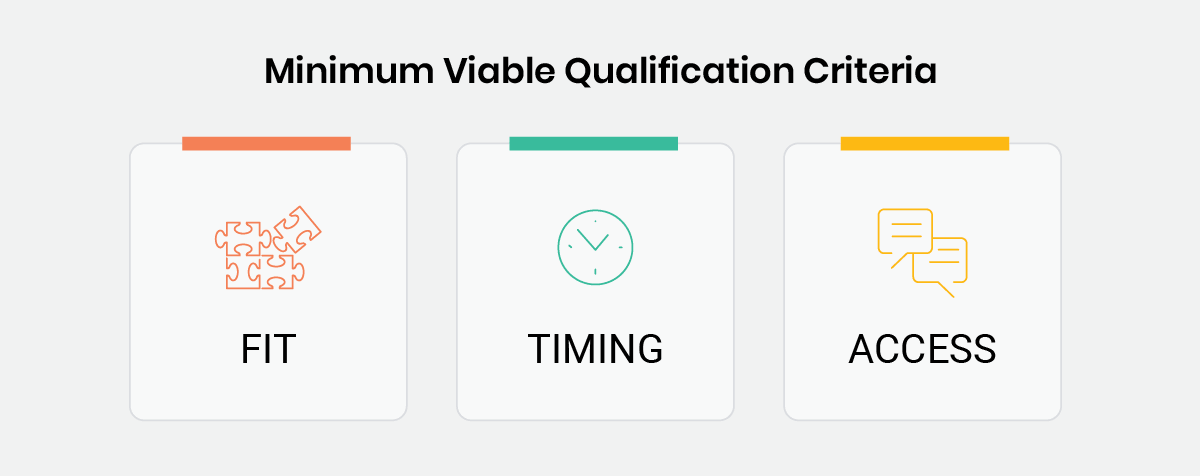
If the answer to all three is yes, move forward. If not, deprioritize or disqualify. The goal is to make fast, confident decisions based on observable data—not to gather every possible data point before taking action.
Use tools that surface qualification signals automatically. Enrichment platforms, intent data providers, and CRM integrations can flag high-fit accounts without manual research, so your reps spend their time talking to prospects—not building spreadsheets.
What Is the Best B2B Prospecting Cadence?
There is no single “best” cadence that works for every prospect in every situation. The most effective prospectors shape their outreach around two key factors: reachability and intent. They adapt based on how responsive a prospect is, which channels they prefer, and how much buying urgency they’re signaling.
The goal isn’t to hit an arbitrary number of touches—it’s to optimize for the right touches at the right time.
If you have a hot inbound lead who’s actively engaging with your content and requesting more information, you need to move quickly. That might mean condensing outreach into a few high-impact touches over several days, rather than spreading it out over weeks.
On the other hand, if you’re prospecting a cold account with no clear buying signals, you may need to space out touches and vary your approach to build awareness over time.
The key is to let the prospect’s behavior and context dictate your cadence, rather than the other way around. That means paying attention to things like:
- How quickly they respond to your initial outreach
- What time of day and day of the week they’re most likely to engage
- Which channels they’re most active and responsive on
- How much research and consideration their buying process typically requires
Based on those signals, you can craft a cadence that maximizes your chances of making a meaningful connection. For example:
- High-intent inbound lead: 2–3 touches across email and phone within the first 24–48 hours to capitalize on momentum
- Outbound to key economic buyer: 4–6 touches across email, social, and phone over 2–3 weeks, with personalized value propositions and relevant content
- Outbound to influencer/champion: 3–4 touches across email and social over 1–2 weeks, focused on education and relationship-building
Notice how the emphasis is on optimizing the momentum window, not just hitting a certain number of touches. In each case, the cadence is designed to balance persistence and personalization based on the prospect’s context and needs.
Pro Tip: For high-intent leads, shorten the gap between your first and second touches to 24 hours or less. You’re not being overly aggressive—you’re matching the prospect’s momentum and increasing the likelihood of conversion.
Quick Wins That Compound Efficiency
You don’t need a massive overhaul to start cutting friction. Small, targeted improvements can unlock immediate gains—and set the stage for bigger changes down the road.
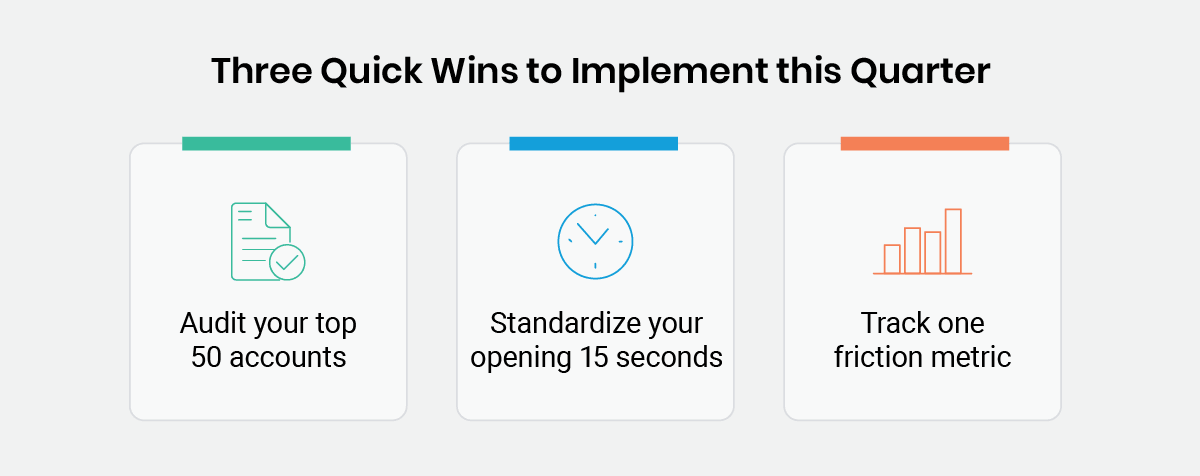
Here are three quick wins to implement this quarter:
- Audit your top 50 accounts: Verify phone numbers, update titles, and enrich records with direct dials. Even a small batch of clean data will improve connect rates and rep confidence.
- Standardize your opening 15 seconds: Create a simple, repeatable intro that states who you are, why you’re calling, and what’s in it for the prospect. Test it, refine it, and make it the default.
- Track one friction metric: Pick a single KPI—like time-to-first-conversation or data accuracy rate—and measure it weekly. Visibility alone will drive improvement.
These aren’t glamorous projects, but they’re high-leverage. And because they’re small, you can test, learn, and iterate quickly without disrupting your entire operation.
What Should You Deprioritize or Stop Doing?
Cutting friction isn’t just about adding better processes—it’s also about removing the activities that don’t move the needle. Most sales teams are doing at least a few things that look productive but deliver little to no return.
Consider deprioritizing or eliminating:
- Vanity metrics: Stop tracking activity for activity’s sake. If your team is hitting dial quotas but not booking meetings, the dials don’t matter.
- Over-personalization: Customizing every email with company-specific research sounds great in theory, but it doesn’t scale. Focus on segment-level personalization that’s fast and repeatable.
- Low-fit accounts: If an account doesn’t match your ICP, no amount of outreach will change that. Disqualify early and move on.
- Redundant tools: Audit your tech stack. If you’re paying for three tools that do the same thing, consolidate and reinvest the savings in better data or training.
The goal is to create space for the activities that actually drive pipeline. Every hour you free up from low-value work is an hour your team can spend having real conversations with real prospects.
Metrics That Prove Friction Is Shrinking
You can’t improve what you don’t measure. The key is to track metrics that reflect execution quality, not just activity volume.
Leading Indicators to Watch
These metrics tell you whether your process is getting faster and cleaner:
- Time-to-first-conversation: How long does it take from list pull to live conversation? Shorter is better.
- Data accuracy rate: What percentage of your contact records are complete, verified, and up-to-date?
- Connect rate: How many dials result in a live conversation? Improving data quality and timing should move this number up.
- Response rate: How many emails or messages get a reply? This reflects both message quality and list fit.
Lagging Indicators to Validate
These metrics confirm that your efficiency gains are translating into business results:
- Meetings booked per rep per week: The ultimate measure of prospecting effectiveness.
- Pipeline generated: Are your efficiency improvements driving more qualified opportunities?
- Sales cycle length: Faster prospecting should lead to faster deals, as you’re engaging the right people at the right time.
- Win rate: Better qualification and cleaner execution should improve close rates over time.
Track both leading and lagging indicators. Leading indicators give you early feedback on what’s working. Lagging indicators prove that your improvements are driving real revenue impact.
Conclusion
Friction shows up in every prospecting motion—but it’s also one of the easiest problems to fix. By focusing on data quality, process efficiency, and smarter execution, you can unlock more conversations without adding more activity. The key is to stop chasing volume and start optimizing for speed, clarity, and relevance.
Salesgenie helps sales teams eliminate friction by delivering verified contact data, real-time intelligence, and seamless CRM integration—so reps spend less time hunting for information and more time closing deals.
Start cutting friction today and watch your pipeline grow.
FAQs
The main culprit is cumulative friction from data gaps, system handoffs, and workflow inefficiencies—not a lack of channels or activity volume. Every missing phone number, unverified contact, or extra click between systems compounds into a slower time-to-first-conversation, putting meetings at risk.
Adding more channels to an already inefficient process is like building on a shaky foundation—it amplifies existing problems instead of fixing them. Each new channel adds complexity, requiring more content, workflows, and coordination, which spreads dysfunction across multiple touchpoints instead of improving execution in your primary channel.
No universal “best” cadence exists because effective outreach must adapt to prospect reachability and intent signals. High-intent leads might need 2–3 touches within 24–48 hours, while cold outbound prospects require 4–6 touches spaced over weeks with personalized value propositions.
Data-to-dial gaps occur when reps encounter missing phone numbers, incorrect extensions, outdated titles, or duplicate CRM records during outreach. These seemingly small issues force context switches that break focus and accumulate into significant lost time and missed opportunities across the entire team.
Focus on verifying data upfront, reducing process steps, and speeding up the path to live conversations—not just increasing activity. Identify and eliminate friction points—like poor data quality or unnecessary system handoffs—to drive more efficient outreach and higher connect rates.