
Lusha is a popular choice for sales teams that need fast access to B2B contact data, especially for prospecting and LinkedIn enrichment. Its Chrome extension, contact database, and workflow tools make it easy to find business emails, direct dials, and company information.
But it is not the right fit for every team. Many businesses start looking for Lusha alternatives when they need more flexible pricing, deeper database coverage, stronger international data, better intent signals, improved compliance support, smoother integrations, or more reliable enrichment quality.
To help you compare your options, we analyzed 11 Lusha competitors across pricing, usability, integrations, and prospecting capabilities. This guide covers SMB-friendly tools, enterprise sales intelligence platforms, and budget-friendly options for teams that want to improve lead generation without overcomplicating their workflow.
For teams looking for a simpler and more affordable prospecting workflow, tools like Salesgenie® offer a compelling alternative.
Quick Comparison: Lusha vs. Leading Alternatives
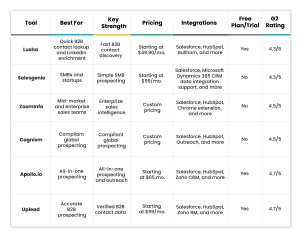
Before choosing a sales prospecting platform, it helps to compare Lusha competitors side by side. The table below highlights how leading B2B contact database tools stack up so you can quickly identify the best Lusha alternative for your team’s budget and workflow.
Looking for the best value-for-money alternative to Lusha? Many growing sales teams choose Salesgenie for its all-in-one workflow and scalable pricing.
Why Businesses Look for Lusha Alternatives
Although Lusha is a useful prospecting tool, you may find that your team outgrows it as your data, workflow, and budget needs become more complex. Here are the most common reasons businesses consider Lusha alternatives:
Limited contact coverage
Some teams find that Lusha does not always provide enough contacts in their target markets, industries, or company segments. This can be especially challenging for sales teams focused on niche audiences, local markets, or specific decision-maker roles.
Inconsistent phone accuracy
Direct-dial accuracy is critical for outbound sales. If phone numbers are outdated, incomplete, or unreliable, your reps will spend more time verifying contact details and less time connecting with qualified prospects.
Expensive scaling
Pricing can become a concern as you add more users, credits, or prospecting volume. For small businesses, the best Lusha alternative is a platform that offers predictable pricing and enough data access to support consistent outreach.
Missing intent data
Many modern B2B sales prospecting tools now include intent signals that can help you identify buyers who may be actively researching solutions. Without these insights, you may have less context for prioritizing outreach.
Weak enterprise workflows
Larger sales organizations often need advanced permissions, team management, CRM syncs, reporting, and workflow controls. When these features are limited, teams may look for alternatives with stronger enterprise support.
Limited enrichment depth
Basic contact enrichment may not be enough for if your team needs deeper company profiles, segmentation, firmographics, or lead scoring. Stronger enrichment can help you build more targeted lists and personalize outreach.
Compliance concerns
Data privacy expectations continue to rise, especially for companies selling across regions. It’s important to compare Lusha competitors based on compliance practices, data sourcing transparency, opt-out processes, and support for regulations like GDPR and CCPA.
Better AI-driven alternatives emerging
AI is reshaping lead generation tools for sales teams, from smarter prospect recommendations to automated research and prioritization. As more AI tools advance, you’ll have more options for improving speed, targeting, and outreach quality.
If rising prospecting costs and limited credits are slowing your team down, Salesgenie provides a more predictable and SMB-friendly alternative.
Pro Tip
Before switching tools, identify the biggest gap in your current workflow. The right choice may be an SMB-friendly platform, an enterprise sales intelligence tool, or a budget-friendly database built for simpler prospecting.
How We Evaluated the Best Lusha Alternatives
To identify the best Lusha alternatives, we compared each platform across the factors that matter most to sales teams evaluating B2B contact database tools and lead generation software.
- Data accuracy: Reliable contact data was a top priority, including current emails, direct dials, company details, and decision-maker information.
- Pricing transparency: Clear, scalable pricing helped determine which tools fit small businesses, growing teams, and enterprise users.
- Ease of use: Strong alternatives make it easy for reps to search, build lists, enrich records, and start prospecting without a steep learning curve.
- Chrome extension functionality: Browser-based tools were reviewed for LinkedIn prospecting, contact capture, and real-time enrichment.
- CRM integrations: Platforms with strong CRM connections stood out because they reduce manual data entry and support cleaner sales workflows.
- Compliance: Each tool was assessed for its approach to data privacy, consent, opt-outs, and support for regulations like GDPR and CCPA.
- Scalability: The best options can support higher prospecting volume, larger teams, advanced workflows, and long-term sales growth.
11 Best Lusha Alternatives for 2026
1. Salesgenie

Lusha has become a popular choice for lightweight prospecting and LinkedIn-based contact discovery but as teams grow, many users begin running into the same challenges:
- Credit limitations
- Rising costs at scale
- Limited workflow capabilities
- Dependence on browser-extension prospecting
What differentiates Salesgenie from other tools is that it provides an end-to-end prospecting experience combining contact data, lead management, segmentation, and outreach tools in one platform.
Key Features to Look for in a Lusha Alternative:
- Verified B2B & B2C Contact Database
- CRM Integrations and Lead Management
Unlike Lusha, which often requires multiple external tools, Salesgenie includes:
- Lead tracking
- Contact organization
- Pipeline management
- Advanced Prospect Segmentation
With Salesgenie, you can filter prospects by:
- Industry
- Revenue
- Geography
- Employee size
- Consumer demographics
- Integrated Email Outreach Tools
Easily manage outreach campaigns directly inside the platform instead of relying on disconnected prospecting stacks.
- Easy to Learn and Use
Salesgenie focuses on usability and quick onboarding, making it easier for sales teams to start generating pipeline without complex setup.
Pros:
- More scalable than credit-heavy prospecting tools
- Easier all-in-one workflow
- Affordable for SMBs and startups
- Built-in CRM reduces tool sprawl
- Faster onboarding and adoption
Cons:
- Less focused on LinkedIn extension workflows
- Fewer enterprise intelligence features than larger platforms
Best For:
- SMBs and startups
- Outbound sales teams
- Businesses scaling lead generation
- Teams looking for a more complete alternative to Lusha
Pricing:
Salesgenie offers more accessible pricing for growing teams, making it a strong alternative to Lusha for companies that need ongoing prospecting without worrying about escalating credit costs. Package pricing is as follows:
- Basic: $99/mo.
- Pro: $149/mo.
- Team: $299/mo.
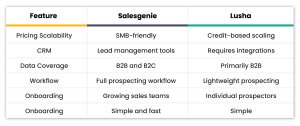
Salesgenie vs. Lusha:
Why Choose Salesgenie Over Lusha?:
If your team is moving beyond basic contact lookup and needs a more scalable outbound workflow, Salesgenie becomes the stronger option.
Choose Salesgenie if you:
- Want to reduce dependence on credit-based prospecting
- Need a more complete sales workflow
- Prefer predictable, SMB-friendly pricing
- Want to centralize prospecting and lead management
While Lusha is excellent for quick contact discovery, Salesgenie is better suited for teams building repeatable and scalable lead generation processes.
Real-World Use Case:
A growing outbound sales team switched from Lusha to Salesgenie after struggling with rising prospecting costs and disconnected workflows. By consolidating lead generation and outreach into one platform, they improved efficiency while reducing overall tool spend.
If you’re evaluating Lusha alternatives based on scalability and ROI, Salesgenie stands out as one of the strongest options for SMB sales teams.
2. ZoomInfo
ZoomInfo is a go-to-market intelligence platform built for sales, marketing, and RevOps teams that need extensive company and contact data, intent signals, and workflow automation. It is often a strong fit for larger teams comparing enterprise-focused Lusha alternatives

Key Features:
- B2B contact and company data
- Advanced search filters
- Buyer intent signals
- CRM integrations and enrichment
Pros:
- Strong enterprise data coverage
- Verified contact data
- Robust workflow tools
Cons:
- Custom pricing
- Some features require add-ons
- May be too advanced for small teams
Best For: Mid-market and enterprise sales teams
Pricing: Custom pricing
Why Choose ZoomInfo Over Lusha?: If you need a more advanced enterprise platform with deeper intent data and sales intelligence tools
3. Cognism
Cognism is a sales intelligence platform focused on accurate B2B data, phone-verified contacts, and compliance-first prospecting. Teams often choose it for global outreach, especially when GDPR-ready data and mobile number quality matter.

Key Features:
- Phone-verified mobile numbers
- B2B contact and company data
- Intent, hiring, and tech signals
- CRM enrichment and integrations
Pros:
- Strong compliance focus
- Useful for European data
- Verified mobile data
Cons:
- Advanced features vary by plan
- Custom pricing
Best For: Compliant global prospecting
Pricing: Custom pricing
Why Choose Cognism Over Lusha?: If compliance, verified mobile numbers, and international prospecting are top priorities
Not every sales team needs enterprise-level complexity or credit-heavy prospecting tools. Salesgenie offers a simpler, more practical alternative for teams focused on consistent outbound growth.
4. Apollo.io
Apollo.io is an AI-powered sales platform for finding leads, enriching data, and automating outreach. Its all-in-one setup can reduce the need for separate prospecting and engagement tools.

Key Features:
- B2B contact database
- Email and phone enrichment
- Automated sequences
- CRM integrations
Pros:
- Transparent pricing
- Built-in outreach tools
- Large contact database
Cons:
- Credit limits vary by plan
- Advanced features cost more
- May take time to configure
Best For: All-in-one prospecting
Pricing:
- Free plan
- Basic: $65/mo.
- Professional: $99/mo.
- Organization: $149/mo.
Why Choose Apollo.io Over Lusha?: If you want B2B data and outreach automation in one platform
5. UpLead
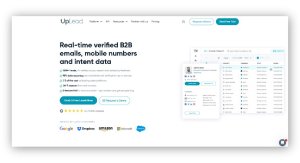
UpLead is a B2B prospecting platform with real-time email verification and contact enrichment. It works well for teams that prioritize data accuracy and simple list building.
 Key Features:
- Verified B2B contacts
- Real-time email verification
- Buyer intent data
- CRM integrations
Pros:
- 95% accuracy guarantee
- Free trial available
- Simple prospecting tools
Cons:
- Credit-based plans
- Advanced features cost more
- Custom pricing for organizations
Best For: Accurate B2B prospecting
Pricing:
- Free trial
- Essentials: $99/mo.
- Plus: $199/mo.
- Professional: Custom pricing
Why Choose UpLead Over Lusha?: If verified contact data and email accuracy matter most
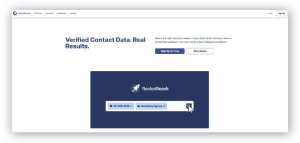
6. RocketReach
RocketReach helps teams find professional emails, phone numbers, and company details. It’s useful for sales, recruiting, and outreach teams that need fast contact lookup.
 Key Features:
- Email and phone lookup
- Company search
- Browser extension
- CRM integrations
Pros:
- Large contact database
- Easy contact search
- Useful for recruiting
Cons:
- Credit limits apply
- Phone access varies by plan
- Pricing can scale quickly
Best For: Fast contact lookup
Pricing:
- Essentials: $69/mo.
- Pro: $119/mo.
- Ultimate: $209/mo.
Why Choose RocketReach Over Lusha?: If you want a simple tool for finding emails, phone numbers, and professional profiles quickly
7. Seamless.AI
Seamless.AI is an AI-powered sales intelligence platform for finding B2B contacts, emails, and direct dials. Teams may choose it for real-time web search and list building.
 Key Features:
- B2B contact search
- Email and phone finder
- Buyer intent data
- Chrome extension
Pros:
- Free plan available
- Real-time data search
- Large contact database
Cons:
- Credit limits apply
- Pricing can vary
- Advanced tools may require upgrades
Best For: AI-assisted prospecting
Pricing: Free plan; paid plans have custom pricing
Why Choose Seamless.AI Over Lusha?: If you want AI-driven prospecting with real-time contact search
8. Kaspr
Kaspr is a LinkedIn Chrome extension and web app for finding B2B emails and phone numbers. It’s built for fast prospecting from LinkedIn and Sales Navigator.
 Key Features:
- LinkedIn Chrome extension
- B2B emails and phone numbers
- Lead lists and workflows
- CRM and sales tool integrations
Pros:
- Free plan available
- Strong European data focus
- Easy LinkedIn prospecting
Cons:
- Credit limits apply
- LinkedIn account required
- Some tools require paid plans
Best For: LinkedIn prospecting
Pricing:
- Free plan
- Starter: $69/mo.
- Business: $99/mo.
- Enterprise: Custom pricing
Why Choose Kaspr Over Lusha?: If you want fast LinkedIn-based prospecting with a strong focus on European contact data
9. Clearbit
Clearbit, now part of HubSpot, provides data enrichment for contact and company records. It’s useful for teams that want cleaner CRM data and better lead routing.
 Key Features:
- Contact enrichment
- Company enrichment
- Lead scoring support
- Visitor intent insights
Pros:
- Native HubSpot fit
- Strong enrichment use case
- Helpful segmentation data
Cons:
- Less focused on outbound
- Works best for HubSpot users
Best For: CRM data enrichment
Pricing: Custom pricing
Why Choose Clearbit Over Lusha?: If enrichment, lead scoring, and HubSpot CRM workflows matter more than standalone prospecting
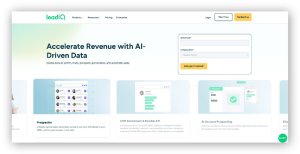
10. LeadIQ
LeadIQ is a B2B prospecting platform for finding contacts, tracking sales triggers, and personalizing outreach. It’s built to cut manual work for outbound teams.
Key Features:
- Contact data capture
- Sales trigger tracking
- AI message writing
- CRM and sales tool integrations
Pros:
- Easy LinkedIn workflows
- Strong sales integrations
- Compliance-focused data
Cons:
- Credit limits apply
- Paid plans add more access
Best For: Outbound prospecting
Pricing:
- Free plan
- Pro: $20/mo.
- Enterprise: Custom pricing
Why Choose LeadIQ Over Lusha?: If your team wants faster prospect capture, sales triggers, and AI-assisted outreach in one workflow
11. Hunter.io
Hunter.io helps teams find, verify, and connect with professional email addresses. It is a simple option for email-first prospecting.
 Key Features:
- Email Finder, Email Verifier, and Domain Search tools
- Cold email sequences
- CRM Integrations
- Bulk Tasks finder and verifier
Pros:
- Free plan available
- Strong email verification
- Unlimited users on paid plans
Cons:
- Less phone-focused
- Credits vary by plan
- Limited beyond email outreach
Best For: Email prospecting
Pricing:
- Free plan
- Starter: $49/mo.
- Growth: $149/mo.
- Scale: $299/mo.
- Enterprise: Custom pricing
Why Choose Hunter.io Over Lusha?: If you mainly need verified emails, domain search, and lightweight outreach
Lusha vs. Top Alternatives
Salesgenie vs. Lusha
Salesgenie is a simpler Lusha alternative for teams that want targeted lead lists, accessible sales tools, and a more small-business-friendly prospecting workflow.
- Data accuracy: Lusha focuses on B2B contact enrichment, while Salesgenie offers targeted B2B and consumer lead data.
- Pricing: Lusha can become costly as teams scale; Salesgenie may be more approachable for small business prospecting.
- Credits: Lusha uses a credit-based model, while Salesgenie is built more around lead access and list building.
- Ease of use: Lusha is useful for quick contact lookup; Salesgenie is designed for simple list building and outreach planning.
- CRM integrations: Lusha supports CRM enrichment, while Salesgenie supports broader sales workflow needs.
- Intent data: Lusha offers prospecting and enrichment features, while Salesgenie is less focused on intent data than enterprise platforms.
ZoomInfo vs. Lusha
ZoomInfo is a more enterprise-focused Lusha alternative for teams that need deeper sales intelligence, intent data, and advanced GTM workflows.
- Data accuracy: Lusha is useful for contact lookup, while ZoomInfo offers broader company and contact intelligence.
- Pricing: Lusha may be more accessible for smaller teams; ZoomInfo typically uses custom enterprise pricing.
- Credits: Lusha relies on credits for contact access, while ZoomInfo’s access depends on package and usage needs.
- Ease of use: Lusha is simpler for quick prospecting; ZoomInfo offers more features but can be more complex.
- CRM integrations: Lusha supports CRM enrichment, while ZoomInfo offers deeper CRM and GTM workflow integrations.
- Intent data: Lusha has limited intent capabilities compared with ZoomInfo’s more advanced buyer intent signals.
Apollo.io vs. Lusha
Apollo is a strong option for teams that want prospecting data and outbound engagement tools in one platform.
- Data accuracy: Lusha focuses on contact enrichment, while Apollo combines B2B data with outreach workflows.
- Pricing: Lusha’s cost can rise with credit usage; Apollo offers more transparent plan options.
- Credits: Lusha and Apollo both use credits, but Apollo ties them to broader prospecting and outreach workflows.
- Ease of use: Lusha is straightforward for finding contacts; Apollo adds sequencing, enrichment, and workflow tools.
- CRM integrations: Lusha supports CRM updates, while Apollo connects prospecting, outreach, and CRM activity.
- Intent data: Lusha is more enrichment-focused, while Apollo offers intent data on select plans.
Cognism vs. Lusha
Cognism is a Lusha competitor for teams that prioritize compliant global prospecting and verified mobile data.
- Data accuracy: Lusha helps find B2B contact data, while Cognism emphasizes phone-verified mobile numbers.
- Pricing: Lusha offers more visible plan options; Cognism uses custom pricing.
- Credits: Lusha uses credits for contact access, while Cognism’s access depends on the selected package.
- Ease of use: Lusha is built for quick contact discovery; Cognism is designed for compliant outbound prospecting.
- CRM integrations: Lusha supports CRM enrichment, while Cognism also supports enrichment and outbound workflows.
- Intent data: Lusha offers limited intent data, while Cognism includes intent and sales trigger signals.
Still deciding between Lusha and its competitors?
If your team needs a more scalable prospecting workflow with fewer limitations, Salesgenie is worth considering.
Best Lusha Alternatives by Use Case
Best for Startups: Apollo.io
Apollo.io is a strong fit for startups that want prospecting data, email outreach, and CRM workflows in one platform. Its free plan and transparent pricing make it easier to test before scaling.
Best for Enterprise: ZoomInfo
ZoomInfo is best for enterprise teams that need deep B2B data, intent signals, enrichment, and advanced GTM workflows. It offers more robust sales intelligence than many tools like Lusha
Best for SMBs: Salesgenie
Salesgenie is a practical choice for SMBs that want targeted lead lists without a complex sales intelligence setup. It is built for simpler prospecting, making it one of the top Lusha alternatives for small business.
Best Budget Option: Hunter.io
Hunter.io is a budget-friendly option for teams focused on verified email discovery. It is best for lean sales teams that need email-first lead generation tools.
Best for International Data: Cognism
Cognism is a good fit for global sales teams that prioritize compliant data and verified mobile numbers. It is especially useful for teams selling into Europe.
Best for LinkedIn Prospecting: Kaspr
Kaspr is best for teams that rely heavily on LinkedIn and Sales Navigator. Its Chrome extension helps users capture contact data directly from LinkedIn workflows.
Which Lusha Alternative Should You Choose?
The best Lusha alternative depends on your team size, budget, and prospecting workflow. Here’s a quick way to narrow your options.
For SMBs: Salesgenie
When speed and simplicity matter, a streamlined prospecting platform can be more useful than a complex enterprise database. Salesgenie helps SMB sales teams build targeted lead lists and reach the right prospects without adding unnecessary workflow friction.
For Enterprise: ZoomInfo or Cognism
Enterprise sales teams usually need deeper data, stronger controls, and workflows that support larger teams. Choose ZoomInfo for broad GTM intelligence, intent data, and advanced integrations. Choose Cognism when compliant global prospecting and verified mobile numbers are the priority.
For Budget Buyers: UpLead or Apollo.io
Cost-conscious teams should focus on usable credits, accurate data, and tools that support daily outreach. UpLead is a solid pick for verified contacts and simple list building. Apollo works well when built-in sequencing and prospecting tools can replace extra software.
For LinkedIn Prospecting: LeadIQ or Kaspr
If LinkedIn is your main prospecting channel, prioritize fast capture, enrichment, and CRM sync. LeadIQ adds helpful sales triggers and AI support for outbound reps. Kaspr keeps LinkedIn and Sales Navigator prospecting quick and easy.
What to Look for in a Sales Intelligence Tool
Choosing between Lusha alternatives starts with knowing what matters most to your sales process. The right platform should help your team find better prospects, keep data clean, and move faster without adding unnecessary complexity.
Here’s what you can look for in a prospective sales intelligence tool:
- Data accuracy: Reliable emails, direct dials, and company details help reps spend less time verifying records and more time selling.
- Coverage: Look for tools that include emails, phone numbers, company data, firmographics, and decision-maker details in your target markets.
- Compliance: Strong data privacy practices, opt-out processes, and support for regulations like GDPR and CCPA are essential for responsible prospecting.
- Integration ecosystem: CRM and sales tool integrations help keep workflows connected, reduce manual entry, and improve follow-up.
- Scalability: The best B2B sales prospecting tools should support your team as prospecting volume, users, and workflow needs grow.
Are Sales Intelligence Tools Compliant?
Sales intelligence tools can be compliant, but it depends on how data is sourced, processed, and used. When comparing Lusha alternatives, look for platforms with clear privacy practices, opt-out processes, and support for responsible outreach.
- GDPR: For European prospecting, potential tools should support lawful data processing, transparent sourcing, and easy opt-out options.
- CCPA: For U.S. outreach, especially in California, your team should understand how providers handle data access, deletion, and privacy requests.
- Ethical outreach: Compliance is only part of the equation. When doing outreach, ensure you contact relevant prospects, personalize messaging, honor opt-outs, and avoid overly aggressive follow-up.
Pro Tip
Before choosing a B2B sales prospecting tool, review its privacy policy, data sourcing practices, and compliance documentation. This helps reduce risk and supports better buyer trust.
Final Thoughts
Salesgenie is one of the best Lusha alternatives for 2026 if your priorities are:
- Scalability
- Simplicity
- Affordability
- Workflow efficiency
Instead of paying for fragmented prospecting workflows, Salesgenie gives growing sales teams a more unified and cost-effective way to generate pipeline.
Looking for a more scalable alternative to Lusha?
If your team has outgrown lightweight prospecting tools and needs a more complete outbound workflow, Salesgenie is one of the best alternatives available in 2026.
Try Salesgenie today to build pipeline faster without the limitations of credit-based prospecting.
FAQs
Some of the best Lusha alternatives include Salesgenie, ZoomInfo, Apollo.io, Cognism, UpLead, RocketReach, Seamless.AI, Kaspr, LeadIQ, and Hunter.io. The right choice depends on your budget, team size, data needs, and sales workflow.
Yes. Budget-friendly tools like UpLead, Apollo.io, and Hunter.io may be good options for teams that want lower-cost B2B sales prospecting tools. Salesgenie is also worth considering for SMBs that want a simpler, more affordable prospecting workflow.
It depends on the type of data you need. ZoomInfo is strong for enterprise sales intelligence, Cognism is known for compliant global data and verified mobile numbers, and UpLead focuses on verified B2B contact data.
Salesgenie may be better than Lusha for small businesses that want targeted lead lists and a straightforward prospecting process. Lusha may be a better fit for teams focused mainly on quick contact enrichment.
Tools like Lusha include ZoomInfo, Apollo.io, Cognism, UpLead, RocketReach, Seamless.AI, Kaspr, LeadIQ, Hunter.io, and Salesgenie. These platforms help sales teams find contacts, enrich data, and support outbound prospecting.
Yes, Several Lusha competitors offer free plans or trials, including Apollo.io, UpLead, RocketReach, Seamless.AI, Kaspr, LeadIQ, and Hunter.io. Free options are useful for testing data quality before committing to a paid plan.