

Picture this: you’re a local coffee shop owner spending hundreds of dollars each month on ads targeting “coffee lovers” in your area.
The results? Fine—but inconsistent.
You’re reaching people who might like coffee, but you don’t know who’s actually buying premium brands, stocking their kitchens, or making purchase decisions right now.
This challenge shows up everywhere—from salons and boutiques to auto shops and insurance agents. Small businesses invest limited budgets in broad demographic or lifestyle targeting, hoping the right people see the message
Sometimes it works. More often, though, it doesn’t.
The core problem isn’t creativity or effort—it’s visibility.
What if you could target households based on what they’ve actually purchased, and how recently that activity happened?
Not inferred interests. Not outdated lifestyle assumptions. Real purchase activity, at the household level.
That’s exactly what Consumer Purchase Signals brings to Salesgenie.
What are Consumer Purchase Signals?

Consumer Purchase Signals is a new premium filter that’s part of the Salesgenie Consumer Database. It lets you filter audiences based on recent, time-stamped household purchase activity—at a highly granular, product-level scale.
“For years, small businesses have been forced to market based on assumptions—who might be interested instead of who’s actually buying. Consumer Purchase Signals flips that model. It gives SMBs the ability to prioritize households that are active in their category right now, which is exactly how you drive better ROI from every campaign.”
—Rob Martin, Senior Vice President of Sales, Salesgenie
Instead of guessing who might be interested, you can focus on households that have demonstrated relevant buying behavior within a defined timeframe.
Purchase Signals include two complementary signal types:
Confirmed Purchases
These reflect verified transaction activity—households where a purchase was observed in transaction data within a defined recency window. These are actual purchases, not modeled assumptions.
Predicted Purchases & Interest Signals
These identify households showing modeled likelihood or declared indicators of purchase behavior, based on patterns such as spending behavior, brand engagement, upgrades, or switching activity. This helps expand reach without losing relevance.
Together, these signals help you balance precision with scale—targeting buyers who are active now, not just broadly “interested.”
Product-Level Precision That Changes How You Target
Consumer Purchase Signals goes far beyond category-level targeting.
Instead of filtering for something vague like “health-conscious consumers,” you can target households that purchased specific products or brands, such as one cereal brand versus another, or specific personal care, automotive, or household items.
“We built Consumer Purchase Signals to solve a very real problem we kept hearing from customers: lifestyle data was too broad and spanned over many years instead of a specific time frame. By anchoring signals to actual or modeled purchase behavior—and clearly showing recency—we’re giving users a way to target with much more confidence and far less guesswork.”
—Smiti Thapar, Product Manager, Salesgenie
That level of precision changes how confidently you can build campaigns:
- A local organic market can focus on households that recently purchased organic or specialty food products—not just people in “organic-leaning” neighborhoods.
- An auto repair shop can prioritize households actively buying car care or maintenance products—signals that suggest real service needs.
- An insurance agent can identify households with recent purchases that may indicate lifestyle or coverage changes.
Each Purchase Signal includes embedded recency (for example, last 30 days, 90 days, or 12 months), so you always know when the activity occurred. You’re not relying on interests from an unknown point in time.
How Filtering Works Inside Salesgenie
Purchase Signals live directly inside the Consumer Database filtering experience, alongside other familiar filters like geography and demographics.
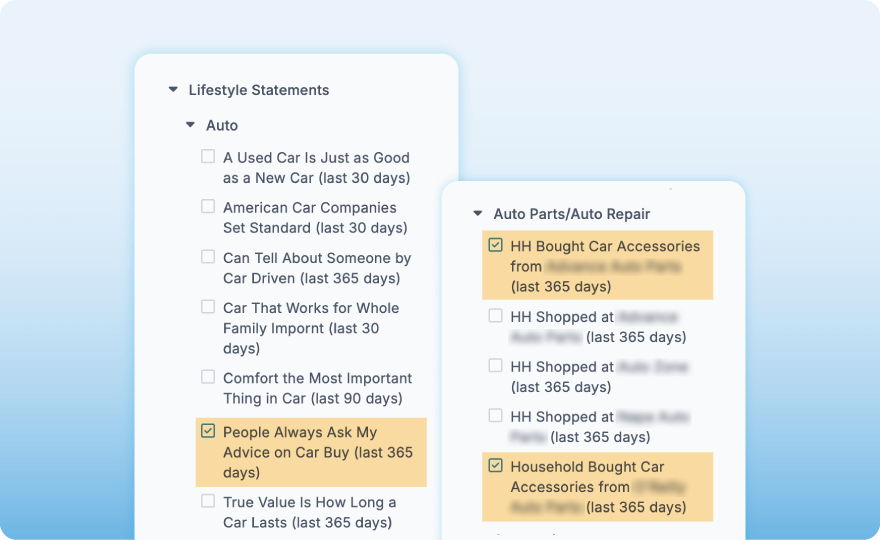
Here’s how it works:
- You can browse or search highly granular purchase topics organized by category → subcategory → segment
- You can select up to 15 purchase topics at a time
- Topics are combined using OR logic (a household only needs to match one selected topic to qualify)
- Purchase Signals are designed to be layered with other filters to keep audiences targeted and actionable
Purchase Signals are used for filtering only. They don’t appear as exported data fields, but you can view which selected topic a record matched—and whether it was confirmed or predicted—inside the record detail view.
The data refreshes monthly, helping keep your targeting aligned with current buying behavior.
Built for How You Actually Want to Market
Consumer Purchase Signals was designed with the realities of small and midsize marketing teams in mind—especially those running local, regional, or seasonal campaigns with limited time and budget.

Fits into existing workflows
Purchase Signals work directly within the Salesgenie Consumer Database, so you can refine audiences using the same list-building process you already use.

Designed for practical targeting
Combining Purchase Signals with geography and other filters helps keep audiences focused, relevant, and easy to activate across channels.

Supports better timing and relevance
Built-in recency helps ensure outreach aligns with when households are most likely to be receptive, without relying on outdated or unknown signals.
Instead of relying on broad assumptions, businesses can use recent purchase-based filters to build more relevant audiences for direct mail, digital advertising, calling, or local outreach—without changing how they plan or execute campaigns.
Why This Matters for Campaign Performance
When you shift from demographic guesswork to purchase-based targeting, the downstream impact is meaningful:
- Campaigns are more relevant because you’re reaching households with demonstrated buying behavior
- Budget waste drops as you eliminate large segments of low-intent audiences
- Personalization improves because timing and product relevance are built into audience selection—often lifting revenue by 5–15%.
For SMBs using direct mail, digital ads, calling, or local outreach, the difference between “might be interested” and “recently purchased” is the difference between hoping and planning.
Ready to Target Using Data-Backed Insights?
Consumer Purchase Signals is available now as an add-on to the Salesgenie Consumer Database.
- Existing subscribers can enable the add-on from the Purchase Signals filter section
- New subscribers can add it during purchase
- Freemium users can use Purchase Signals in one-time list exports
If you’re ready to stop guessing and start targeting based on what households actually buy—and how recently they’ve done it—Consumer Purchase Signals gives you that visibility.
Your best prospects are already out there. Now you can find them with far more confidence.
Talk with our data experts to add Purchase Signals to your Salesgenie account.
FAQs
Lifestyle and interest data estimate what someone might like based on demographics or behavior patterns. Consumer Purchase Signals focus on what households have actually purchased or shown strong purchase indicators for, with clear recency. That means targeting based on real buying activity, not assumptions.
Each Purchase Signal includes a defined recency window, such as the last 30 days, 90 days, or 12 months. This makes it clear when the activity occurred, so you’re not relying on outdated or unknown timing.
Yes. Purchase Signals are designed to work alongside existing filters like geography, demographics, and household attributes. This allows you to narrow audiences while keeping them relevant and practical for real campaigns.