Customer retention has become the new growth engine for small and medium businesses (SMBs). With acquisition costs rising and privacy regulations tightening, the companies that thrive are the ones that reduce customer churn and use data-driven retention strategies to keep their customers engaged, satisfied, and loyal.
The reality is that many SMBs remain stuck in an acquisition-first mindset—pouring resources into constant lead generation while overlooking the untapped value of their existing customers. That neglect leaves revenue on the table and puts long-term growth at risk.
It’s time for a retention revolution. And it starts with transforming your first-party customer data into targeted, personalized campaigns that reduce churn, increase lifetime value, and create a sustainable competitive advantage.
In this comprehensive blog, we’ll walk you through the step-by-step process of building a data-driven retention machine, from foundational strategies to advanced tactics. You’ll learn how to:
- Identify and segment your most valuable customers
- Predict and prevent churn before it happens
- Design automated campaigns that deliver the right message at the right time
- Measure and optimize your retention efforts for maximum ROI
Whether you’re a small business owner, marketing manager, or customer success leader, this playbook gives you the tools and frameworks to make retention your top growth priority—today and in the long term.
Let’s begin turning your customer data into retention results.
How Customer Retention Outperforms Acquisition

If you’re a small or medium business owner, you’ve probably heard the old saying that it’s cheaper to keep a customer than to find a new one. But today, that’s not just a catchy phrase —it’s a critical growth strategy.
Here’s the reality: acquiring a new customer can cost up to five times more than keeping an existing one. For every dollar you spend on retention, you’d have to spend five dollars to get the same results from acquisition. That’s a significant difference in ROI.
But the benefits of retention don’t stop there. Loyal customers are more likely to buy from you again, spend more over time, and refer their friends and colleagues. They’re the foundation of sustainable, profitable growth.
You might be thinking, “I already have a retention strategy—I send out a newsletter and offer a loyalty program. I’m good.” But modern retention requires much more.
The businesses that will thrive in the coming years are the ones that take a data-driven, personalized approach to retention. They continuously analyze customer behavior, anticipate needs, and engage proactively. They don’t just react to churn; they predict and prevent it.
This is especially important in a world where privacy regulations are getting stricter, and customers are more cautious about sharing their data. Blanket emails and generic loyalty points won’t cut it anymore. To keep your customers, you need to show them that you understand their unique needs and preferences.
So, if you want to grow your SMB, it’s time to put retention at the top of your priority list. Not just as a one-time campaign, but as an ongoing, data-driven strategy. The payoff in lower costs, higher profits, and sustainable growth will be well worth the effort.
Pro Tip
Track your retention spend separately from acquisition to reveal hidden ROI. Many SMBs discover their highest-margin growth comes from existing customers once the numbers are isolated.
Building Your First-Party Customer Data Strategy Foundation
In a privacy-first world, an effective first-party data strategy is the foundation of personalized retention, targeted campaigns, and long-term customer loyalty. But what exactly is first-party data, and how can you harness its power?
What Is First-Party Data?
First-party data is information you collect directly from your customers, with their explicit consent. It includes purchase history, website behavior, preferences, and feedback. Unlike third-party data, which is often detached from context, first-party data provides a rich, authentic understanding of your customers.
Mapping Data Collection Touchpoints
To build a strong foundation for your retention strategy, start by mapping out all the touchpoints where you can collect first-party data. This might include:
- Website registration and login
- Purchase and transaction records
- Customer support interactions
- Surveys and feedback forms
- Email and newsletter engagement
- Loyalty program activity
By capturing data at each stage of the customer journey, you’ll gain a comprehensive view of customer needs, behaviors, and preferences. This empowers you to create targeted segments, personalize your messaging, and proactively address issues before they lead to churn.
Pro Tip
Start by improving just one or two high-quality data sources—such as purchase history or support interactions—before expanding. Tight, accurate data beats collecting everything at once.
Privacy and Compliance
With great data comes great responsibility. Transparency and consent are critical. Make sure customers understand what data you collect, how it’s used, and that they have control over it. Implement secure storage, access controls, and regular audits to ensure ongoing compliance.
From Setup to Ongoing Management
Managing first-party data doesn’t require a massive team. Begin with a simple data quality audit: what data are you currently collecting, is it accurate and up-to-date, how is it stored and accessed, and does it align with your retention goals? Focus first on the most critical data points, prioritizing quality over quantity. As you see results, gradually expand and refine your approach.
Remember, first-party data isn’t a one-time project—it’s an ongoing process of learning, iterating, and adapting to your customers’ evolving needs. By investing in this foundation now, you’ll be able to create personalized, trust-based experiences that drive long-term retention and sustainable growth.
Master Customer Lifecycle Segmentation for Targeted Retention
Not all customers are created equal. Some are brand new, just getting to know your product. Others are loyal power users, relying on you daily. And then there are those who are slipping away, at risk of churning. To create retention strategies that resonate, you need to speak to each customer based on where they are in their journey.
At its core, lifecycle segmentation involves grouping customers based on their journey stage and engagement level. New customers in onboarding are still learning your product, while those in growth are actively using and deriving value. Mature customers consistently engage and advocate for your brand, and at-risk customers show signs of disengagement or potential churn. Segmenting customers this way allows you to tailor retention efforts, from providing education and support for new users to loyalty programs and upsell offers for mature customers.
Layer Behavioral and Demographic Insights
The lifecycle stage is just the beginning. To create truly targeted campaigns, combine it with behavioral and demographic insights. Behavioral segmentation looks at how customers interact with your product—frequency of use, feature adoption, and purchase patterns. Demographic segmentation considers characteristics like industry, company size, and role within the organization.
By layering these insights onto lifecycle segments, you can identify high-value groups such as power users who frequently engage with advanced features, recent purchasers open to cross-sells, or dormant accounts that need reactivation.
Putting Segmentation Into Practice
Once you’ve defined your lifecycle, behavioral, and demographic segments, it’s time to turn insights into action. Start by creating a simple segmentation worksheet where you list your key customer groups, define the behavioral and demographic criteria for each, and identify the primary goals and challenges they face. For each segment, brainstorm tailored retention tactics that address their unique needs.
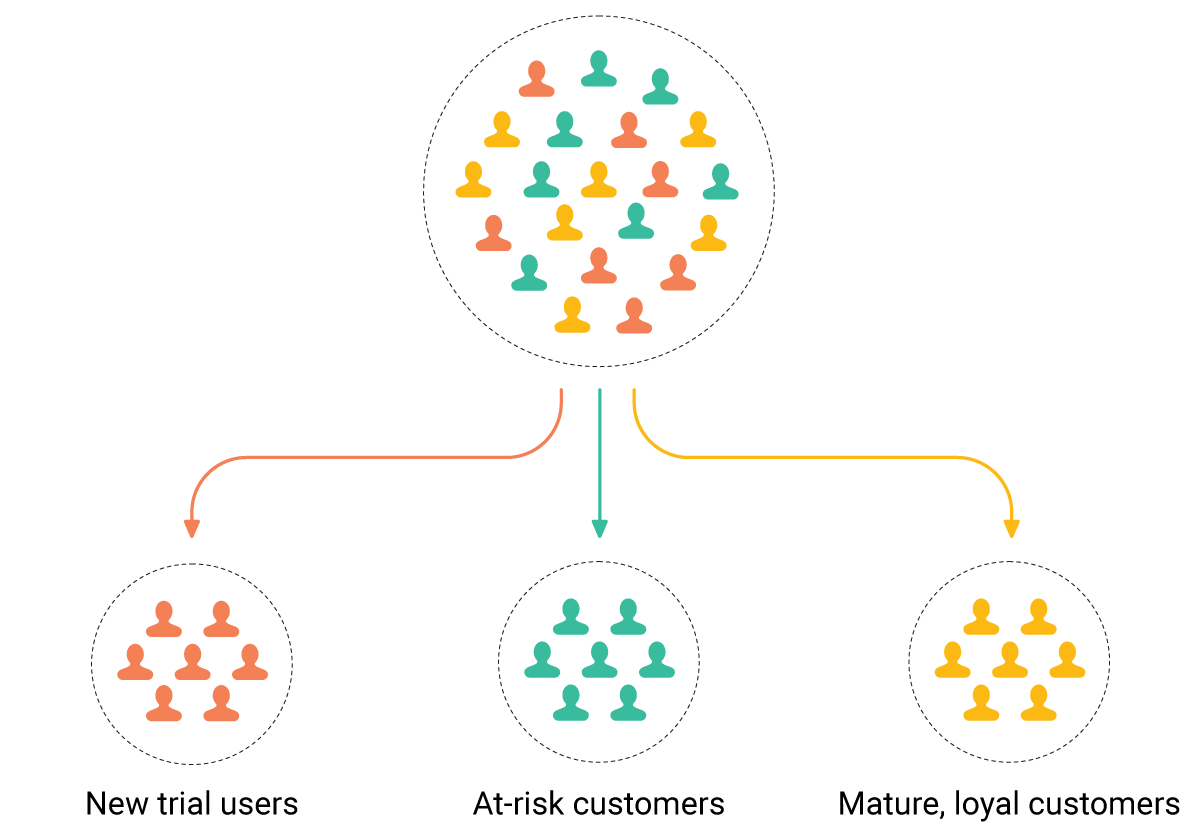
Key customer segments and tactics:
- New trial users (signed up but not yet completed onboarding): Personalized email sequences, step-by-step tutorials, or interactive guides to help them get started and see value quickly
- At-risk customers (haven’t purchased in 60 days or whose engagement has declined): Targeted win-back campaigns, special discounts, or proactive support outreach
- Mature, loyal customers: Loyalty programs, early access to new features, or personalized upsell opportunities that recognize their ongoing engagement
Next, craft messaging for each segment that aligns with their stage and behavior. Onboarding emails should be clear, educational, and supportive. Feature adoption campaigns should highlight underused tools and demonstrate value. Win-back offers must feel personalized and timely, while loyalty communications should make top customers feel recognized and rewarded.
Finally, remember that segmentation is an iterative process. Track the performance of your campaigns, monitor engagement trends, and refine your segments and strategies over time. By continually adjusting based on insights and outcomes, you ensure that each customer receives the right message at the right time—maximizing retention and long-term growth.
Implementing Churn Prediction Models Without a Data Science Team
What if you could identify at-risk customers before they leave? Churn prediction models give you that power. By analyzing customer data and behavior patterns, these models identify at-risk customers before they leave, giving you a chance to save the relationship.
For many SMBs, churn prediction can feel out of reach. The good news? You don’t need advanced machine learning or a dedicated data science team. Starting with simple scoring models built from your existing metrics can provide actionable insights right away.
Building a Basic Churn Prediction Model
Start by identifying early warning signals, such as decreased product usage, lower purchase value, increased support tickets, or negative feedback. Then define your churn risk thresholds—for instance, customers who haven’t logged in for 30 days or whose monthly spend has dropped by 50%. Assign risk scores based on these behaviors and segment customers into low, medium, and high-risk groups.
Once you have risk segments, prioritize your retention efforts on the highest-risk customers first. By following this framework, you can start to predict and prevent churn without needing a complex data science infrastructure. Of course, as your business grows and your data capabilities mature, you can always layer on more sophisticated predictive models. But this approach provides a solid foundation to build upon.
Leveraging Tools and Taking Action
Even without a data science team, SMBs can make churn prediction more accessible by using purpose-built tools. Spreadsheets, predictive analytics platforms (like Canopy Labs or Preact), or customer success software (like ChurnZero or Gainsight) can calculate risk scores and highlight at-risk customers automatically.
Remember, the goal of churn prediction is not just to identify at-risk customers, but to take action to retain them. Use your predictive insights to drive proactive retention interventions such as:
- Personalized check-in emails to re-engage inactive users
- Special offers or discounts to incentivize at-risk customers to stay
- Targeted education campaignsto help struggling users find more value in your product
- Proactive outreach from customer successto address potential issues before they escalate
By combining simple predictive models with targeted retention tactics, you can effectively reduce churn and boost customer lifetime value—no data science PhD required.
So don’t let the complexity of churn prediction hold you back. Start small, iterate often, and let your customer data guide your retention efforts. Your future self (and your bottom line) will thank you.
Measuring Success and Optimizing Your Retention Strategy

You’ve segmented your customers, predicted churn, and launched targeted retention campaigns. But the work doesn’t stop there. To truly maximize results, you need to measure what’s working, test new ideas, and continuously optimize your approach.
Start by establishing baseline metrics for your key retention KPIs, including:
- Customer Churn Rate: The percentage of customers who cancel or fail to renew in a given period.
- Net Revenue Retention (NRR): The percentage of revenue retained from existing customers, including upgrades and downgrades.
- Customer Lifetime Value (CLV): The total revenue a customer is expected to generate over their relationship with your brand.
These benchmarks give you a clear picture of where you stand today and help you set realistic improvement targets. For example, you might aim to reduce monthly churn from 5% to 3% within 90 days, increase NRR from 90% to 95% over the next two quarters, or grow CLV by 10% by year’s end. Setting specific, measurable goals gives you direction and makes it easier to evaluate whether your retention strategies are truly moving the needle.
Next, create a testing framework to keep improving over time. Start small—experiment with one variable at a time and carefully monitor results. You could A/B test different subject lines or incentives in your retention emails, run cohort analyses to see which customer groups respond best to specific campaigns, or use customer surveys and exit interviews to uncover why people stay or leave.
As you gather insights, refine and reapply what works. If you find that customers who attend your onboarding webinars retain longer, build more of those sessions. If engagement spikes after loyalty program launches, double down on expanding rewards. The key is to treat retention optimization as a living, ongoing process—one that evolves alongside your customers and continuously strengthens your relationship with them.
Pro Tip
Create a simple “retention wins” dashboard. Highlight just 3–5 metrics that matter most so your team stays focused and avoids data overload during experimentation cycles.
Putting It All Together: Tools, Timelines, and Next Steps
To keep your optimization efforts structured and achievable, break them into manageable 90-day sprints:
- Days 1–30: Establish baseline metrics, set your retention goals, and identify 2–3 initiatives to test
- Days 31–60: Launch your first campaigns, collect feedback, and analyze early performance trends
- Days 61–90: Review results, iterate on what worked, and plan your next cycle of experiments
This timeline helps you maintain momentum and ensures that retention improvement becomes part of your regular business rhythm—not an occasional project.
If managing metrics and experiments feels complex, consider using a retention platform like Salesgenie to simplify the process. Salesgenie allows you to track and visualize your KPIs in customizable dashboards, automate A/B tests and follow-up campaigns, and leverage built-in analytics that guide ongoing optimization. Plus, with its unlimited data access and consultative support, you’ll have the insight and structure you need to turn data into action.
Ultimately, retention success isn’t about a single campaign—it’s about building a repeatable system of testing, learning, and improving. By pairing automation with human insight, you can create a program that not only keeps customers longer but also drives sustainable, long-term growth.
Ready to take your retention strategy to the next level? Get started with Salesgenie today and turn your customer data into measurable retention results.
Your Data-Driven Retention Roadmap
This article has outlined how to turn customer data into actionable retention strategies. It all begins with strong first-party data, a clear understanding of your customers, and intentional, data-driven actions that keep them engaged.
Begin by ensuring your first-party data is collected across all touchpoints in a privacy-compliant way. Use this information to segment your customers based on lifecycle stage, behavior, and value, enabling targeted retention approaches. Implement churn prediction models to identify at-risk customers early, and launch automated campaigns that deliver personalized messaging and offers at scale.
Success requires ongoing measurement and optimization. Establish baseline metrics and KPIs, track performance, and iterate based on results. By committing to a systematic, data-driven approach, your retention program becomes a living system that evolves with both your customers and your business.
To put this framework into action, focus on five key steps:
- Assess your current capabilities: Audit your data, tools, and processes to identify gaps and prioritize improvements.
- Set clear goals and KPIs: Define what success looks like and establish measurable benchmarks.
- Build a cross-functional team: Align marketing, sales, product, and customer success for accountability and collaboration.
- Implement the right tools and processes: Leverage customer data platforms, marketing automation, and analytics for efficient execution.
- Continuously learn and iterate: Review metrics, gather feedback, and test campaigns to optimize outcomes over time.
The Business Impact of Data-Driven Retention
The benefits of systematic retention strategies go beyond reducing churn—they create a sustainable competitive advantage. Companies that prioritize retention see 2–4x higher revenue growth, and even a 5% increase in retention can boost profits by 25–95%. Retained customers also spend up to 67% more than new customers, highlighting the direct financial impact of keeping your audience engaged.
The businesses that thrive are the ones that build deep, lasting relationships with their customers. Using data to understand and meet customer needs at scale is the key to making that possible.
Investing in a structured, data-driven retention program isn’t optional—it’s a business imperative. By following the roadmap above, you can turn raw customer data into actionable insights, drive measurable retention results, and position your business for long-term growth.
Ready to take your retention strategy to the next level? Explore Salesgenie’s retention-focused features and start turning your customer data into meaningful, revenue-driving results today.