
Generic “Dear Valued Customer” emails are killing your conversion rates. In an era where consumers receive over 120 emails per day, your message either speaks directly to individual needs or gets deleted within seconds. Email personalization now uses behavioral data, predictive analytics, and dynamic content to create individualized experiences that drive results.
Email marketing remains a top return on investment, yet most businesses barely scratch the surface, relying on basic demographic segmentation while competitors implement artificial intelligence (AI)-powered personalization strategies that dramatically outperform generic messaging. One recent study found that more than 80% of marketers saw performance improvement when using subject line personalization.
This guide will walk you through the complete email personalization Maturity Model—a four-stage framework that transforms your email marketing from basic merge tags to sophisticated, AI-driven campaigns. You’ll discover:
- How to build a solid data foundation that powers effective segmentation strategies.
- How personalization lifts engagement. For example, personalized subject lines are about 26% more likely to be opened.
- AI-powered dynamic email content implementation that scales personalized experiences.
- Privacy-compliant personalization strategies that build trust while driving conversions.
- A practical 30-60-90 day implementation plan for immediate results.
Why Email Personalization is Critical for Business Growth
Today, email personalization represents a fundamental shift from demographic assumptions to behavioral intelligence. Modern personalization leverages real-time data to understand not just who your subscribers are, but how they interact with your brand, what drives their purchasing decisions, and when they’re most likely to engage with your content.
The competitive advantage is undeniable. Companies excelling at personalization generate 40% more revenue than those using generic messaging approaches. With four-fifths of global consumers preferring personalized experiences, it’s now a competitive must-have.
Consider the stark difference between traditional batch-and-blast campaigns and personalized messaging. Benchmarks show around 3.25% average click-through rate (CTR) across campaigns; triggered emails (behavior-based) average about 5.02% CTR.
The stakes continue rising as privacy regulations reshape data collection practices. Successful personalization now requires balancing sophisticated targeting with transparent consent management, making strategic implementation more crucial than ever for sustainable business growth.
The Email Personalization Maturity Model Framework
The Email Personalization Maturity Model provides a clear progression path from basic tactics to sophisticated AI-driven campaigns. This framework helps you assess your capabilities and plan next steps to improve performance.

Stage 1
Basic Personalization focuses on fundamental data collection and simple merge tag implementation. Most businesses start here with name insertion and basic demographic segmentation, achieving modest engagement improvements while building essential data infrastructure.

Stage 2
Segmented Personalization introduces advanced segmentation strategies using behavioral and firmographic data. Companies at this stage create targeted campaigns for specific customer groups, significantly improving relevance in email personalization and engagement rates through strategic list division.

Stage 3
Behavioral Personalization leverages dynamic content and trigger-based messaging to deliver individualized experiences. This stage implements product recommendations, lifecycle marketing, and real-time content customization based on user actions and engagement patterns.

Stage 4
AI-Powered Personalization employs machine learning algorithms for predictive analytics, automated optimization, and hyper-personalized content generation. Advanced practitioners use AI for send-time optimization, predictive customer lifetime value (CLV) modeling, and automated A/B testing with winner selection.
Stage 1 – How to Use Basic Email Personalization
Quality data serves as the cornerstone of all successful personalization efforts. Even the best personalization tools produce generic results without accurate data.
Essential data collection focuses on three core categories that power effective segmentation strategies:
- Demographic data: Age, gender, location, job title, and income level provide basic segmentation opportunities for broad message customization
- Firmographic data: Company size, industry, revenue, and employee count enable B2B marketers to create highly targeted business-focused campaigns
- Engagement data: Email opens, clicks, website behavior, and purchase history reveal customer interests and preferences for behavioral targeting
Salesgenie® provides clean, enriched prospect data that amplifies your segmentation effectiveness from day one. With access to verified contact information and comprehensive firmographic details, you can implement sophisticated targeting strategies without waiting months to collect sufficient internal data for meaningful personalization campaigns.
Stage 2 – How to Use Segmented Email Personalization
Advanced segmentation uses behavior, lifecycle, and engagement data to go beyond mere demographics. This strategic approach enables precise message customization that significantly improves campaign performance and customer satisfaction.
Behavioral segmentation leverages customer actions to predict interests and preferences. Create segments based on website browsing patterns, email engagement frequency, and purchase behavior to deliver relevant content that matches demonstrated interests rather than assumed demographics.
Lifecycle-based segmentation recognizes that customers have different needs at various relationship stages.
Tailor messaging for:
- New subscribers: Welcome series and brand introduction content that builds familiarity and trust
- Active customers: Product recommendations and loyalty programs that encourage repeat purchases
- At-risk customers: Re-engagement campaigns and special offers designed to prevent churn
- Win-back prospects: Targeted incentives and personalized content to reactivate dormant subscribers
Pro Tip
Combine segmentation dimensions for exponential impact. For example, overlay behavioral triggers (recent site visits) with lifecycle stages (active customers) to send hyper-relevant offers at the perfect time.
Stage 3 – How to Use Behavioral Email Personalization
Behavioral email personalization transforms static email campaigns into dynamic experiences that adapt to individual subscriber actions and preferences. This approach leverages real-time data to deliver content that feels personally curated for each recipient, significantly boosting engagement and conversion rates.
Modern email platforms enable content block customization based on subscriber data, allowing single templates to display different products, offers, or messaging for various segments simultaneously.
Real-world dynamic content applications demonstrate the power of behavioral personalization:
- Product recommendations: Display items based on browsing history, past purchases, or similar customer preferences
- Geographic customization: Show local events, store locations, or region-specific offers automatically
- Industry-specific messaging: Adapt value propositions and use cases to match subscriber business sectors
- Engagement-based content: Provide different information depth based on demonstrated interest levels
Stage 4 – How to Use AI-Powered Email Personalization
AI takes email marketing from reactive to predictive, analyzing customer data to anticipate needs, personalize content, and send messages at the moment each subscriber is most likely to engage.
Predictive analytics identify which products or content to recommend next, using past behavior and seasonal trends to increase relevance. Automated A/B testing refines subject lines and calls to action on the fly, applying winning versions automatically.
These tools don’t just respond to clicks—they predict them. By factoring in purchase patterns, inventory, and timing, AI drives higher engagement and measurable revenue growth.
How to Use Privacy Compliant Email Personalization Best Practices
Privacy regulations fundamentally reshape personalization strategies, requiring marketers to balance sophisticated targeting with transparent consent management and data protection practices. General Data Protection Regulation (GDPR), California Consumer Privacy Act (CCPA), and emerging privacy laws demand explicit permission for data collection while consumers increasingly expect personalized experiences.
Consent management strategies must clearly communicate data usage purposes and provide granular control over personalization preferences. Implement preference centers that allow subscribers to choose their desired level of personalization, from basic demographic targeting to comprehensive behavioral analysis.
Privacy-first personalization tactics build trust while maintaining effectiveness:
- Zero-party data collection: Ask subscribers directly about preferences and interests rather than inferring from behavior
- Contextual personalization: Use real-time context like weather, location, or current events without storing personal data
- Aggregated insights: Leverage anonymized behavioral patterns to inform personalization without individual tracking
- Transparent algorithms: Explain how personalization works and allow subscribers to understand recommendation logic
Compliance checklists ensure your personalization practices meet regulatory requirements. Create checklists to stay up to date, document consent collection methods, implement data retention policies, provide clear opt-out mechanisms, and establish processes for data deletion requests that maintain compliance while preserving personalization capabilities.
Transparent privacy practices tend to improve performance. Subscribers who understand and approve of your data practices engage more actively with personalized content, providing better data quality and more accurate behavioral signals for optimization.
How Mobile-First Personalization and Interactive Emails Enhance Customer Engagement
There’s no doubt that mobile optimization drives personalization strategy. Apple email clients (iPhone, Apple Mail, iPad) accounted for around 46% of all opens in Sept 2025, far ahead of other clients. It’s clear that mobile users engage differently, and your strategy should reflect that.
Accelerated Mobile Pages (AMP) for email enables interactive experiences that personalize content within the email itself without requiring website visits. Implement interactive product carousels, real-time inventory updates, and in-email purchase capabilities that adapt to individual subscriber preferences and behaviors.
Mobile-responsive personalization tactics account for smaller screens and touch-based interactions:
- Simplified dynamic content: Prioritize most relevant information for limited screen space
- Touch-optimized CTAs: Ensure personalized buttons and links work effectively on mobile devices
- Progressive disclosure: Reveal personalized details gradually to avoid overwhelming mobile users
- Location-based personalization: Leverage mobile GPS data for hyper-local content customization
Measuring and Optimizing Your Email Personalization Performance
Effective measurement goes beyond open rates. Track lifetime value, lift, and long-term engagement. Effective measurement strategies isolate personalization impact from other campaign variables to demonstrate true ROI and identify optimization opportunities.
Key personalization metrics provide comprehensive performance insights:
- Personalization lift: Compare personalized campaign performance against generic versions to quantify improvement
- Segment performance variance: Analyze engagement differences between various personalized segments
- Dynamic content effectiveness: Measure click-through rates and conversions for different content variations
- Predictive accuracy: Track how well AI recommendations align with actual customer behavior
- Customer lifetime value impact: Monitor long-term value changes attributed to personalization efforts
Your 30-60-90 Day Email Personalization Implementation Plan
Systematic implementation ensures personalization success through manageable phases that build capabilities progressively. This phased plan keeps teams focused while building long-term capabilities.
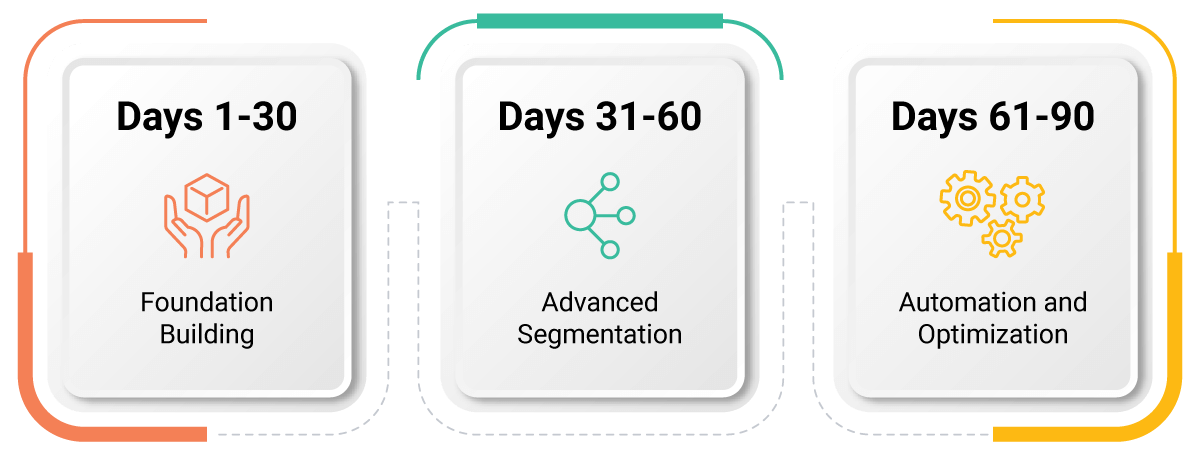
- Days 1-30: Foundation Building focuses on data collection and basic segmentation implementation. Audit existing customer data, implement progressive profiling strategies, create initial demographic and geographic segments, and establish data hygiene processes that support future personalization efforts.
- Days 31-60: Advanced Segmentation introduces behavioral targeting and dynamic content creation. Develop lifecycle-based segments, implement basic behavioral triggers, create dynamic content templates, and begin testing personalized subject lines and send times for performance optimization.
- Days 61-90: Automation and Optimization establishes sophisticated automated personalized email workflows and measurement systems. Deploy behavioral automation sequences, implement AI-powered recommendations where appropriate, establish comprehensive analytics tracking, and develop optimization protocols for continuous improvement.
You may run into some common implementation challenges like data quality issues, technology integration complexity, and resource allocation constraints. Address these proactively by establishing clear data governance policies, selecting compatible technology platforms, and allocating sufficient time for testing and optimization activities.
Pro Tip
Treat each 30-day phase as a sprint with measurable goals and feedback loops. Regularly review metrics such as open rate lift, segmentation accuracy, and automation efficiency to refine each phase before advancing.
Transform Your Email Marketing with Strategic Personalization
The Email Personalization Maturity Model is your roadmap from basic merge tags to AI-powered email campaigns that drive measurable results. By building a strong data foundation, advancing segmentation, and adopting automation and AI, you can create lasting customer connections and higher ROI while moving beyond generic messaging.
Salesgenie® gives you the clean, enriched prospect data and firmographics to activate these strategies fast—no need to wait months to build an internal database. Try Salesgenie today to start turning generic campaigns into revenue-driving personalization.
FAQs
You need accurate demographic, firmographic, and behavioral data to personalize effectively. Combining basic audience details with real-time engagement and purchase behavior enables messages that feel timely, relevant, and authentic.
Personalization works because it delivers relevance. When messages reflect each subscriber’s needs, interests, and timing, engagement naturally increases across every stage of the customer journey.
People often rely too heavily on first names, use outdated data, or ignore context. Effective personalization balances accuracy, timing, and respect for user preferences to avoid coming across as intrusive or irrelevant.
Automation, dynamic content, and AI make large-scale personalization possible. These tools customize messages in real time, ensuring every subscriber receives relevant offers without requiring manual segmentation.
Track metrics like personalization lift, click-through rates, and conversion performance to gauge effectiveness. Over time, improvements in engagement and customer lifetime value reveal the true impact of personalization.
Email personalization efforts respect privacy by using data responsibly and with explicit consent, following laws like GDPR and CCPA by obtaining permission before collecting data, clearly explaining how it’s used, and giving subscribers control over their preferences.