
What Is a B2B Sales Strategy?
A B2B sales strategy is your company’s plan for how to win business. It defines who you sell to, why customers choose you, how you reach them, and how success is measured. In practice, it connects the go-to-market to daily execution by turning business goals into a practical B2B sales plan with targets, territories, capacity, and accountability.
Sales strategy vs. sales tactics
Strategy sets the direction; tactics are how you carry it out.
- Strategy decides the markets, segments, and plays you’ll prioritize, as well as the KPIs you’ll use to measure success.
- Tactics are the actions reps take, such as emails, calls, discovery questions, demos, proposals. Tactics should vary by account and deal, but they should always align to the strategy’s specified guardrails.
In 30 Seconds: B2B sales strategy is a blueprint for finding, engaging, and winning the right customers. It aligns sales, marketing, and product teams around shared goals, ensuring consistent messaging and focus. This strategy defines how you structure territories, teams, tools, and metrics. Think of it as the big-picture direction while tactics are the daily moves that turn that vision into results.

Why You Need a Defined Sales Strategy
Imagine missing your goals three quarters in a row, not because your team can’t sell, but because you’re chasing the wrong accounts with inconsistent messaging and no shared plan. That’s the true cost of operating without a defined B2B sales strategy.
High-performing sales teams treat strategy like an operating system for the entire revenue org. It defines who you’re targeting, how you talk about your value, and how sales, marketing, enablement, and RevOps work together to move deals forward. The payoff is measurable. Research shows that when sales, marketing, and product operate from a shared strategy and metrics, companies achieve 19% faster revenue growth and 15% higher profitability.
Having a great strategy isn’t enough. It only works if your team consistently follows it. In other words, execution matters just as much as design. Sales teams see real gains in win rates and quota attainment when 75% or more of reps actually stick to the defined process.
In our B2B Sales 101 Guide, we emphasized that strategy is the foundation for growth. This guide walks you through the essentials: what a B2B sales strategy is, the core components, which strategy types fit which situations, and a step-by-step framework to build (and iterate) yours. If B2B Sales 101 is the big picture, this is the detailed blueprint you’ll use to drive growth day to day. If you’re comparing B2B sales strategies, this guide will help you choose and execute with confidence.
Core Components of a Winning B2B Sales Strategy
A solid sales strategy isn’t just a slide in a presentation but something your team applies every day. It’s reflected in how you define your market, position your value, and run your deals. The following components bring structure and focus to your efforts, helping you drive consistent, measurable growth.
Market Research & ICP Definition
Start by understanding the landscape: What segments exist in your market, and which ones are the best fit for your product or service? Use firmographics (like industry, company size, and region), technographics (like tools they use), and buying behavior to define your Ideal Customer Profile (ICP), helps define the type of customer that benefits most from your product or service.
Value Proposition & Messaging
Your value proposition should clearly communicate the problems you solve, the outcomes your solution delivers, and what makes you different from competitors. But it’s not enough to keep this high-level.
Translate that message into versions tailored by industry and buyer role. Include proof points like real results, case studies, or benchmarks to back up your claims. Equip your team with objection counters, which are concise responses to the common questions or pushback they’ll hear during sales calls. This lets reps personalize their pitch without drifting off-message.
Buyer Journey Alignment
To sell effectively, you need to understand how your buyers make decisions, not how you hope they do. That means mapping out the real-world journey your prospects take from first contact to closed deal.
Start by identifying the key questions buyers ask, the stakeholders involved at each stage, and the approvals they need before moving forward. For example, a mid-market deal might begin with a manager researching solutions, but the decision could ultimately rest with a VP and require IT or legal signoff.
Once you’ve mapped these steps, align your sales process accordingly. Ensure that your reps have the right content, talk tracks, and tools at each stage, whether that’s a one-pager to convince a technical buyer or a business case to win budget approval. Also define clear stage exit criteria, like confirmed interest or stakeholder buy-in, so deals move forward based on buyer progress, not just seller activity.
Sales Process Mapping
Your sales strategy needs a clear path to follow. That’s where a documented sales process comes in. Start by defining the key stages of your sales cycle—awareness, discovery, proposal, and so on.
For each stage, outline what the buyer needs to do to move forward (these are called verifiable customer actions, or VCAs). That could be things like booking a demo, confirming a budget, or involving the final decision-maker. Next, set inspection points, moments where managers or systems check that deals are progressing as expected. This helps catch stalled opportunities early. To keep everyone aligned, visualize the process in a simple flowchart, so reps, managers, and new hires all understand how to move deals from open to closed.
Finally, choose a sales methodology to support your process. For example, MEDDICC helps with qualification, while SPIN or Challenger are great for guiding discovery and messaging. The goal is consistency across the team—so every deal follows the same high-quality playbook.
Sales Enablement & Technology Stack
Your team needs more than just a strategy; they need tools and resources to carry it out. Sales enablement means giving reps the content and guidance to sell effectively: playbooks for process, talk tracks for key conversations, and materials that prove ROI.
Your tech stack should support the strategy, not complicate it. That includes a CRM to track deals, engagement tools to reach buyers, and AI features to help with qualification, forecasting, and coaching.
Team Structure & Roles
To run a smooth sales motion, every team member needs a clear role. Define who’s responsible at each stage of the sales cycle, from first contact to customer handoff. For example:
- Sales Development Representatives (SDRs) handle early outreach and lead qualification.
- Account Executives (AEs) manage discovery, demos, and closing the deal.
- Sales Engineers (SEs) support technical validation or product deep-dives.
- Customer Success (CS) ensures a strong onboarding and long-term customer health.
Make sure responsibilities are clearly assigned and handoffs are structured—this keeps deals from stalling and ensures a better experience for the buyer.
Types of B2B Sales Strategies
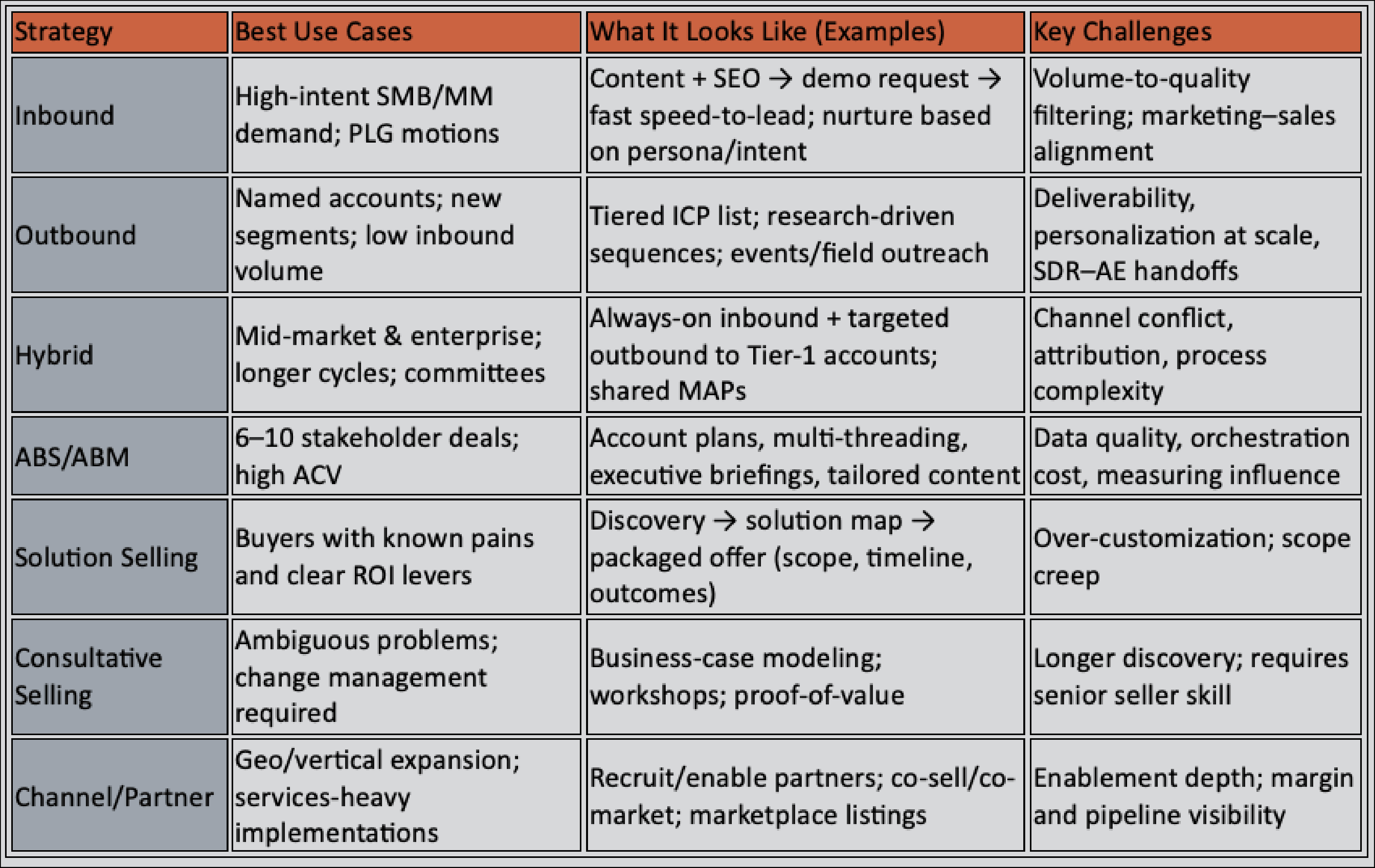
Your sales strategy influences nearly everything like how you talk to buyers, which channels you use, and what your sales process looks like inside your CRM. The key is finding a sales motion (or mix of various approaches) that fits your audience, deal size, and overall go-to-market approach.
Below, we’ll break down the major types of B2B sales strategies to help you pick the right fit or blend a few to suit your needs.
Inbound vs. Outbound vs. Hybrid
- Inbound sales strategies focus on attracting potential buyers by offering valuable content, optimizing for search engines (SEO), and using product-led signals. These strategies are most effective when your business already has strong brand recognition, consistent website traffic, and a clearly defined ideal customer profile (ICP). Once leads are generated, they’re routed to the sales team for follow-up and conversion.
- Outbound sales strategies involve proactively reaching out to prospects through targeted outreach, such as cold emails, calls, or event-based engagement. This approach is especially effective for businesses targeting specific ICPs, pursuing named accounts, or entering new markets where inbound interest is low or non-existent. A focused B2B outbound sales strategy means proactive, targeted outreach to high-fit accounts when inbound demand is thin or you’re entering new segments.
- Hybrid strategies combine the best of both worlds: continuous inbound lead generation with focused outbound efforts aimed at high-value Tier 1 accounts. This dual approach works well for mid-market and enterprise sales where multiple decision-makers are involved and buying cycles tend to be longer and more complex.
Account-Based Selling (ABS/ABM)
Account-based selling (also known as account-based marketing, or ABM) is a strategy where sales and marketing work together to focus on specific, high-value accounts—often called “named accounts.” Instead of casting a wide net, you craft tailored outreach plans (“plays”) for each target company, involve multiple decision-makers (“multi-threading”), and aim for executive-level engagement. This approach works best when deals are large, sales cycles are long, and you need buy-in from several stakeholders.
Solution Selling
Solution selling is about offering a complete answer to a customer’s specific business problem. You start by understanding the pain point the buyer is trying to solve and then package your product or service in a way that clearly addresses that problem. This method works well when the buyer already knows they have a challenge and is actively looking for a trusted partner to help solve it.
Consultative Selling
In consultative selling, the seller acts more like a trusted advisor than a product rep. You focus on asking smart questions, diagnosing the buyer’s needs, and helping them think through possible solutions and trade-offs. This strategy is especially useful for complex purchases or when the buyer isn’t sure what they need yet and could use help shaping their buying criteria.
Channel/Partner Sales Strategy
A channel or partner strategy means you don’t go to market alone. Instead, you work with outside parties, like resellers, implementation partners, or marketplaces. who help sell or deliver your product. This approach can expand your reach, boost customer trust, and help you enter new regions or industries more efficiently. It’s a great fit for companies with limited direct sales capacity or products that require services to implement.
Step-by-Step Framework to Build Your Strategy
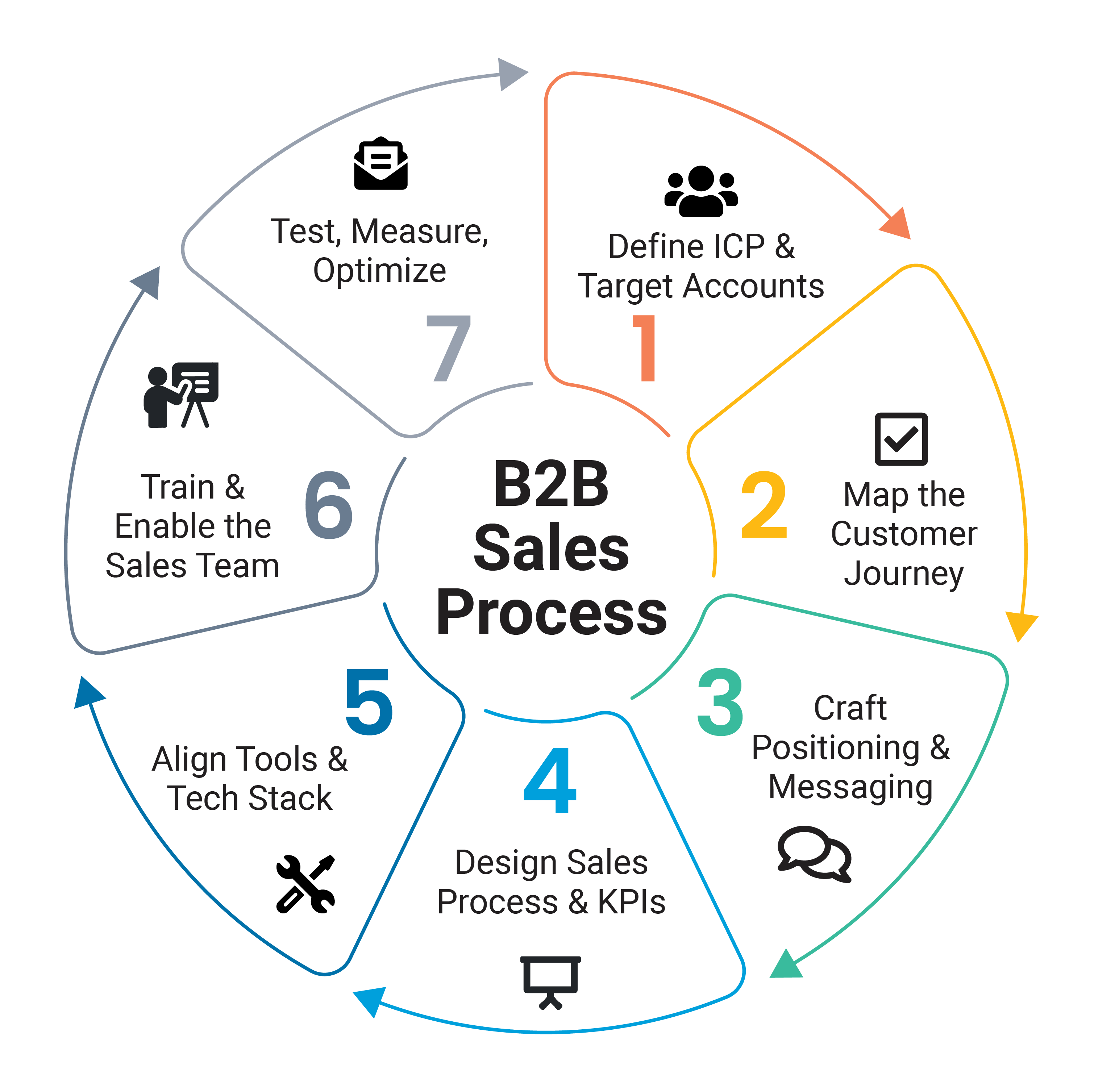
Step 1: Define ICP & Target Accounts
An ICP describes the type of company that’s most likely to see strong results and long-term value. Target accounts are the specific businesses that match your ICP and become the focus of your sales and marketing efforts.
Step 2: Map the Customer Journey
Document triggers, stakeholders, approvals, and risks through buyer interviews and call reviews.
Step 3: Craft Positioning & Messaging
Translate problems into outcomes and build role and industry-specific narratives with proof.
Step 4: Design Sales Process & KPIs
Operationalize the path to “closed won,” and define stages and verifiable customer actions, attach inspection points and KPIs, and choose supporting frameworks.
Step 5: Align Tools & Tech Stack
Make tools serve the process; configure CRM fields, engagement sequences, enablement libraries, and AI prompts.
Step 6: Train & Enable the Sales Team
Teach the plays, coach the behaviors, and reinforce with call reviews and deal clinics; track certification and adoption.
Step 7: Test, Measure, Optimize
Pilot with a pod or segment, inspect weekly via KPI dashboards and feedback, iterate monthly, and update the strategy playbook.
Real-World Examples of Winning Strategies
Example 1: SaaS startup uses Account‑Based Marketing (ABM) to unlock pipeline growth.
A SaaS startup wanted to grow its pipeline more efficiently. Instead of casting a wide net, they instead focused on a list of high-fit companies. The sales and marketing teams worked together to send tailored messages to key decision-makers at those companies, using tools that showed when prospects were actively researching hiring solutions.
This targeted approach helped them increase the number of quality opportunities by 40%, shorten their sales cycle by nearly 20%, and boost the number of inbound leads that turned into real deals.
Takeaway: Account-based strategies work best when you have a clear picture of who your best-fit customers are. Success depends on tight collaboration between sales and marketing, personalized outreach, and tracking meaningful engagement.
Example 2: Manufacturing firm runs a hybrid inbound/outbound engine.
A manufacturer wanted to increase both visibility and deal volume, so they built a hybrid strategy. They improved their website’s SEO, created helpful content, and ran targeted LinkedIn campaigns to attract inbound interest. At the same time, their sales team reached out directly to top accounts using personalized outbound messages.
By combining both efforts under one unified plan, they nearly doubled their organic traffic and built an active pipeline of 28 strategic accounts, several of which resulted in large RFPs and multi-site deals.
Takeaway: Inbound and outbound work better together. Use content to generate awareness, and outbound to engage high-fit accounts directly. Just make sure both sides are targeting the same audience and tracking performance in a shared funnel.
Common Mistakes to Avoid When Building a Strategy
Mistake 1: Too product‑centric, not buyer‑centric
It’s easy to fall into the trap of leading with features, especially if you’re proud of what your team built. But buyers aren’t evaluating specs in a vacuum, they’re looking for solutions to their problems, confidence in outcomes, and a partner who understands their world.
When your sales strategy centers on product instead of buyer needs, you’ll often see lower engagement, stalled conversations, and longer sales cycles. Even the best product pitch can fall flat if it doesn’t speak directly to what matters most to the customer.
How to fix it:
Flip the script. Start by identifying the core jobs your buyers are trying to get done, the risks they’re trying to avoid, and the outcomes they care about. Build your messaging and content around those insights. Then, map the buyer journey with what questions they ask, what internal approvals they need, and align each sales stage with verifiable customer actions (like “pilot approved” or “executive sponsor confirmed”) that show real progress, not just internal activity.
Mistake 2: Misalignment between Sales & Marketing
Even the best sales strategy will fall apart if Sales and Marketing aren’t rowing in the same direction. When the two teams use different definitions for key terms or target different ICPs, the result is predictable: finger-pointing, wasted budget, and a leaky funnel.
Sales says the leads aren’t qualified. Marketing says sales isn’t following up. And in the meantime, good opportunities fall through the cracks.
How to fix it:
Start by defining a shared ICP and tiering model so both teams are targeting the same accounts with the same expectations. Then align on what counts as a Marketing Qualified Lead (MQL) and Sales Qualified Lead (SQL) and put it in writing. Agree on clear service-level agreements (SLAs) for lead follow-up times and hold both teams accountable.
Mistake 3: Lack of meaningful and measurable KPIs
Without clear, actionable metrics, even the most thoughtful sales strategy turns into a guessing game. Teams chase vanity metrics like email open rates or top-of-funnel volume, while the real drivers of revenue like stage progression, win rate, sales cycle time, go untracked or ignored. When you can’t measure execution, it’s impossible to improve it. Worse, you can’t spot where deals are stalling or where reps need coaching.
How to fix it:
Start small. Choose a core set of non-negotiable KPIs that directly tie to your sales process, things like conversion rate between key stages, average time-in-stage, or forecast accuracy. Instrument those metrics in your CRM so they’re visible and easy to log.
Build a shared dashboard that updates automatically and becomes a fixture in weekly pipeline reviews. Then use what you learn to improve: adjust plays, retrain on weak spots, and flag early risks before they hit your number. You don’t need a dozen metrics, just a few that tell you what’s working and what’s not.
Key Takeaways: Checklist for a Winning Strategy
Use this checklist to prioritize the strategies to increase B2B sales that matter most.
- ICP and segmentation are clearly defined and tiered, so time and resources focus where you’re most likely to win.
- The buyer journey is mapped, including key triggers, stakeholders, approval steps, and deal risks.
- Messaging is tailored by role and industry, with value props, proof points, and objection responses baked in.
- Your sales process is documented and aligned to strategy, with clear stages, exit criteria, and verifiable customer actions.
- You’ve chosen a go-to-market motion intentionally (inbound, outbound, hybrid, or account-based), and accounts are worked from a shared plan.
- Territories, coverage models, and capacity planning are in place and revisited at least quarterly.
- You’re tracking meaningful KPIs: stage conversion rates, time-in-stage, win rate, pipeline coverage, and forecast accuracy.
- Enablement delivers what sellers need, including playbooks, talk tracks, ROI tools, and customer stories matched to each stage.
- Your tech stack supports the strategy—CRM, engagement, enablement, and AI tools are aligned to execution.
- Operating cadence is consistent: weekly pipeline reviews, monthly deal inspection, and quarterly strategy checkpoints.
- Team handoffs are clearly defined, and there’s a test–measure–improve rhythm to drive continuous optimization.
Next, dive into The B2B Sales Process to operationalize your strategy.
FAQs
A strategy sets the overall direction like who you’re targeting, what value you’re offering, and how you’ll win. The sales process is the step-by-step execution of that strategy, including the specific stages a deal moves through, what needs to happen at each stage, and how success is measured.
Look at both outcomes and execution. Outcome metrics include things like win rate, pipeline coverage by segment, revenue growth, and how quickly you recover customer acquisition costs. Execution metrics include stage conversion rates, time spent in each stage, forecast accuracy, and rep attainment.
Start with a narrow, well-defined ICP. A simple Hybrid approach is often most effective early on. Consider a lightweight account-based approach with a short list of named accounts, and document what’s working so you can repeat it.
Do light updates quarterly such as refining your ICP, messaging, and team coverage. Plan a deeper review every 6 to 12 months, or anytime there’s a major shift (like a new product launch, pricing change, or entry into a new market).
Yes. AI can help identify your best-fit customers, score leads and accounts, surface intent signals, and summarize sales calls. It can also flag risks in your forecast. But human judgment is still essential for messaging, pricing strategy, and closing complex deals.
Most teams can build a solid B2B sales strategy in four to eight weeks. The exact timeline depends on factors like deal complexity, number of segments, and level of cross-team alignment required. What matters most is ensuring the strategy is adopted and refined over time.
Ready to Put Your Sales Strategy Into Action?
Building a strategy is only the beginning. The real results come when you operationalize it with processes, plays, and tools working together to drive revenue.
Explore our B2B Sales Process Guide next, or get started with Salesgenie® to see how we can help you target, engage, and win the right customers faster.