

You’re hustling—posting on LinkedIn, attending networking events, maybe even cold calling during lunch breaks. But your pipeline still feels like a slot machine: unpredictable, frustrating, and impossible to scale. The problem isn’t effort. A repeatable system that connects the right prospects with the right message at the right time is absent from your strategy.
Here, you can learn how to build a client acquisition engine that delivers consistent results by aligning your niche, messaging, list-building, outreach cadence, and measurement into one cohesive framework.
Why Do Tactics Alone Stall Growth?
Picture this: You’ve read countless blogs, attended webinars, and maybe even invested in a new CRM. So you start trying a bit of everything—a Facebook post here, a cold call there, a random coffee meetup in between. A few months later, you’re hustling harder than ever but your pipeline is a roller coaster.
It’s a common story, and here’s why those scattered tactics aren’t working:
- Without a clear target audience, your messaging falls flat.
- Without consistent follow-up, you’re leaving money on the table.
- Without a compliance checkpoint, you’re one misstep away from regulatory fire drills.
So how do financial advisors get clients reliably? By aligning:
- Audience
- Message
- List building
- Outreach
- Measuring what works
Skip these steps, and you’ll keep burning precious hours chasing low-intent prospects. Worse, you’ll never have a system you can scale, because you won’t know which levers move the needle.
Pro Tip
If a tactic can’t be measured in 30 days (inputs and outcomes), park it. Focus on moves you can track right now, so you can make confident decisions about where to double down.
Which Niche Should You Own First?
As a financial advisor, you’ve likely heard the advice “choose a niche” ad nauseam. But what does that mean in practice? And how do you decide which slice of the market to focus on first?
Here’s a simple framework: look for a niche that offers strong fit, clear buying intent, and easy reachability.
- Fit means you understand the niche’s unique challenges, goals, and language. For example, helping tech employees navigate equity compensation and IPOs.
- Buying intent means there’s a visible, recurring trigger event you can target, like a liquidity event, job change, or retirement window.
- Reachability means you can source accurate contact data for your niche and know which communities they belong to, such as specific employers, associations, or local organizations.
- Tighter messaging that resonates and fills your calendar faster.
- Lower compliance risk, since your claims are tailored to a specific audience and scenario.
- Higher response rates, because relevance rules—targeted outreach to a well-defined niche will always outperform generic “we serve everyone” pitches.
Skip the niche-selection process, and your growth efforts will suffer. Without clear targeting, your marketing will be too generic to stand out. You’ll end up competing on price and personality rather than expertise.
Pro Tip
Set aside an hour this week to shortlist 2–3 potential niches using the Fit, Intent, Reachability framework. You can always expand later, but early focus will accelerate your results.
Why bother narrowing your focus? Three reasons:
What’s Your Compliant Value Message?
Once you’ve chosen a niche to focus on, the next step is crafting a clear, compelling message that speaks to their specific needs without risking compliance. The key? Promise a concrete outcome that’s tied directly to a known trigger event for your niche.
Example: “Make your tech IPO windfall last 30 years without sacrificing your lifestyle.”
Why is specificity so important? Simply put, it drives more meetings. When your message is tailored to a prospect’s unique situation, they’re far more likely to engage. And it reduces compliance headaches, because the more specific your claims are to a particular scenario, the easier it is to keep them compliant.
How to Stay Within RIA/CFP Guardrails
As a financial advisor, your messaging needs to stay on the right side of regulations at all times. That means understanding the difference between educational content and promissory language, and using disclosures whenever necessary.
For RIAs and CFPs, certain phrases are simply off-limits in marketing. Avoid terms like “beat the market,” “guaranteed returns,” or “risk-free” at all costs. Instead, focus on the concrete value you provide in language that’s crystal clear to both prospects and regulators.
Why it matters: Every piece of marketing content should be documented, pre-approved by compliance, and stored for recordkeeping. When in doubt, err on the side of caution and get compliance approval before hitting send.
Message Angles That Convert
So what goes into a compelling, compliant message? Try this simple structure:
- Lead with a known trigger event for your niche
- Highlight the cost of inaction
- Promise a specific outcome
- Provide proof via a relevant case study (not returns or guarantees)
Example: “When your company goes IPO, you’ll face a ticking tax timebomb on your shares. Without proper planning, you could lose significant equity to Uncle Sam. Our IPO Success Roadmap has helped tech executives keep more of their hard-earned equity while still achieving their lifestyle goals. Let’s walk through your options.”
See how that works? We’re speaking directly to a niche (tech employees), highlighting a trigger event (IPO), promising a specific outcome (keeping more equity), and backing it up with a relevant case study. No vague claims. No banned phrases. Just a clear, compliant message laser-focused on the prospect’s needs.
Pro Tip
Spend a few hours this month building a library of pre-approved subject lines, opener templates, and calls-to-action. Having a set of proven, compliant messages at your fingertips will speed up your outreach efforts without sacrificing quality or consistency.
How Do You Build a Qualified Prospect List?
You’ve got a razor-sharp niche and a compelling message—now it’s time to build a list of qualified prospects to engage. The key here is quality over quantity. You want accurate, up-to-date contact information for people who fit your ideal client profile to a tee. Anything less will tank your response rates, no matter how great your messaging is.
Choose Reachable, Verified Data
Not all prospect data is created equal. Free lists scraped from the internet are riddled with inaccuracies and missing fields. If you’re serious about filling your pipeline, it pays to invest in a reputable data provider.
Look for data that’s:
- Is verified regularly for accuracy (email, phone, title, etc.)
- Is GDPR and CCPA compliant
- Is searchable by multiple criteria (more on this next)
- Is exportable to your CRM or marketing tools
This last point is crucial for independent advisors looking to scale. You need a data source that integrates seamlessly with your tech stack so you can build lists quickly and compliantly.
Apply Filters That Matter
Once you have a reliable data partner, it’s time to build a hyper-targeted list. The goal is to zero in on prospects who match your niche as closely as possible.
Start with basic firmographic and demographic filters:
- Company size, industry, and location
- Title, role, and seniority level
- Age range and income level
Then layer on event-based triggers that indicate a prospect is ready for your services:
- Retirement window (e.g., age 55–60)
- Job change or promotion
- Company IPO or liquidity event
- Sale of a business
- Sudden wealth event (inheritance, lottery win, etc.)
The more specific you can get with your filters, the more qualified your list will be. Don’t be afraid to start narrow and expand gradually as you validate your targeting.
Pro Tip
As you build your list, tag each record with the relevant trigger event (e.g., “retiring in 12–24 months”). This will allow you to customize your outreach cadence and messaging to speak directly to their situation. No more generic “financial advice for everyone” blasts.
How to Build an Outreach Cadence That Wins Meetings
You’ve got a targeted list and a compelling message, so now it’s time to put them to work with a strategic outreach cadence. By planning a series of touchpoints in advance, you can stay top-of-mind without being pushy and maximize your chances of getting a response.
What breaks if you skip this step? You’ll leave qualified prospects on the table simply because you didn’t follow up enough times. Research shows most sales require five or more touches, yet most advisors give up after one or two attempts.
Here’s what a winning nine-touch cadence might look like:
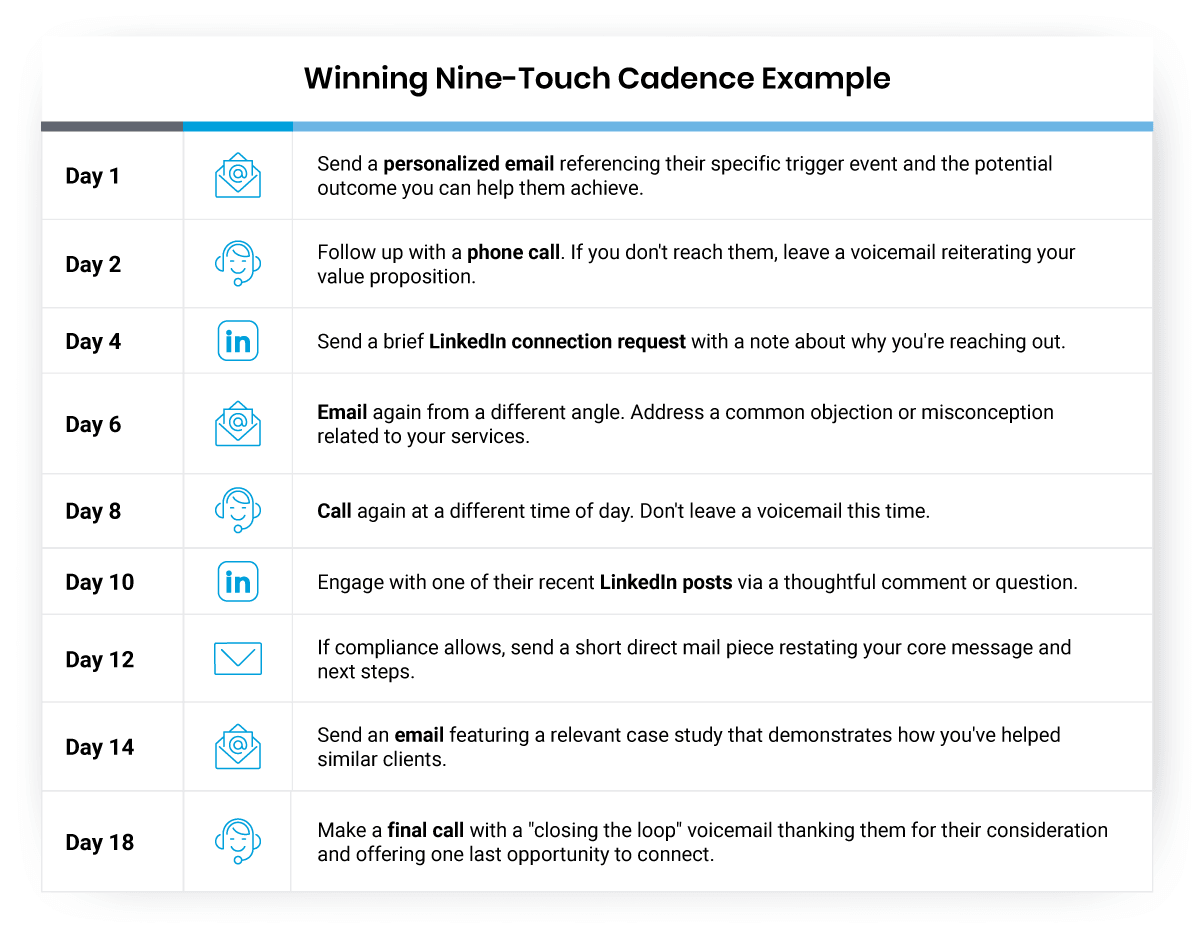
Here are some key things to remember about this cadence:
- Strike a balance between persistence and respect. You want to give the prospect multiple opportunities to respond without bombarding them.
- Alternate sequences between email, phone, and social touches, with the potential for a direct mail piece if your compliance team approves. This multi-channel approach increases your odds of getting through and demonstrates your commitment to adding value.
- Customize each touchpoint to the prospect’s unique situation. Remember those trigger event tags we talked about in the last section? Use them to tailor your messaging and make each interaction feel relevant and timely.
How Do You Create a Referral Engine?
While proactive outreach fills your pipeline with new prospects, referrals from existing clients and centers of influence can supercharge your growth with warm, pre-qualified leads. The key is building a systematic approach to earning and activating referrals, not just hoping they happen organically.
Start by identifying your most satisfied clients—those who’ve achieved meaningful outcomes working with you and naturally speak highly of your services. Then make it easy for them to refer by providing specific language they can use and clear criteria for who makes a good fit.
Example: “If you know any colleagues at your company who are approaching their IPO lock-up period, I’d love to help them navigate the same tax-efficient strategies we used for you. Just introduce us via email and I’ll take it from there.”
Beyond client referrals, cultivate relationships with professionals who serve your target niche but don’t compete with you directly. Think CPAs, estate attorneys, HR executives at target companies, and industry association leaders.
These centers of influence can become a steady source of qualified introductions if you:
- Provide value first (share insights, make introductions, co-host events)
- Stay top-of-mind through regular, non-salesy touchpoints
- Make it easy for them to refer by clearly defining your ideal client
- Close the loop by updating them on outcomes (with client permission)
The advisors who master referral generation don’t treat it as a passive byproduct of good service. They build intentional systems that make referrals a predictable, measurable part of their pipeline.
What Derails Advisor Pipelines?
Even with a solid system in place, certain pitfalls can quietly sabotage your client acquisition efforts. Recognizing these common derailers early allows you to course-correct before they become chronic problems:

Inconsistent execution
You launch a new outreach campaign with enthusiasm, see modest results in the first few weeks, then let it slide when client work picks up. Sporadic effort produces sporadic results.

Poor list hygiene
You build a great list, but never update it as contacts change jobs, emails bounce, or prospects convert to clients. Over time, your data degrades and your response rates plummet.

Messaging drift
You start with a tight, niche-specific message, but gradually water it down to appeal to a broader audience. Before long, you’re back to generic pitches that don’t resonate with anyone.

Ignoring compliance
You skip the pre-approval process to move faster, or you borrow language from a competitor without vetting it. One regulatory misstep can derail months of progress and damage your reputation.
Block time each week to execute your cadence, review your data, refine your messaging, and ensure compliance. Treat prospecting like the mission-critical business function it is, not a side project you’ll get to “when you have time.”
Show Up Where Prospects Already Are
While outbound prospecting is essential, strategic visibility in the places your niche already gathers can dramatically accelerate your pipeline. The goal isn’t to be everywhere; it’s to be present and valuable in the specific communities your ideal clients trust.
Start by identifying where your niche congregates online and offline. For tech employees, that might be company Slack channels, Reddit communities like r/financialindependence, or local meetups for startup professionals. For pre-retirees, it could be AARP events, community education classes, or LinkedIn groups focused on retirement planning.
Once you’ve identified these channels, focus on providing genuine value before ever pitching your services:
- Answer questions thoughtfully in online forums
- Speak at industry conferences or local events
- Write guest articles for niche publications
- Host educational webinars on trigger-event topics
- Sponsor or participate in association events
The key is consistency and patience. You’re building trust and authority over time, not chasing immediate conversions. When prospects in these communities eventually need financial advice, you’ll be the obvious choice because you’ve already demonstrated expertise and earned credibility.
Pro Tip
Track which visibility channels drive the most inbound inquiries and double down on those. Not every community will be worth your time, so let the data guide your focus.
Measure and Optimize With Pipeline Math
You can’t improve what you don’t measure. The difference between advisors who scale predictably and those who stay stuck in feast-or-famine mode often comes down to one thing: rigorous tracking and data-driven decision-making.
Start by establishing clear metrics for each stage of your pipeline:
- List quality: Email deliverability rate, phone connect rate
- Outreach effectiveness: Open rate, response rate, meeting booking rate
- Conversion efficiency: Discovery-to-proposal rate, proposal-to-close rate
- Referral velocity: Referrals per client, referral-to-client conversion rate
Track these metrics weekly, and look for patterns. And remember, small, incremental gains across multiple metrics compound into dramatic pipeline growth over time.
Pro Tip
Set a weekly “pipeline review” appointment with yourself. Spend 30 minutes analyzing your numbers, identifying one bottleneck, and testing one improvement. This habit alone will put you ahead of 90% of advisors.
Conclusion: Turn Consistent Actions Into Consistent Clients
The real secret to success as a financial advisor isn’t any one tactic or tool, it’s the discipline to execute a focused plan consistently over time. When you commit to this system, your pipeline becomes more predictable, your close rates improve, and your client base grows organically.
That’s where Salesgenie® becomes your force multiplier, delivering the verified, compliant prospect data and integrated tools you need to execute this system at scale without the manual busywork.
Register with Salesgenie to start building your repeatable client acquisition engine.
FAQs
Without a clear target audience, a consistent follow-up system, and compliance checkpoints, tactics become ineffective and unpredictable. Success requires aligning audience, message, list-building, and outreach into a measurable system rather than trying random approaches.
Look for a niche that offers strong fit (you understand their challenges), clear buying intent (visible trigger events like IPOs or retirement), and easy reachability (accessible contact data and known communities). This framework helps you target effectively rather than trying to serve everyone.
Promise a concrete outcome tied to a specific trigger event for your niche, like “Make your tech IPO windfall last 30 years without sacrificing lifestyle.” Avoid banned phrases like “guaranteed returns” and focus on specific value you provide with relevant case studies as proof.
A winning cadence typically includes 8-9 touchpoints over 18 days, alternating between email, phone calls, LinkedIn engagement, and potentially direct mail. The key is persistence without being pushy, giving prospects multiple opportunities to respond across different channels.
Taking a scattershot approach by jumping from one tactic to another without giving strategies time to work. Sustainable growth comes from consistently executing a focused plan with the same niche, message, and outreach process while making data-driven adjustments over time.