
As a B2B marketer, you’ve likely faced this frustrating scenario: you pour effort into SEO, driving more traffic to your website month after month, yet when you dig into the numbers, you realize that your sales pipeline hasn’t grown at the same pace. The harsh truth is that the problem is a lack of fit. Many of the companies finding your site aren’t a match for your product or service, resulting in wasted effort and missed opportunities.
But there’s good news: by leveraging customer and lead data to inform your SEO strategy, you can attract more of the right companies, the ones most likely to convert into qualified opportunities and, ultimately, revenue.
In this blog, we’ll walk you through how to improve your SEO performance with a practical, step-by-step approach using the data you already have, focusing on the actions that drive real results.
Why Improve SEO with Buyer Data?
For too long, B2B marketers have focused on metrics like website traffic and keyword rankings. But those numbers don’t tell the whole story. You can have the top spot on Google for a bunch of keywords, but if the people clicking through aren’t a good fit for your product, all that visibility isn’t going to translate into revenue.
Use what you know about your best customers and highest-converting leads to guide your SEO strategy so you can start optimizing for the metrics that really matter: qualified leads and pipeline.
Here’s what you’ll avoid:
- Vanity metrics so you can start focusing on what drives revenue
- Investing in the wrong pages and keywords
- Missing out on in-market accounts
Which Buyers Should You Optimize For First?
Not all buyers are created equal. The key is to get crystal clear on your ideal customer profile (ICP). Look for patterns among your best customers and highest-converting leads using firmographic data:
- What industries are they in?
- How big are their companies in terms of revenue or employee count?
- What regions are they concentrated in?
- What technologies do they tend to use?
Once you’ve identified a few key characteristics, work with your sales team to validate which of these segments are most likely to convert. You’ll see results faster by focusing your efforts on the companies most likely to buy, and you’ll avoid attracting leads that aren’t a good fit.
Pro Tip
Pick the top 1–2 characteristics that matter most for your business, and use those to guide your SEO strategy. Remember, the goal isn’t to get on the right track. It’s to focus on the buyers that are most likely to turn into customers.
What Customer Data Sharpens Topic and Keyword Choices?
Choosing the right keywords requires thinking about intent. What are your ideal buyers searching for when they’re in the market for a solution like yours? The best way to figure that out is to go straight to the source: your customers and prospects.
Use Firmographics to Narrow Keywords
Use your ICP characteristics to qualify your keyword list.
Example
If you’re targeting enterprise companies, you might add modifiers like “for large businesses” or “enterprise-grade” to your seed keywords. This will help you attract more of the right folks and fewer of the wrong ones.
Tap Intent Signals and CRM Notes
Tools that provide intent data can show you which accounts are actively researching topics related to your product. If you see a spike in intent around a particular keyword, that’s a good sign it’s worth targeting.
Your sales reps are having conversations with potential customers all day long, so mining your CRM data can uncover common themes and phrases to target with your content. Look at the notes from your closed-won and closed-lost opportunities. What language did these buyers use to describe their pain points and goals?
Pro Tip
Build a “do not target” list of keywords that tend to attract the wrong segments. This might include broad, top-of-funnel terms as well as keywords that are specific to industries or use cases that aren’t a good fit for your product.
How Do You Map Intent to Page Types?
You’ve got your list of customer-validated, intent-qualified keywords. Now it’s time to map those keywords to the right types of content. To avoid mismatches that lead to bounces and poor conversions, you need to get crystal clear on the intent behind each of your target keywords.
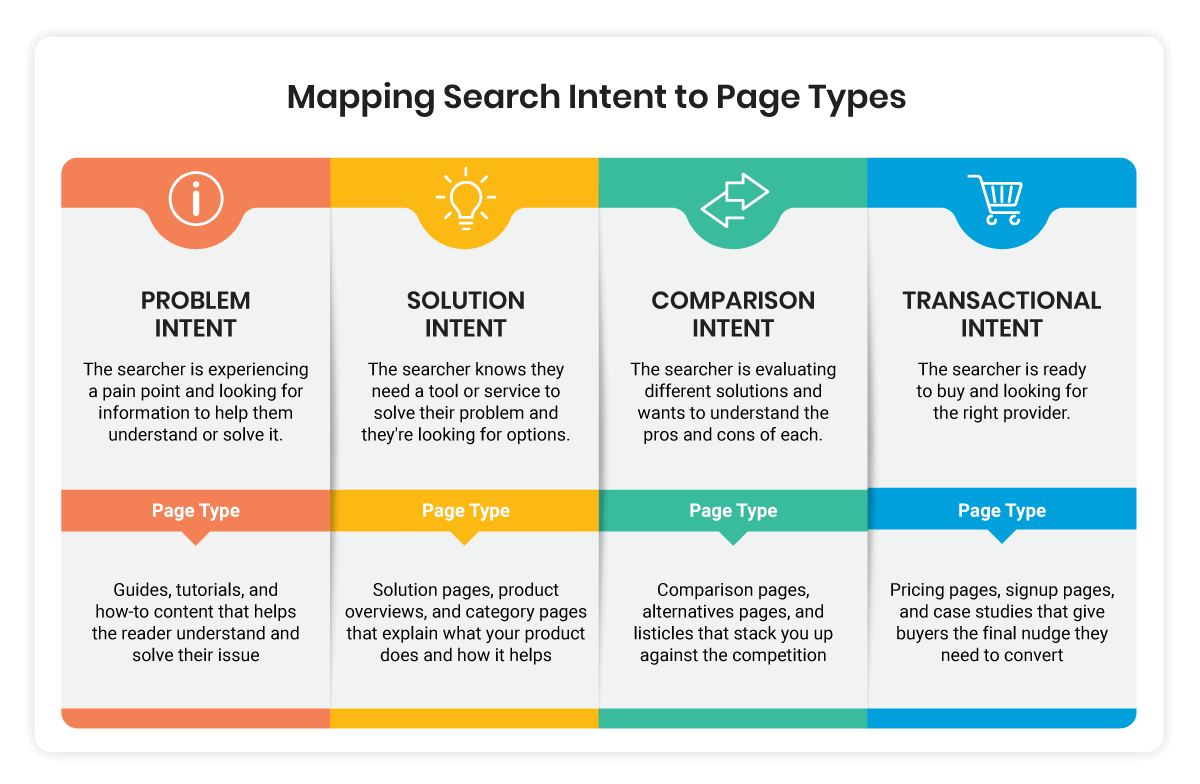
In general, there are four main types of search intent:
- Problem intent: The searcher is experiencing a pain point and looking for information to help them understand or solve it.
- Solution intent: The searcher knows they need a tool or service to solve their problem and they’re looking for options.
- Comparison intent: The searcher is evaluating different solutions and wants to understand the pros and cons of each.
- Transactional intent: The searcher is ready to buy and looking for the right provider.
Once you’ve classified your keywords by intent, match them to the appropriate page type:
- Problem intent: Guides, tutorials, and how-to content that helps the reader understand and solve their issue
- Solution intent: Solution pages, product overviews, and category pages that explain what your product does and how it helps
- Comparison intent: Comparison pages, alternatives pages, and listicles that stack you up against the competition
- Transactional intent: Pricing pages, signup pages, and case studies that give buyers the final nudge they need to convert
Getting this match right increases conversion rates and reduces bounce rates. When a searcher lands on a page that matches their intent, they’re much more likely to stick around and take the next step.
On-Page Fixes That Lift Qualified Traffic
Even the most targeted keywords won’t deliver qualified leads if your on-page SEO is a mess. Effective on-page optimization for B2B boils down to three key elements: messaging that speaks to buyer pain points, social proof that’s relevant to your ICP, and page structure that’s scannable and SERP-friendly.
Messaging That Screens For Fit
Your headlines, subheads, and body copy should directly address the challenges and objectives that are top-of-mind for your target buyers. Use the same language they use to describe their problems and desired outcomes. By speaking directly to your ICP’s needs, you become a magnet for your most valuable prospects.
Here’s how to optimize your on-page elements:
- Align your H1 and page intro copy with your ICP’s most pressing pain point or desired outcome
- Include industry-specific and role-specific language in your H2s and body copy
- Add schema markup to help search engines better understand and display your content
- Use internal links to guide readers to key mid- and bottom-funnel pages
- Place ICP-relevant logos, testimonials, and success metrics in prominent above-the-fold locations
What Technical Issues Block B2B Buyers?
If your technical SEO foundation is shaky, even the most compelling content can fail to reach and convert your target buyers. Technical SEO issues are especially challenging for B2B sites, which tend to have complex architectures, lengthy buying cycles, and strict security requirements.
Watch out for these common technical SEO issues:

Crawlability issues
If search engine bots can’t easily crawl and index your pages, they won’t show up in search results. Common crawlability blockers include broken links, orphan pages, and suboptimal internal linking structures.

Indexation bloat
Some B2B sites have too many low-value pages in their index. This can happen when you have lots of thin, duplicate, or auto-generated pages that don’t provide unique value to searchers.
In terms of site speed, B2B buyers won’t wait for slow pages. Research shows that slow site speed directly impacts conversion rates. Bloated code, unoptimized images, and excessive third-party scripts are common speed killers.
If your site has glaring security holes, like outdated SSL certificates or missing security headers, you’ll have a hard time convincing prospects to hand over their sensitive data.
Pro Tip
Prioritize technical fixes on your highest-intent pages first. These are the pages that are most likely to drive conversions and revenue, like your product pages, pricing pages, and integration guides. By ensuring that these critical assets are easy to find, fast to load, and secure to interact with, you can maximize the impact of your technical optimizations.
How Do You Prove Lead Quality Gains?
The key is to connect your SEO metrics to business outcomes at every stage of the funnel. That means going beyond surface-level metrics like traffic and rankings, and instead focusing on lead quality indicators that tie directly to pipeline and revenue.
To get started, have your forms capture key buyer data like job title, company size, and industry. Then, connect your organic traffic to CRM outcomes using UTM parameters and hidden form fields to pass source and page data into your CRM. This will allow you to track how organic visitors progress through your funnel.
Lead-Quality Metrics That Matter
Focus on a handful of key metrics that directly connect your organic traffic to revenue:
- Qualified visit rate: The percentage of organic visits that meet your target buyer criteria
- Organic demo request rate: The percentage of organic visits that result in a demo request or contact form submission
- Organic-to-MQL and -SQL conversion rates: The percentage of organic leads that convert to marketing-qualified and sales-qualified status
- Pipeline and revenue per organic visit: The average amount of pipeline and revenue generated per organic session
By tracking these metrics over time, you can prove the value of your SEO efforts and make data-driven decisions about where to focus your resources for maximum impact.
Attribution Setup Without Overkill
Start with a simple first-touch attribution model, where you give 100% credit to the initial organic source that drove a lead into your funnel. As you get more sophisticated, you can layer on assist touches to account for the impact of organic content throughout the buyer’s journey.
The key is to focus on directional accuracy over perfect precision. Use UTM parameters consistently, and make sure your CRM is set up to capture source data at each stage of the funnel.
Pro Tip
Create a dashboard that shows the flow of organic traffic through your key funnel stages: qualified organic visits, organic demo requests, organic-sourced MQLs and SQLs, and pipeline and revenue influenced by organic content. By tracking this cascade week over week, you can show the direct impact of your SEO efforts on lead quality and revenue generation.
Which Data-Driven SEO Pitfalls Should You Avoid?
As you start to incorporate more data into your SEO strategy, watch out for these common pitfalls:
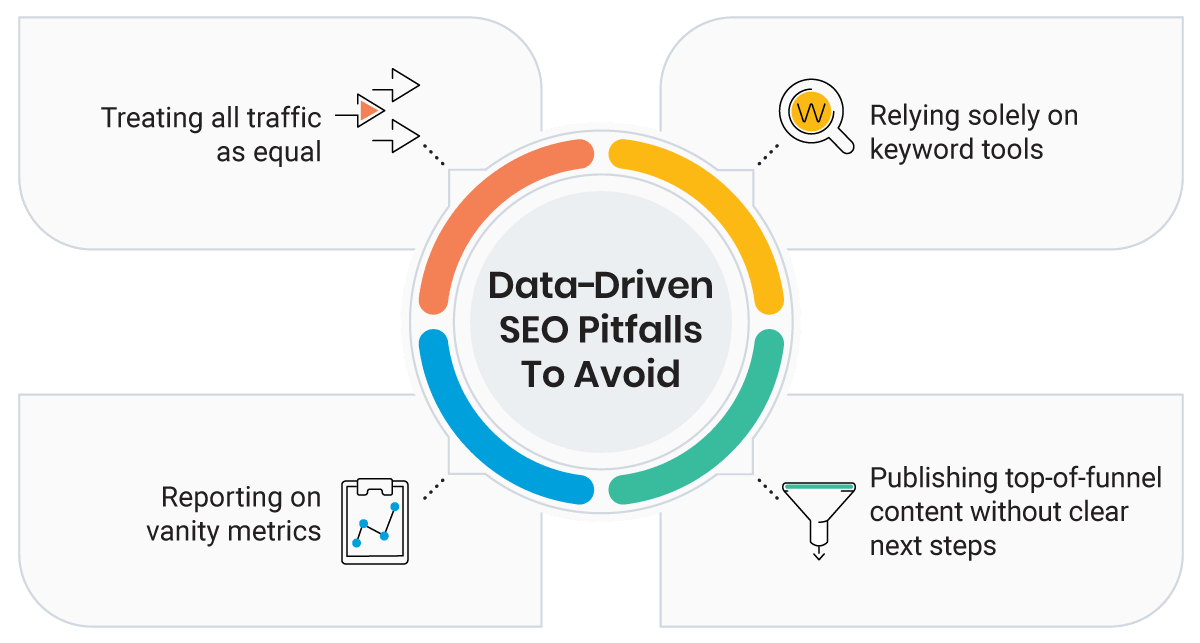
Treating all traffic as equal
Not all visitors are created equal. Score your visitors based on fit using firmographic and behavioral data to identify your most qualified leads.
Relying solely on keyword tools
Combine keyword tool data with real-world insights from your CRM and sales team to build a more targeted and effective keyword strategy.
Publishing top-of-funnel content without clear next steps
Create middle- and bottom-of-funnel content that helps move prospects closer to a purchase decision, and include clear calls-to-action on all of your content.
Reporting on vanity metrics
Focus on metrics that directly connect to business results—like qualified lead volume, conversion rates, and pipeline generated—rather than overall traffic volume and keyword rankings.
Conclusion
The key to driving more qualified leads and revenue with SEO is to re-center your efforts around your best-fit buyers.
You can attract more of the right people to your site and guide them toward a purchasing decision by:
- Defining what an ideal customer looks like for your business
- Choosing topics and keywords based on real customer data
- Matching search intent to the right types of pages
Whether you’re just getting started with SEO or looking to take your existing strategy to the next level, adopting a buyer-first approach is essential for driving more qualified leads, pipeline, and revenue from your organic search efforts.
Contact a Salesgenie® representative to discuss our SEO solutions to help you get on the right track.
FAQs
Using customer data helps you attract qualified leads who are more likely to convert into revenue, rather than just driving high traffic from visitors who aren’t a good fit for your product. This approach ensures your SEO efforts focus on metrics that actually drive business results like qualified leads and pipeline growth.
Focus on won/lost deal notes, CRM conversation data, and customer interviews to understand the language buyers actually use when describing their problems and evaluating solutions. Layer in firmographic data (company size, industry) and intent data to ensure you’re targeting keywords that attract your ideal customer profile.
Map problem intent keywords to guides and tutorials, solution intent to product pages, comparison intent to competitive content, and transactional intent to pricing and case study pages. This alignment increases conversion rates by giving searchers exactly what they’re looking for based on where they are in the buying process.
The most critical issues include crawlability problems that prevent pages from being found, slow site speed that causes prospects to bounce, security vulnerabilities that damage trust, and indexation bloat that makes important content hard to discover. Prioritize fixing these issues on your highest-intent pages first.
Track metrics that connect organic traffic to revenue outcomes, such as qualified visit rates, organic-to-SQL conversion rates, and pipeline generated per organic visit. Use UTM parameters and CRM integration to create a simple weekly cascade showing how organic traffic flows through each funnel stage to closed deals.