

The harsh truth about B2B content marketing? Most companies are drowning in vanity metrics while their sales teams starve for qualified leads. Content marketing leads represent the critical intersection between strategic content creation and measurable revenue generation, and many marketers struggle to connect their content efforts to actual pipeline growth. The pipeline-first framework transforms this dynamic by reverse-engineering content strategy from revenue goals, ensuring every blog post, eBook, and video directly contributes to qualified lead generation and closed deals.
You’ll learn how to structure a content conversion funnel that moves prospects from awareness to decision, how to implement qualification systems that sales teams trust, and how to use content performance tracking to prove the revenue impact of content.
Why Traditional Content Marketing Falls Short for Lead Generation
The vanity metric trap has led many teams to celebrate traffic spikes and social engagement while missing the bigger picture: revenue. A viral post with 50,000 views means nothing if visitors lack buying intent. When KPIs prioritize impressions instead of customer acquisition through content, marketing optimizes for the wrong outcomes.
Misalignment between content and the sales cycle creates a disconnect. Marketers often produce top-of-funnel pieces without addressing the deeper questions prospects have as they evaluate solutions. The result is a library heavy on awareness but lacking strong buyer persona content, middle-funnel materials, and bottom-funnel proof needed to drive conversions.
The Pipeline-First Content Framework Explained
The pipeline-first approach fundamentally reframes content marketing as a revenue-generating function rather than a brand awareness activity. Follow these tips to get started:
- Start with your quarterly or annual revenue targets and reverse-engineer the content strategy needed to achieve those goals.
- Map every piece of content to specific funnel stages and buyer intent levels to ensure strategic alignment throughout the customer journey.
- Focus relentlessly on inbound lead generation rather than raw volume metrics that inflate your database with unqualified contacts.
- Build measurement systems from day one that connect content performance to pipeline outcomes and revenue attribution.
Understanding Content Marketing Funnel Stages
Top-of-Funnel Content for Awareness
Your primary goal at this stage is driving qualified volume while capturing early-stage buyer interest through educational, problem-focused content. This is where strong lead-magnet content plays a major role in fueling the top of your content conversion funnel.
The most effective formats include:
- Industry trend reports and market research
- Educational blog posts addressing common challenges
- Thought leadership podcasts and video series
- Interactive tools like assessments or calculators
Middle-of-Funnel Content for Consideration
At this stage, prospects are actively evaluating solutions and need content that demonstrates your unique value proposition and competitive advantages. High-performing content types include:
- Detailed solution comparison guides
- Industry-specific case studies and success stories
- Product demo videos and interactive tours
- Buyer’s guides and evaluation frameworks
Bottom-of-Funnel Content for Decision
Prospects need precise information to make confident decisions, and targeted content distribution channels ensure these assets reach them at the right time. The most impactful formats include:
- ROI calculators and business case templates
- Implementation timelines and success frameworks
- Customer reference stories and testimonials
- Free trial offers and proof-of-concept programs
Building Your B2B Content Marketing Lead Generation System

Define Your Ideal Customer Profile (ICP)
Your ICP serves as the foundation for all content decisions, ensuring every piece resonates with prospects who can actually buy your solution. Start with firmographic criteria including:
- Company size (employee count and annual revenue)
- Industry verticals and sub-segments
- Geographic location and market maturity
- Growth stage and funding status
After you define the criteria:
- Layer in behavioral indicators that signal buying intent and content consumption preferences. Look for prospects who engage with competitor content, attend industry events, download solution-focused resources, and visit key pages on your website.
- Map specific pain points to content topics, ensuring your editorial calendar addresses the challenges that keep your ICP awake at night.
- Develop a comprehensive lead scoring framework that weights both demographic fit and behavioral engagement. Assign point values for company size, industry match, job title relevance, and content consumption patterns.

Create Content That Converts
Topic selection should be driven by buyer intent data rather than keyword volume or trending industry discussions. Use tools like G2, TrustRadius, and review sites to understand what questions prospects ask during their evaluation process. Analyze sales call recordings and lost deal post-mortems to identify content gaps in your current library.
Format optimization requires matching content types to both funnel stage and audience preferences within your ICP. Survey your existing customers about their content consumption habits and preferred formats.
Call-to-action strategy should implement progressive profiling that gathers information incrementally across multiple touchpoints. Start with basic contact information and company details, then layer in budget, timeline, and decision-making process data through subsequent content interactions.

Implement Lead Capture and Enrichment
Form optimization requires constant testing to balance data collection needs with conversion rate performance. Start with minimal required fields and use progressive profiling to gather additional information over time. Test different form lengths, field types, and value propositions to maximize conversion rates while maintaining lead quality standards.
Data enrichment should happen automatically through integration with B2B databases and intent monitoring platforms. Append firmographic details, technographic information, and contact data to create complete prospect profiles that sales teams can act upon immediately.
Lead routing automation must consider both qualification scores and sales team capacity to ensure optimal follow-up timing and assignment. Route high-scoring leads to senior sales representatives while directing early-stage prospects to inside sales or marketing automation nurture campaigns.
Pro Tip
Prioritize precision over volume. Building your system around a sharply defined ICP and intent-driven content will dramatically increase the quality of the leads you generate. When every touchpoint is mapped to buyer signals and enriched with accurate data, your content becomes a reliable engine for creating sales-ready opportunities.

Leveraging Buyer Intent Content Strategy
A strong buyer intent content strategy turns data into direction—helping you recognize when prospects are actively researching, comparing, or ready to buy. By aligning content with these intent signals, you can deliver timely, personalized experiences that guide decision-makers through the funnel with precision.
- Understanding intent signals requires monitoring both first-party behavioral data and third-party intent indicators across the broader web. Track website behavior patterns including page visits, content downloads, time spent on key pages, and return visit frequency. Layer in search behavior, social media engagement, and review site activity to build comprehensive intent profiles.
- Content personalization should adapt messaging based on both explicit data (company size, industry, role) and implicit behavioral signals (content consumption patterns, engagement frequency, topic preferences). Use dynamic content blocks, personalized email sequences, and customized landing pages to deliver relevant experiences that advance prospects through your funnel.
- Account-based content strategies target high-value prospects with highly customized experiences designed around their specific challenges and business context. Create industry-specific case studies, role-based content tracks, and company-size-appropriate messaging that speaks directly to your most valuable potential customers.
- Intent-based follow-up systems should trigger automated sales outreach when prospects demonstrate high-intent behaviors like visiting pricing pages, downloading bottom-funnel content, or engaging with competitor comparison materials. Set up alert systems that notify sales representatives when target accounts show increased engagement or multiple stakeholders begin consuming content.
Tools and Technology for Content-to-Pipeline Success
Driving real pipeline impact from content depends on creative ideas, as well as the technology that connects every stage of the buyer journey. The right mix of platforms streamlines how content is planned, distributed, and tracked, while ensuring leads are captured, enriched, and nurtured with precision.
Content Management and Creation
Your planning platform should connect directly to your customer relationship management (CRM) platform and marketing automation tools. SEO should focus on intent-driven terms to attract prospects actively exploring solutions. Analytics must connect engagement to outcomes through robust content performance tracking.
Lead Capture and Enrichment Platforms
Accurate contact data, including firmographic and technographic details, is essential for engaging the right decision-makers. Integrated systems keep data fresh while enabling targeted outreach through precise audience filters.
Marketing Automation and Nurturing
Automation transforms engagement into momentum, tailoring nurture tracks to industries, roles, and lifecycle stages. Lead scoring helps sales prioritize high-intent prospects while real-time alerts keep reps informed about buyer activity across your content distribution channels.
Measuring Content Marketing Lead Generation Success
Measuring content marketing’s impact on lead generation is ultimately about proving how content drives qualified opportunities and revenue. By tracking the right metrics, connecting content performance to pipeline outcomes, and continuously refining through data-driven insights, marketers can demonstrate true business impact.
Key Metrics That Matter
- Lead volume and quality metrics: Track Marketing Qualified Leads (MQLs) generation rates, Sales Qualified Leads (SQLs) conversion percentages, and opportunity creation numbers to understand how effectively your content moves prospects through the funnel.
- Content attribution analysis: Use multi-touch attribution models to understand how different content assets work together throughout the buyer’s journey, identifying high-performing pieces that deserve additional promotion and distribution.
- Pipeline velocity measurements: Track the time from first content engagement to opportunity creation, and from opportunity creation to closed-won status, comparing content-influenced deals to those without content touchpoints.
- Revenue attribution calculations: Measure both directly attributed revenue (deals where content was the primary source) and influenced revenue (deals where content played a supporting role in the sales process).
Reporting and Optimization
- Monthly performance reviews: Create dashboards that show content’s contribution to lead generation, opportunity creation, and closed-won revenue to demonstrate business impact.
- A/B testing programs: Focus testing efforts on content pieces that already show strong conversion potential rather than trying to optimize underperforming assets.
- Sales feedback integration: Conduct regular win/loss interviews, sales team surveys, and deal review sessions to identify content gaps and optimization opportunities.
- ROI calculation methodologies: These should account for both direct costs (content creation, tools, personnel) and opportunity costs (alternative marketing investments) to provide accurate cost-per-lead and customer acquisition cost metrics.
Common Challenges and Solutions
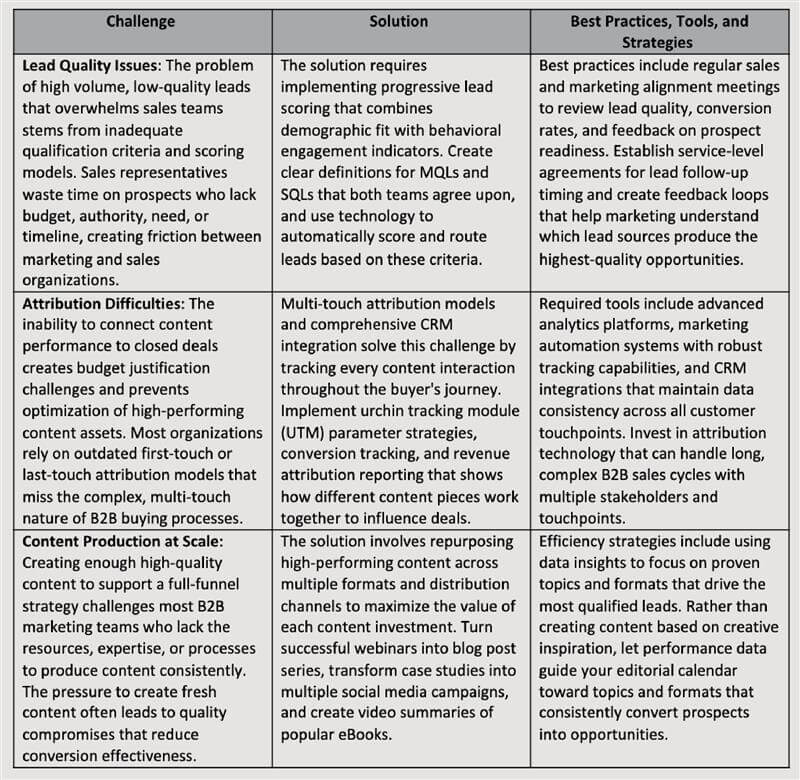
Even the strongest content strategies face obstacles when it comes to turning engagement into measurable growth. From managing lead quality and proving attribution to producing content at scale, these challenges can limit both efficiency and impact. Practical solutions rooted in data, collaboration, and smart process design can help marketing teams overcome bottlenecks, align with sales, and keep content driving pipeline momentum.
Getting Started with Your Content to Pipeline Strategy
Ready to dive in? Here’s a quick 30-day plan you can follow to get started:
Week 1
Focus on auditing your existing content library to identify pieces that already contribute to pipeline generation. Review analytics data, CRM records, and sales team feedback to understand which content assets currently drive qualified leads and influence closed deals. Document gaps in your content funnel where prospects drop off or fail to progress to the next stage.
Week 2
Define your Ideal Customer Profile (ICP) and lead qualification criteria in collaboration with your sales team. Create detailed buyer personas that include firmographic data, behavioral indicators, pain points, and content consumption preferences. Establish clear definitions for MQLs and SQLs that both teams agree upon.
Week 3
Map content gaps to specific buyer journey stages and create an editorial calendar that addresses missing pieces in your funnel. Prioritize content creation based on potential pipeline impact rather than ease of creation or creative preferences. Focus on middle and bottom-funnel content that directly supports sales conversations and accelerates deal closure.
Week 4
Implement lead capture and enrichment systems that automatically qualify and route prospects based on your established criteria. Set up progressive profiling forms, behavioral scoring models, and CRM integration to ensure seamless handoff between marketing and sales teams.
Building Long-Term Success
To succeed after your 30-day plan, schedule quarterly strategy reviews to align content planning with evolving sales goals and market conditions. Analyze content performance data, pipeline contribution metrics, and revenue, and adjust editorial calendars based on what’s actually driving qualified leads rather than what seems interesting or trendy.
Continuous optimization requires using performance data to refine your content approach over time, so double down on topics, formats, and distribution channels that consistently generate qualified leads and eliminate or improve underperforming assets. Test new content types and promotion strategies based on successful patterns in your data.
Ensure your content strategy stays connected to real market needs and encourage feedback. Establish regular communication cadences, shared metrics and goals, and collaborative planning processes that keep both teams focused on pipeline generation rather than departmental silos.
Technology stack evaluation should ensure your tools support pipeline objectives rather than just content creation and distribution. Invest in platforms that provide lead enrichment, behavioral tracking, attribution reporting, and CRM integration to maximize the business impact of your content marketing efforts.
Conclusion
Content marketing leads bridge the gap between strategy and measurable business growth. A pipeline-first framework ensures every asset—from top-of-funnel education to bottom-of-funnel proof—directly supports revenue goals and qualification standards trusted by sales. With the right planning, precision, technology, and continuous optimization, your content becomes a scalable engine for predictable customer acquisition through content.
Ready to transform your content strategy into a pipeline-generating machine? The comprehensive lead database and enrichment tools from Salesgenie® ensures your content marketing for small business leads and enterprise prospects reach the right buyers at the right time. With access to over 25 million phone-verified business contacts and advanced filtering across 100+ demographic and firmographic criteria, you can ensure your content reaches the right prospects and converts them into qualified opportunities. Salesgenie’s seamless CRM integrations and real-time data updates eliminate manual lead enrichment tasks while providing sales teams with the contact intelligence they need to convert prospects faster.
Discover how Salesgenie can enhance your content-to-pipeline strategy with phone-verified data, CRM integrations, and marketing automation tools designed for B2B lead generation success.
FAQs
Content that aligns with buyer intent typically generates the highest-quality leads. These formats directly support the content-to-pipeline journey by addressing real evaluation criteria and prompting meaningful conversions.
Most organizations begin seeing measurable inbound lead generation results within 60–90 days, depending on content volume, distribution, and optimization. Pipeline impact accelerates as more content is mapped to funnel stages and supported by strong automation and enrichment systems.
Content marketing focuses on educating, attracting, and nurturing prospects through valuable information, while lead generation targets the capture and qualification of those prospects for sales. When combined through a pipeline-first approach, content becomes the engine that drives predictable demand.
Tracking metrics such as MQL, SQL conversion rates, multi-touch attribution, pipeline velocity, and influenced revenue reveals how content contributes to opportunity creation. Advanced content performance tracking shows exactly which assets move prospects through the funnel and toward purchase decisions.
Most content underperforms because it prioritizes traffic over intent, lacks alignment to the buyer journey, or isn’t supported by strong capture, routing, and enrichment systems. Without clear ICP definitions and targeted distribution, even good content fails to reach prospects who are ready to engage.
Small businesses can generate leads by creating intent-driven content that answers buyer questions, showcases expertise, and supports each stage of the customer journey. Pairing this with consistent distribution and simple automation tools helps convert website visitors into qualified prospects efficiently.