

Most small business owners waste precious time chasing contacts who will never buy, simply because they don’t understand what a real lead actually is. A lead is a potential customer who has shown some level of interest in your product or service through specific actions—but hasn’t yet been fully qualified as ready to purchase.
This guide will show you how to identify genuine leads, implement practical qualification frameworks, and build qualified lead criteria that actually work for SMBs. You’ll learn the difference between Marketing Qualified Leads (MQL) and Sales Qualified Leads (SQL) categories, discover proven lead management strategies, and avoid the common mistakes that drain your sales resources.
What is a Lead in Sales? The SMB Definition That Matters
In the world of small and medium-sized businesses, understanding what a lead truly means can make or break your sales success. A sales lead conversion is a potential customer who has shown some level of interest in your product or service, but has not yet been fully qualified as a prospect or paying customer.
It’s crucial to recognize that leads are distinct from prospects, customers, and cold contacts.
- Prospects have been qualified as having a genuine need for your offering, the budget to purchase, and the authority to make decisions.
- Customers have already made a purchase.
- Cold contacts have had no prior interaction with your brand and have not expressed any interest.
One common misconception among SMBs is that all leads are immediately ready for a sales conversation. In reality, leads exist on a spectrum of readiness and qualification. Some may have simply filled out a form on your website, while others may have actively reached out for more information.
Consider these real-world examples:

For a local plumbing company, a lead might be a homeowner who has requested a quote through your online form. They’ve shown interest, but you still need to assess their specific needs and timeline.

In the B2B software space, a lead could be someone who has downloaded a free trial of your product. They’re clearly interested, but you need to qualify whether they have the budget and authority to make a purchase decision.

For an e-commerce store, a lead might be someone who has abandoned their shopping cart after adding items—they’ve demonstrated purchase intent but may need nurturing to complete the transaction.
The Lead Generation Landscape for Small Businesses in 2025
In 2025, the ways small and medium-sized businesses generate leads are evolving rapidly. While tried-and-true methods like website forms, referrals, and networking remain valuable, digital channels are taking center stage more than ever.
One key distinction to understand is the difference between inbound and outbound leads.
- Inbound leads are prospects who find you organically through Google searches, social media posts, or word-of-mouth referrals. These leads are already interested in what you offer, so they tend to be warmer from the start.
- Outbound leads come from your team’s proactive outreach efforts through cold emails, targeted ads, or direct calls. While these leads might not be as immediately ready to engage, they can still be valuable when you’re targeting the right people with the right message.
Modern lead sources SMBs should prioritize include:
- Intent data: Helps you to better understand online behavior indicating purchase interest
- Social selling: Platforms like LinkedIn and Twitter allow for authentic relationship building.
- Content marketing: Campaigns that address specific pain points attract qualified inbound leads naturally
Did You Know?
When generating inbound leads, 89% of B2B marketers use LinkedIn, and 62% say it helps them obtain more leads than other social platforms.
Types of Leads in Sales: A Practical SMB Framework
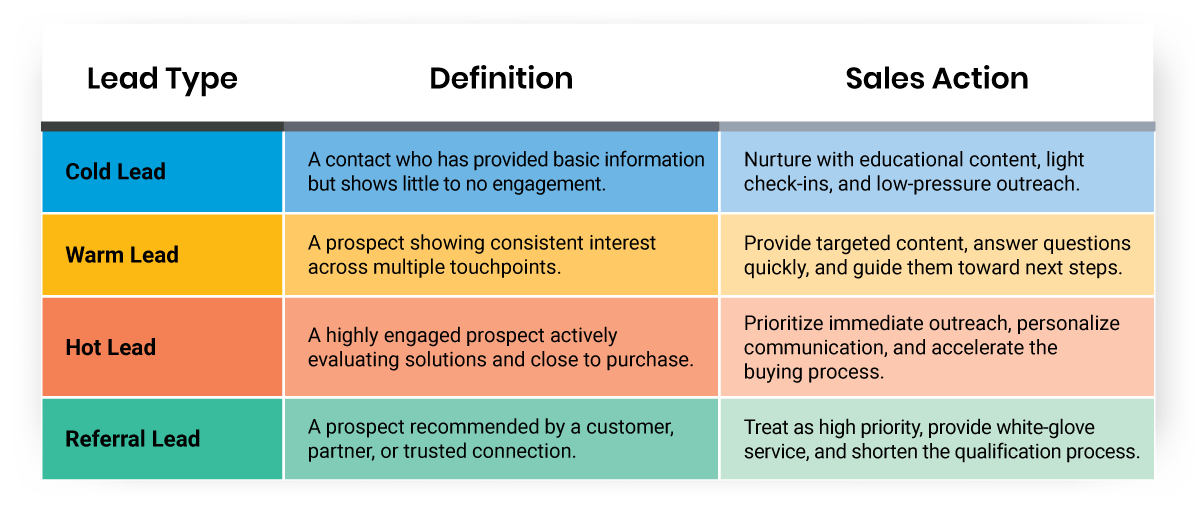
Not all leads are created equal, and understanding the different types helps you prioritize your efforts effectively. Here’s a practical framework for categorizing your leads:
MQL vs. SQL Difference: Why SMBs Need Both Categories
Understanding the distinction between MQL and SQL prevents wasted effort and improves conversion rates. An MQL is a lead that marketing has determined shows enough interest and fit to warrant sales attention, but hasn’t yet been fully qualified by the sales team.
Marketing typically qualifies leads based on demographic fit, engagement behavior, and interest signals. For example, a lead might become an MQL after downloading three pieces of content, visiting your pricing page, and matching your ideal customer profile. However, they haven’t yet been contacted by sales or confirmed as having budget and authority.
An SQL, on the other hand, has been contacted and qualified by sales as having genuine purchase potential. They’ve confirmed budget availability, decision-making authority, specific needs, and reasonable timeline. SQLs represent leads that sales should actively pursue with personalized outreach and proposals.
Lead Qualification Process: A Step-by-Step SMB Approach
An effective lead qualification framework follows a systematic approach that saves time and focuses effort on the most promising opportunities:
- Initial lead capture and data collection: Gather essential information including name, company, job title, contact details, and initial interest signals through forms, conversations, or digital interactions.
- Basic fit assessment using BANT criteria: Evaluate Budget (financial resources available), Authority (decision-making power), Need (specific problems to solve), and Timeline (urgency for solutions).
- Interest level evaluation through engagement tracking: Monitor website visits, content downloads, email opens and clicks, social media interactions, and response rates to outreach attempts.
- Decision-making authority confirmation: Determine whether your contact can make purchase decisions independently or needs approval from others, and identify all stakeholders involved in the buying process.
- Timeline and urgency assessment: Understand their ideal purchase timeline, competing priorities, key deadlines, and factors that might accelerate or delay their decision.
Lead Scoring Examples That Work for Small Businesses
Lead scoring and sales leads don’t require complex systems to be effective. Simple point-based frameworks help SMBs prioritize their most promising opportunities without overwhelming their resources.

Demographic scoring assigns points based on company size, industry relevance, geographic location, and job title authority. For example, decision-makers at companies in your target industry and size range might receive higher scores than individual contributors at mismatched organizations.
Behavioral scoring tracks online engagement through website visits, content downloads, email interactions, and social media engagement. Multiple website sessions, premium content downloads, and high email engagement rates indicate serious interest worthy of higher scores.
Engagement scoring measures direct interactions with your sales and marketing teams through demo requests, pricing inquiries, sales call participation, and response rates to outreach. These high-intent behaviors deserve the highest point values since they indicate active evaluation.
Adjust your scoring based on your specific business model and sales cycle length. B2B software companies might weight behavioral signals more heavily, while local service businesses might prioritize geographic proximity and immediate need indicators.
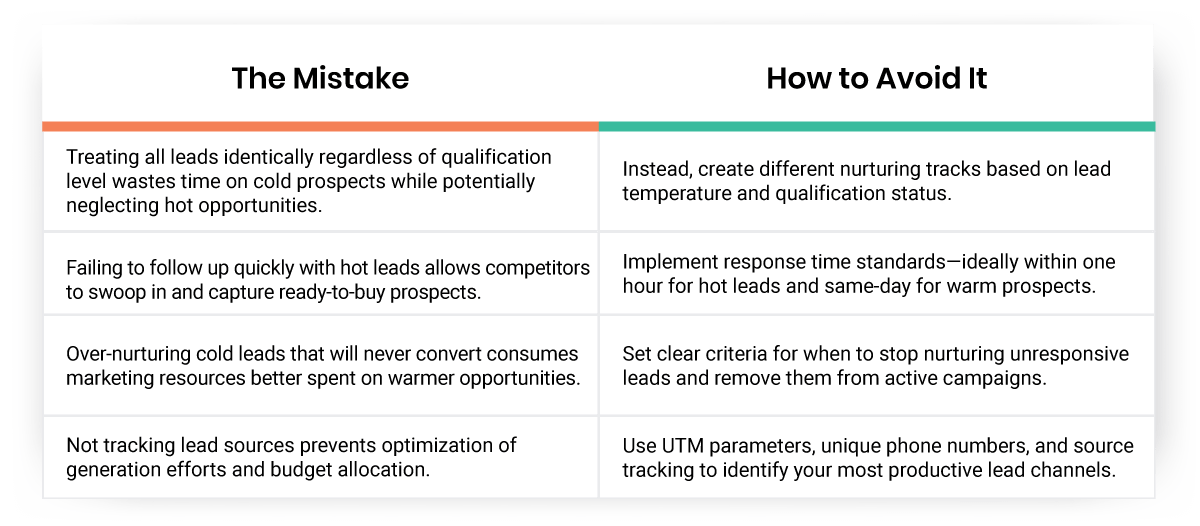
Common Lead Management Mistakes SMBs Make (and How to Avoid Them)
Many SMBs sabotage their lead management efforts through preventable mistakes that drain resources and reduce conversion rates.
Modern Tools and Systems for SMB Lead Management
Spreadsheets eventually fail growing SMBs due to limited collaboration, poor scalability, and lack of automation capabilities. Modern lead management systems and platforms offer significant advantages without overwhelming complexity.
Key features and capabilities to prioritize include:
- Contact management with detailed interaction history, lead scoring and qualification tracking, email integration and automation, reporting and analytics capabilities, and mobile access for field sales teams.
- Integration capabilities with existing CRM systems, email marketing platforms, and website analytics ensure seamless data flow across your sales and marketing stack. Look for platforms offering pre-built integrations with popular SMB tools.
- Data quality and enrichment features save manual research time by automatically appending company information, contact details, and firmographic data to your lead records. This information improves qualification accuracy and personalization efforts.
- Compliance and privacy considerations are increasingly important in 2025. Choose platforms offering data compliance, data security certifications, and consent management features to protect your business and customers.
Building Your Lead Management System: Next Steps for SMBs
Implementing effective lead management requires systematic planning and execution across several key areas.
- Start by auditing your current lead tracking and qualification processes to identify gaps and inefficiencies. Document how leads currently flow through your system and where prospects are getting lost or delayed.
- Implement a simple lead scoring framework within 30 days using the demographic, behavioral, and engagement criteria discussed earlier. Start simple and refine based on actual conversion data and sales team feedback.
- Set up proper MQL to SQL handoff procedures with clear qualification criteria, documentation requirements, and feedback loops. Ensure marketing understands what sales considers a qualified lead and vice versa.
- Choose tools that scale with your business growth rather than requiring complete replacement as you expand. Consider platforms offering tiered pricing and feature sets that accommodate your current needs while providing room for growth.
- Create accountability measures for lead response times, conversion rates, and source performance. Regular review meetings help identify optimization opportunities and ensure consistent execution across your team.
- Plan for ongoing review and optimization of your lead management approach based on performance data, market changes, and business evolution. What works today may need adjustment as your company grows and markets shift.
Conclusion
Effective lead management starts with clear definitions and practical frameworks tailored to SMB resources, directly impacting revenue growth and sales efficiency for small businesses. By understanding what constitutes a genuine lead, implementing systematic qualification processes, and using simple scoring systems to prioritize opportunities, you can focus your limited time and resources on prospects most likely to convert. The key is consistency in execution—from initial lead capture through qualification, scoring, and handoff to sales.
Transform your lead qualification process with the comprehensive platform from Salesgenie® designed specifically for growing SMBs, providing access to over 25 million verified business contacts, custom lead scoring capabilities, and complete sales pipeline management in one intuitive workspace.
Sign up with Salesgenie and discover how proper lead management can accelerate your business growth while eliminating the guesswork from your sales process.
FAQs
B2B sales leads are typically people who have shown interest through actions like downloading content, requesting a demo, or engaging with your team. In B2C, a lead is a consumer who signals buying intent through behaviors such as browsing products, signing up for emails, or adding items to a cart.
A person converts into a sales lead when they demonstrate interest in your product or service through specific actions, such as filling out a form or engaging with your content. They are not yet a prospect until they’ve been evaluated for fit, budget, need, and authority.
A lead becomes an opportunity once sales has confirmed they have a real need, decision-making authority, a workable timeline, and the budget to buy. This typically occurs after initial outreach, discovery conversations, and qualification.
Sales leads represent the earliest stage of potential revenue and fuel the entire pipeline. Without a steady flow of qualified leads, SMBs struggle to scale, forecast, and close new business consistently.
Key metrics include engagement level, ideal customer profile fit, decision-maker status, budget, and intent signals such as pricing page visits or demo requests. Strong leads also show consistent responsiveness across email, web, or sales outreach.
Common mistakes include treating all leads as sales-ready, poor follow-up timing, and failing to qualify based on need, authority, budget, and urgency. Many SMBs also neglect the lead nurturing process, causing warm prospects to go cold.
Conversion timelines vary widely based on industry and complexity, but many SMB leads convert within a few days to several weeks when nurtured effectively. Higher-ticket or B2B purchases often require longer cycles due to additional stakeholders and decision processes.