

Why Email Outreach Still Wins in B2B Sales
Amid the rise of social media, paid ads, and real-time messaging tools, B2B email outreach remains one of the highest-ROI channels in modern sales. Recent benchmarks show email delivers one of the strongest returns among outbound channels, averaging about $36 for every $1 invested. Litmus’ latest data finds many brands report $10 to $36 in revenue for every $1 spent on email.
But it’s not just about cost-effectiveness. It’s also about control. Email lets your team deliver targeted, personalized messages directly into the inboxes of decision-makers, without battling algorithms or ad fatigue.
Done right, a strong email outreach strategy can help you reach more prospects, warm up cold leads, and move opportunities through the pipeline without overwhelming your reps or relying on massive ad budgets. Whether you’re booking demos or re-engaging dormant accounts, email outreach gives you a predictable, scalable path to pipeline growth.
Want a full look at B2B prospecting channels? Explore our full guide on B2B Sales, Sales Strategy, and Sales Frameworks.
Quick Answer
What is B2B Email Outreach?
B2B email outreach is a structured, value-led approach to contacting potential buyers through email—typically using a B2B email sequence with multiple touchpoints to spark conversations, qualify interest, and build pipeline.
In the next sections, we’ll unpack how to craft a high-performing email outreach strategy, explore email outreach best practices, review the top email outreach tools, and show you how to turn cold contacts into warm leads.
How to Set the Foundation: Audience & Goals
Before you write a single line of copy, get clear on who you’re trying to reach and what each B2B email sequence should accomplish. Start by defining your Ideal Customer Profile (ICP).
Next, map out the buying roles, decision-makers, and influencers involved in your sales process. Understanding their pain points and priorities will help you tailor your message so it actually lands. After this, it’s time to focus on one clear outcome per sequence. Whether your goal is to book a discovery call, re-engage a lead, or introduce a new product to an existing customer, every step in the cold email outreach flow should point toward that objective. That alignment makes your results easier to track and your copy easier to write.
This is also the moment to connect goals to pipeline stages so you can measure progress like how many replies lead to meetings or how fast prospects move from interest to opportunity. Common outcomes include booking discovery calls, nurturing early interest, and driving account expansion.
Finally, remember that the best email outreach strategies are built with the long game in mind. Plan your cadence, choose the right email outreach tools, and don’t leave segmentation as an afterthought. Relevance is what drives response.
Next, we’ll dive into how to write B2B messages that actually get read—starting with subject lines, structure, and personalization techniques that reflect today’s email outreach best practices.
Why Building High-Quality Prospect Lists Matters
Your email outreach strategy is only as strong as the list behind it. Even the most compelling message won’t perform if it’s landing in the wrong inboxes or bouncing entirely. To get real traction with cold email outreach, you need a high-quality, precisely targeted prospect list that reflects your ICP and supports strong segmentation.
Start with ethically sourced data. That means combining first-party data, LinkedIn research, and privacy-compliant intent signals with trusted email outreach tools and enrichment platforms. Stay away from scraped lists and unverified bulk databases that can tank your deliverability.
Once you’ve identified the right contacts, standardize your list by cleaning up fields like industry, role, and geography. Tag each contact by buying stage so you can serve tailored messaging to decision-makers at different points in the funnel. This step is critical for personalized B2B email outreach that actually resonates.
Pro Tip
Always verify emails before sending. Remove hard bounces, duplicates, and generic role-based addresses (like info@ or sales@) to protect your sender reputation and keep your outreach engine running smoothly.
Moving forward, we’ll cover how to craft messaging that feels personal even when you’re automating at scale.
How to Craft Irresistible Outreach Emails
The best cold email outreach campaigns start with a subject line that earns the open. Keep it short, clear, and buyer-focused. Personalization goes a long way—mention a mutual contact, recent initiative, or specific tool they’ve adopted to spark interest. Aim for curiosity without sounding vague or generic.
Example subject lines:
- “Quick idea for {{company}}’s Q1 pipeline”
- “{{mutual_contact}} suggested I reach out”
- “30-second thought on {{tool_you_saw}} usage”
Once you have their attention, your opening line should immediately signal that this email was written for them—not just anyone. Reference something recent or relevant: a product launch, growth signal, or team change. This shows you’ve done your homework and makes it easier for the reader to keep going.
In the body of the message, simplicity wins. Lead with one pain point, tie it to a clear benefit or business outcome, and offer an easy next step. Social proof helps. Mention a notable client win, stat, or use case when it strengthens your point. Where relevant, reference a customer outcome or metric that mirrors the reader’s context.
Example call-to-actions:
- “Open to a 15-minute call next week?”
- “Want me to send a quick one-pager?”
- “Would a short demo be helpful?”
Wrap it all with strong formatting and technical hygiene. Follow email outreach best practices: use accurate headers, clear sender info, and mobile-friendly layouts. Always make opting out easy. It’s good etiquette, and it also protects your deliverability.
Continue reading to learn how to structure your email outreach into effective sequences that match where each lead is in the buying journey.
Multi-Touch Outreach Sequences
One email is rarely enough to earn a response, especially in cold email outreach. That’s why the most effective outreach strategies use structured, multi-touch B2B email sequences designed to stay helpful and top of mind without overwhelming the prospect.
Here’s a five-step sequence to start with:
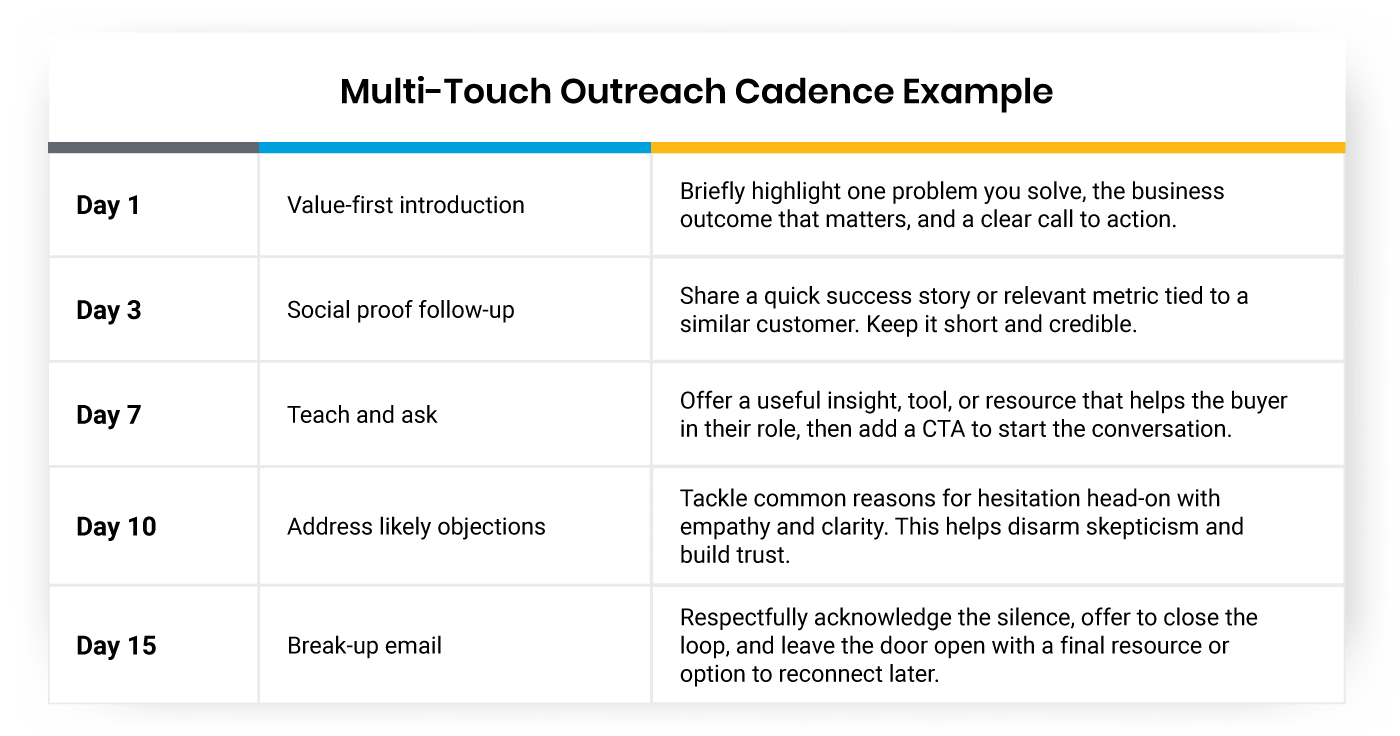
To boost response rates, blend email with light touches across other channels. A LinkedIn view or connection request before your second message, or a short voicemail after the third, can help you stand out without being pushy. Spacing messages by a few business days keeps the tone conversational and prevents fatigue.
Personalization at Scale
Strong personalization doesn’t have to come at the cost of scale. Start by segmenting your outreach by firmographics and behavior. Group contacts by industry, use case, and company maturity. Then personalize further using dynamic fields such as job role, tech stack, and key performance metrics. To take it a step deeper, layer in account-level insights like recent funding, product launches, or hiring trends.
Build two to three modular templates per persona. These should include a strong baseline message with flexible components you can tailor by vertical, company size, or buying trigger. This approach keeps your messaging relevant while enabling efficient production.
Email outreach tools like Outreach, Salesloft, and Apollo help streamline this entire process. From inserting dynamic fields to triggering timely sends based on intent signals, they give your team the ability to deliver timely, high-quality messages across a large number of prospects.
Pro Tip
Personalization works best when it’s relevant, not random. Focus on details tied to business priorities like hiring, tech stack, revenue goals, or recent initiatives. Before you hit send, sanity-check every dynamic field by previewing emails in bulk, because one broken token (or a wrong company name) can undo trust faster than a “Dear {{FirstName}}.”
Timing, Frequency & Deliverability
Small changes in timing and setup can make a big difference in how often your emails reach inboxes and spark replies. Start by testing send times. Multiple studies point to mid-week mornings as a strong starting point for testing. HubSpot’s research found higher engagement between 9 a.m. and noon, and a meta-analysis by CoSchedule highlights Tuesday, Wednesday, and Thursday as the most consistent days. Your ideal window may vary by persona or industry; be sure to monitor performance and adjust accordingly.
Keep your cadence thoughtful. Sending too frequently can hurt your response rate or worse, land you in the spam folder. A few well-spaced messages are far more effective than a rapid-fire sequence.
On the technical side, domain health matters. Authenticate your sending domain with SPF and DKIM records, and warm up any new subdomains slowly with low volume sends. Avoid formatting that looks suspicious to spam filters. That means maintaining a good balance of text to images, using clear subject lines, and steering clear of excessive links or caps.
Continuously scrub your list to protect deliverability. Remove bounces and disengaged recipients and make it easy to opt out. The more you respect the inbox, the more likely your emails are to be opened and answered.
Next, we’ll look at how to measure performance and improve your outreach based on real data.
Measuring & Optimizing Performance
Consistent measurement is what turns guesswork into strategy. Start by tracking the full performance funnel of your outreach campaigns. Key indicators to watch include open rate, reply rate, meetings booked, and pipeline value. These metrics tell you what’s working and where prospects drop off.
- Use A/B testing to improve results over time. Try out different subject lines, calls to action, and opening lines. Break down your results by industry, role, or company size so you can fine-tune your messaging by segment.
- Avoid getting stuck on surface-level stats. Tie your B2B email outreach performance back to real sales outcomes inside your CRM. Look at which sequences lead to qualified opportunities and how far they progress through the funnel.
- Make weekly reporting a habit. Then review patterns and optimize your email outreach strategy every month. When something performs well, roll that messaging into your next round of templates
- For visibility, create a dashboard inside your CRM. Useful views include open and reply rates by sequence, meetings booked by rep, and total pipeline sourced by campaign.
Why You Should Take Compliance & Ethical Considerations Seriously
Staying compliant with global privacy laws is essential for responsible outreach. Whether you are sending cold email outreach to North America, Europe, or beyond, following key regulations protects your brand and keeps your campaigns running smoothly.
At a minimum, your emails must meet the basics of CAN-SPAM, CASL, and GDPR. That means:
- Honest “from” names and subject lines
- A visible physical business address
- A working opt-out link
- Prompt removal of unsubscribes
For GDPR-regulated regions, make sure you have a lawful basis for contact. That could be documented consent or a legitimate interest based on business context. Keep records of how each contact entered your system and when consent was granted if applicable.
You should also understand the difference between single opt-in and double opt-in. While single opt-in is faster, double opt-in adds a confirmation step that helps improve list quality and demonstrate compliance.
Finally, good email etiquette is just as important as legal requirements. Respect unsubscribe requests immediately, avoid aggressive frequency, and send only relevant, helpful content. Ethical outreach protects your sender reputation and builds trust over time.
Pro Tip
Don’t treat compliance as a final checklist. Instead, build it into your workflow by documenting data sources, consent status, and lawful basis at the contact level. A clean audit trail and a fast unsubscribe process don’t just keep you legal; they also protect deliverability and signal that your brand respects the inbox.
Tools & Templates to Streamline Outreach
Effective email outreach starts with the right tools. When your stack is built for speed, accuracy, and scale, your team can focus less on busywork and more on starting real conversations.
Here are four email outreach tools worth considering:
Salesgenie
Perfect for building targeted B2B lists, Salesgenie offers firmographic filters that help you zero in on the right companies and contacts. Great for teams who want clean data and a fast start.
Apollo
A popular platform that combines enrichment, sequencing, and A/B testing in one place. Apollo makes it easy to automate a cold email outreach workflow while personalizing messages at scale.
UpLead
Known for its real-time email verification, UpLead helps protect deliverability by reducing bounce rates. It’s ideal for teams that want to keep their sender reputation strong and their lists accurate.
Cognism
Especially strong in EMEA markets, Cognism delivers global contact data with a focus on compliance and access to mobile numbers. A solid option for expanding into international accounts.
To stay sharp, maintain a template library that includes multiple types of touchpoints: cold intros, follow-ups, nurtures, and breakups. Refresh those templates quarterly to reflect what’s working.

Download
Want a head start? Grab our editable cold and follow-up email pack to kick off your next campaign with high-performing copy.
Where to Incorporate Advanced Tactics
Once your core sequences are humming along and consistently generating replies, it’s time to explore more advanced strategies that can boost engagement and help your messages stand out in crowded inboxes.
Try short video messages.
Adding a quick video—whether it’s a screen share, intro clip, or explainer—can humanize your outreach and increase response rates. Tools like Vidyard and Loom make it easy to record and embed in your emails.
- Experiment with trigger-based outreach.
Use your CRM to launch messages based on real-time actions like form fills, content views, or inactivity. This keeps your follow-up timely and relevant without manual effort. - Use AI to enhance your copy.
Modern platforms offer AI-powered tools that suggest subject lines, rewrite body copy, and analyze sentiment. These can help fine-tune tone, speed up writing, and tailor your message more effectively to the reader. - Build omnichannel sequences.
Create variations of your email messaging tailored by persona and deal size. Then combine those with LinkedIn touches and phone calls to increase your chances of breaking through. Start simple with a few combinations and scale what works.
When used intentionally, these tactics can help your team move from good to great—and keep your email outreach strategy evolving with the market.
Real-World Success Stories
When executed well, cold email outreach can drive real business outcomes. Whether it’s booking more demos, speeding up deal cycles, or scaling with a lean team, the strategies outlined in this guide have helped sales orgs across industries hit aggressive pipeline goals. Below are just a few examples of what happens when the fundamentals click.
- B2B SaaS: Smarter sequencing, stronger results
Blink increased demos booked by 237% after rolling out structured cadences and tightening its sales rhythm with Salesloft. The team also saw a 126% lift in revenue after implementing the program. - Manufacturing: Intent data drives better timing
Siemens used intent-driven targeting to prioritize outreach earlier in the buying journey. Bombora reports that Siemens shortened sales cycles and cut telequalification costs for sales-accepted leads by 99%, while dramatically improving acceptance of MQLs. - Healthcare IT: Small team, big impact
Clearwave shortened sales cycles by 20% with an account-based program that focused messaging on buyer challenges and timing.
Now that you’ve seen what’s possible, let’s bring it all together. Here’s a quick recap and your next steps to start building a smarter email outreach strategy.
Key Takeaways & Next Steps
Successful cold email outreach does not happen by accident. It starts with a sharp understanding of your ICP and decision-maker personas. From there, every step should align toward a single outcome.
Here’s a quick checklist to guide your next campaign launch:
- Clarify your outcome for each sequence. Know what action you want the reader to take.
- Segment your list tightly by role, industry, and stage. The narrower the list, the sharper your message.
- Use modular templates that balance personalization with scale. Aim for relevance over cleverness.
- Build a 5-step outreach sequence that mixes value, proof, education, and a clear ask.
- Layer in additional channels like LinkedIn touches or light phone calls where appropriate.
- Protect your domain health by verifying emails, monitoring bounce rates, and following compliance best practices.
- Track performance beyond opens. Optimize around replies, meetings booked, and actual pipeline created.
- Keep learning. Every campaign gives you insights you can fold into your next playbook.
Read our B2B Sales Guide, which includes tips on holistic B2B sales strategies.
FAQs
A well-paced cold email outreach sequence typically includes two to three follow-ups spaced a few business days apart. Each message should offer a new perspective, such as a customer success example, a helpful resource, or a concise response to a common hesitation. Keeping the tone fresh and the angle varied helps maintain interest without overwhelming the prospect.
Short, sharp subject lines work best. Aim for four to seven words that fit easily on a mobile screen and connect clearly to the first line of your message. The goal is to catch attention without sounding forced or clickbait-y.
Deliverability starts with strong technical hygiene. Make sure your domains are authenticated using SPF and DKIM. Warm up new sending domains gradually and remove inactive or bounced contacts regularly. Avoid all-caps, excessive punctuation, and overly promotional language, and maintain a healthy balance of text versus images in your messages.
Reply rates can vary depending on audience and offer, but a typical baseline for cold email outreach is 5 to 10 percent. More important than just replies, though, is the quality of those replies. Track how many of them turn into booked meetings or pipeline opportunities to get a clearer view of campaign success.
The most effective approach blends both. Start with persona-based templates that speak to shared challenges and goals, then layer in one or two lines that reflect account-specific or role-specific context. This keeps the message relevant while still scalable.