

If your team has ever used “demand generation” and “lead generation” like they mean the same thing, you’re not alone. In B2B organizations, the two terms are often blurred together in planning meetings, campaign reports, and revenue discussions.
But they are not interchangeable, and treating them that way is where many B2B teams go wrong.
The debate exists because the purposes of demand generation and lead generation overlap:
- They aim to move buyers closer to a purchase
- They rely on content, campaigns, channels, and data
- They matter when you are trying to build a healthy pipeline
The difference is in what each strategy is designed to accomplish.
This is not a demand generation vs. lead generation decision. Strong B2B growth depends on both. Demand generation creates market attention and buyer confidence that makes conversion possible. Lead generation turns that momentum into identifiable opportunities sales can act on.
In this guide, we’ll break down where B2B teams get the relationship wrong, how each strategy supports different stages of the buyer journey, and how to use both together to drive more qualified leads and better revenue outcomes.
Learn how you can incorporate both demand and lead generation into the bigger picture of your strategy by reading our complete B2B lead generation guide.
What is Lead Generation in B2B?
Lead generation is the process of attracting potential buyers and converting that interest into an identifiable contact your sales and marketing teams can nurture. In most cases, that means getting a prospect to take a trackable action, such as filling out a form, downloading a resource, requesting a demo, signing up for a webinar, or subscribing to your email list.
Learn how you can incorporate both demand and lead generation with help from Salesgenie®.
At its core, B2B lead generation is about turning anonymous traffic into known prospects. While B2B demand generation builds awareness and interest across a broader audience, lead generation is the point where that interest becomes measurable and actionable. That is one of the biggest distinctions in the demand generation vs. lead generation conversation: one creates market interest, while the other captures it.
Pro Tip
If your lead conversion rates are low, the issue may not be your form or CTA. It may be that your audience has not reached enough awareness or intent yet.
The Goal of Lead Generation
The main goal of lead generation is to generate qualified leads that have a realistic chance of becoming customers.
For B2B teams, that usually means aligning lead capture efforts with sales readiness. A strong lead generation strategy helps marketing identify who is engaging, what they care about, and whether they match the company’s ideal customer profile (ICP). This gives sales a clearer starting point for follow-up and helps both teams focus on opportunities with greater revenue potential.
B2B lead generation programs are typically built to support goals like:
- Increasing the number of marketing-qualified leads (MQLs)
- Driving demo requests, consultations, or sales inquiries
- Building email lists for nurture campaigns
- Improving lead quality and fit
- Creating a stronger pipeline for the sales team
- Lowering acquisition costs by improving conversion efficiency
Core Lead Generation Metrics
Because lead generation is conversion-focused, its performance is usually measured with direct-response metrics. Common key performance indicators (KPIs) include:
- Total leads generated
- Landing page conversion rate
- Form completion rate
- Cost per lead (CPL)
- MQLs
- Sales-qualified leads (SQLs)
- Demo or meeting requests
- Lead-to-opportunity conversion rate
- Opportunity-to-close rate
- Pipeline sourced from marketing
Where Lead Generation Fits in the Funnel
In most B2B funnels, lead generation sits in the mid- and bottom-funnel stages, where buyers move from awareness into consideration and decision-making.
A simple way to think about it:
- Top of funnel: Buyers are learning, researching, and defining their problem
- Middle of funnel: Buyers are comparing options and engaging more seriously
- Bottom of funnel: Buyers are ready to talk to sales or evaluate a solution
Lead generation becomes most effective once a prospect has enough context and interest to exchange their information for something valuable.
That is why the demand gen vs. lead gen distinction matters so much. If you push lead capture too early, conversion rates may suffer and sales may end up with low-intent contacts. If you wait too long, you risk losing engaged buyers who are ready to take the next step.
Now that you understand how lead generation works, read our guide on how to build an effective B2B lead generation framework.
What Is Demand Generation in B2B?

Demand generation is the strategy of creating awareness, interest, and buying intent before a prospect is ready to convert. Instead of focusing first on form fills or demo requests, B2B demand generation is designed to help the right audience understand their problem, recognize potential solutions, and become familiar with your brand long before they enter a sales conversation.
In simple terms, if B2B lead generation captures existing interest, demand generation helps create it.
The Core Focus of Demand Generation
Buyers rarely move from first touch to sales call in one step. Research from Gartner says that 75% of B2B buyers prefer a rep-free sales experience, which supports your point that awareness and education often happen before direct sales interaction. They research, compare, revisit, and involve multiple stakeholders before making a decision. Demand generation supports that journey by making sure your company shows up early and often with useful, relevant content, messaging, and the right tools for marketing teams to reach high-value prospects more effectively.
This is a key reason the lead generation vs. demand generation debate exists. Many teams are under pressure to prove short-term results, so they default to lead capture tactics. But if buyers are not yet aware of the problem, not convinced of the urgency, or not familiar with your brand, those tactics often underperform.
Strong B2B demand generation efforts help solve that problem by increasing:
- Brand awareness among the right accounts
- Market education around pain points and solutions
- Trust and credibility over time
- Engagement with high-value content
- Buyer intent before a conversion moment happens
The differences come down to timing and purpose. Demand generation builds the foundation, while lead generation activates it.
Metrics That Matter in Demand Generation
Unlike lead generation, demand generation is not measured only by how many contacts fill out a form. Its impact is broader, and the KPIs should reflect that. The most useful demand generation metrics show whether your brand is gaining visibility, attracting the right audience, and increasing engagement and intent over time.
Common demand generation KPIs include:
- Website traffic from target audiences
- Branded search volume
- Content engagement rates
- Return visitor rate
- Time on page and pages per session
- Webinar or event attendance
- Social engagement and share of voice
- Email engagement from non-conversion campaigns
- Influenced pipeline
- Account engagement across buying committees
Pro Tip
Measure demand generation with a mix of engagement and pipeline influence metrics. If you judge it only by form fills, you will undervalue the activity that creates future pipeline.
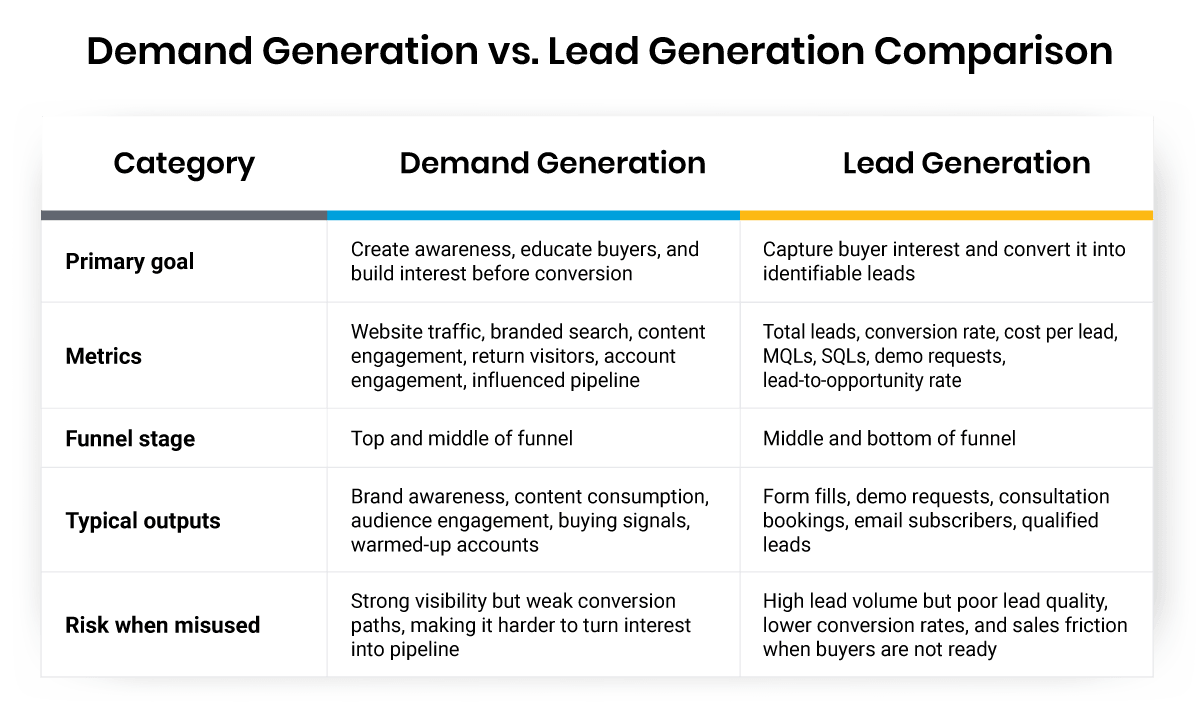
Demand Gen vs. Lead Gen (Side-by-Side Comparison)
The easiest way to understand demand generation vs. lead generation is to compare what each one is designed to do.
Below, we compare the key differences to help you better understand when you should use each tactic.
Practical Takeaway for B2B Teams
A simple way to think about lead generation vs. demand generation is this:
- Use B2B demand generation to get in front of the right audience early.
- Build credibility with useful content and consistent messaging.
- Introduce B2B lead generation offers when buyer interest becomes more active and measurable.
- Connect both motions to shared pipeline and revenue goals.
This approach makes the demand gen and lead gen relationship much easier to operationalize across marketing and sales.
What B2B Teams Get Wrong
The biggest problem in the demand generation vs. lead generation debate is that B2B teams misunderstand how the two are meant to work together.
B2B teams usually get three things wrong:
- They treat demand generation and lead generation as competing motions
- They measure demand generation with lead capture metrics alone
- They overlook sales feedback that could improve lead quality and campaign performance
This framing leads to weak strategy, mixed reporting, and unnecessary tension between marketing and sales. Ideally, lead and demand generation should operate as connected parts of the same revenue engine.
Mistake 1
Treating Demand Gen and Lead Gen as Competing Motions
One of the most common errors in lead generation vs. demand generation planning is acting as if a company must prioritize one at the expense of the other.
This usually shows up in familiar ways:
- Marketing leaders argue over whether budget should go to awareness campaigns or form-fill campaigns.
- Sales teams push for more leads while brand and content teams focus on reach and engagement.
- Performance gets evaluated in silos, and each team defends its own numbers instead of looking at the full path to pipeline.
When teams treat them as competing motions, they create a false choice. The result is often one of two extremes: strong top-of-funnel visibility with weak conversion paths, or aggressive lead capture with too little buyer education and intent.
Mistake 2
Measuring Demand Gen with Lead Metrics
Another major issue in the demand gen vs. lead gen discussion is measurement.
Many B2B teams try to evaluate demand generation with the same KPIs they use for lead generation. They look only at form fills, demo requests, MQL volume, or cost per lead, then conclude that demand generation is underperforming because it is not producing immediate conversions.
That approach misses the purpose of demand generation.
B2B demand generation is meant to increase awareness, trust, engagement, and buying intent over time. Its impact often appears earlier in metrics like:
- Growth in branded search
- More direct and return website traffic
- Higher engagement with ungated content
- Increased target account activity
- Better email engagement from nurture audiences
- More influenced pipeline over time
By contrast, B2B lead generation is designed to drive measurable conversion actions, so lead volume and conversion rates make more sense there.
Mistake 3
Ignoring Sales Feedback
A third issue B2B teams get wrong is failing to use sales feedback as part of campaign strategy and performance analysis.
Marketing may see strong lead volume and assume programs are working. Sales may see low-quality conversations and conclude that marketing is sending the wrong prospects. In many cases, improving targeting starts with better data and more precise audience selection, including targeted business leads that align more closely with your ICP.
This is especially damaging because sales feedback helps clarify whether the problem is:
- Not enough market awareness
- Poor audience targeting
- Weak qualification criteria
- The wrong offer at the wrong funnel stage
- A disconnect between campaign messaging and real buyer pain points
For example, if sales consistently says leads are unready or unqualified, the issue may not be lead generation execution alone. It may point to a broader demand problem: the audience does not yet understand the solution, the campaign is attracting low-intent traffic, or the messaging is not resonating with the right buyers.
Sales conversations often reveal what dashboards cannot. They show whether interest is real, whether objections are repeating, and whether leads match buying intent. That insight is essential if you want lead and demand generation programs to improve over time.
Pro Tip
Review sales feedback monthly against campaign data. If sales says leads are unready, revisit your offer, targeting, and funnel stage before increasing spend.
How High-Performing Teams Use Both
High-performing revenue teams do not get stuck in the demand generation vs. lead generation debate. They understand that both play distinct roles in driving growth, and they build their marketing and sales motions accordingly.
The most practical answer is that each motion supports a different stage of the same buying journey.
Using Demand Generation to Create Intent
In B2B markets, most buyers are not ready to talk to sales the first time they encounter a brand. They need context, education, proof, and repeated exposure before they are willing to take action. That is why B2B demand generation matters so much.
Strong demand generation programs help teams:
- Reach the right accounts before they are in an active buying cycle
- Educate buyers around pain points, risks, and opportunities
- Build brand familiarity and trust over time
- Increase engagement with useful, relevant content
- Generate early buying signals that indicate future interest
A few common demand generation tactics include:
- Thought leadership content
- Webinars
- Ungated resources
- Search visibility
- Podcasts
- Social campaigns
- Customer proof
- Category education content
These efforts often influence pipeline well before a buyer ever fills out a form.
Using Lead Generation to Capture Intent
Once buyers move from passive interest to active evaluation, B2B lead generation becomes critical. This is the stage where marketing gives prospects a clear path to raise their hand, share their information, and signal that they want deeper engagement.
That may include:
- Downloading a gated resource
- Registering for a product-focused webinar
- Requesting a demo
- Booking a consultation
- Signing up for a nurture sequence
- Submitting a contact or pricing form
Instead of forcing every interaction into a form fill, successful teams create a progression:
- Educational content builds awareness first
- Mid-funnel resources deepen engagement
- Bottom-funnel offers make it easy for qualified buyers to convert when the timing is right
How Sales Closes Intent
Even the strongest lead and demand generation strategy is incomplete without sales. Marketing can create awareness and capture engagement, but sales is what converts real buying intent into opportunities, conversations, and closed revenue.
High-performing teams make this handoff smoother by combining strong process with tools that support sales and marketing alignment across lead data, engagement history, and qualification, such as:
- Clear context on lead source and engagement history
- Qualification criteria tied to real buying signals
- Messaging aligned to campaign content and buyer pain points
- Feedback loops to improve targeting, offers, and lead quality
Pro Tip
Build a shared handoff between marketing and sales that includes source, content engagement, intent signals, and qualification notes. That context helps sales prioritize the right conversations faster.
When sales and marketing are aligned, intent does not get lost between teams. Instead, it moves through a connected system that supports the full funnel.
Conclusion & Next Steps
The real takeaway from the demand generation vs. lead generation discussion is that B2B teams need to stop treating these motions like competing strategies.
This is not a question of which one to use or which one deserves more attention. Rather, it’s a question of sequence, alignment, and execution. That’s why the smartest approach to lead and demand generation is building a system where each motion supports the next. When demand gen creates interest, lead gen captures it, and sales acts on it effectively, the full revenue engine becomes stronger.
If you’re ready to put these strategies into action, register for Salesgenie to explore tools that help your team identify prospects, build targeted lists, and support more effective B2B outreach.
To go even deeper, explore these related resources from Salesgenie:
- B2B Lead Generation: Strategies, Channels & Tools to Drive Qualified Leads for a broader view of channels, tactics, and tools that support pipeline growth
- B2B Lead Generation Strategies for practical ways to attract and convert more qualified prospects
FAQs
Demand generation builds awareness, trust, and buying intent, while lead generation captures that intent once a prospect is ready to engage. In B2B, demand gen supports early-stage interest and lead gen converts that interest into identifiable opportunities.
Neither strategy is “better” because they serve different purposes in the funnel. The strongest B2B strategy uses both, with demand generation creating intent and lead generation capturing it.
B2B teams confuse them because both use similar channels, content, and campaigns, and both support pipeline growth. The difference is that demand gen creates market interest, while lead gen converts existing interest.
Yes, but it usually leads to lower-quality leads and weaker conversion rates because buyers may not be ready to act. Without demand generation, lead capture efforts often miss the awareness and trust needed to drive stronger pipeline results.
Demand generation creates awareness and buying intent, and lead generation gives interested buyers a clear way to convert. Together, they move prospects from early interest to qualified pipeline more effectively.
Demand generation is typically measured by metrics like traffic, branded search, engagement, and influenced pipeline, while lead generation is measured by leads, conversion rates, cost per lead, MQLs, and SQLs. The key is to evaluate each based on its role in the funnel, not with a single shared KPI set.