

A weak sales pipeline comes at a high cost: missed revenue, poor forecasting, and wasted team effort. With buyers becoming more selective and competition increasing, teams can’t afford to rely on guesswork or inconsistent processes. According to recent data, only about 24.3% of salespeople exceed their annual quota, underscoring how rare fully effective pipelines are.
This article will walk you through how to:
- Define objective deal stages
- Configure your CRM for visibility and automation
- Qualify leads using a data-driven approach
- Build effective multichannel outreach cadences
- Monitor overall pipeline health
- Continuously optimize performance
What is a Sales Pipeline?
At its core, a sales pipeline is a visual representation of your sales process from prospect to customer. It’s a systematic way to track and manage the progress of each deal, so you always know where things stand and what actions to take next.
Pipeline mismanagement creates a cascade of problems that compound over time. Common issues include:
- Stalled deals that sit in stages without clear progression criteria
- Inaccurate forecasts that stem from poor pipeline data quality
- Team misalignment that occurs when everyone manages their pipeline differently.
How Do You Define Your Sales Pipeline Stages and Exit Criteria?
The foundation of any effective sales pipeline lies in clearly defined stages with objective progression criteria. Without this structure, your pipeline becomes a collection of wishful thinking rather than a predictable revenue engine.
Most B2B sales pipelines follow a similar progression: Prospecting → Qualification → Needs Analysis → Proposal/Demo → Negotiation → Closing → Post-Sale.
Note that each stage should reflect your industry, sales cycle length, and buyer journey complexity. Consider the following:
- Customize your stages: Enterprise software teams may need extra steps for evaluation and approvals, while SMB service providers may combine stages to keep the process efficient.
- Use objective stage criteria: Define clear, measurable requirements for moving deals forward to remove subjectivity and improve forecasting accuracy.
- Set entry and exit criteria: Entry criteria define when a deal qualifies for a stage; exit criteria define what must be completed before advancing. Both should be tied to buyer actions, not seller tasks.
- Align with buyer behavior: Build your stages around the buyer’s decision process, not internal tasks, so your pipeline stays aligned and customer-centric.
Pro Tip
Keep your progression criteria tied to buyer actions, not seller intuition. When every stage requires a clear, observable signal from the prospect, your pipeline becomes far more accurate and much easier to coach, forecast, and scale.
How Do You Build a B2B Lead Qualification Framework?
A strong qualification framework ensures only viable opportunities enter your pipeline, improving forecast accuracy and helping your team focus on deals most likely to close.
Choose the Right Qualification Methodology
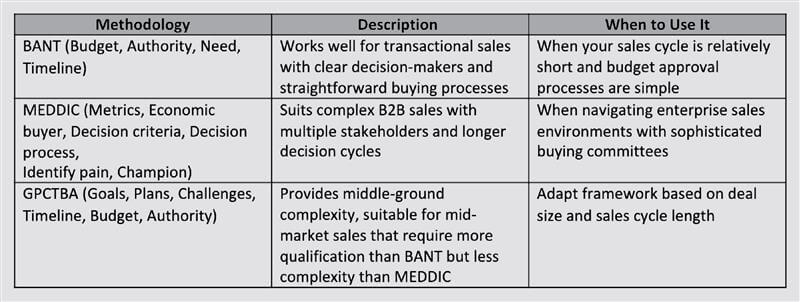
Create qualification scorecards and assessment templates that assign point values to each qualification criterion. This quantitative approach enables consistent evaluation across different sales reps and provides objective pipeline entry criteria.
Integrate Qualification into your Pipeline Process
Qualification shouldn’t be a one-time step—it should be validated throughout the entire sales process. Add checkpoints at each stage to ensure deals remain viable as new information emerges. Reinforce consistency with role-plays, call reviews, and coaching sessions so reps apply the framework the same way every time.
Use qualification data to strengthen forecasting:
- Weight deals based on qualification scores
- Prioritize follow-up for high-scoring opportunities
- Review closed-won and closed-lost outcomes to refine criteria
Leverage data and technology to qualify smarter
Intent data and engagement scoring add objective signals into your qualification process by highlighting buying activity across your digital channels—website visits, content engagement, search behavior, and more. Automated workflows can:
- Route leads based on qualification score
- Trigger follow-up for partially qualified prospects
- Alert reps when prospect behavior shifts
When your marketing automation platform integrates with your CRM, qualification insights flow directly into the pipeline, giving sales reps a complete picture of each prospect and improving the quality of every conversation.
How Do You Create Multi-Channel Cadence Templates?
Modern B2B buyers engage across multiple channels, requiring coordinated outreach sequences that deliver consistent messaging while respecting communication preferences and compliance requirements.
Developing Stage-Specific Outreach Sequences
Prospecting cadences work best when they follow a multi-channel approach across email, phone, social media, and direct mail. Typically structured over 8–12 touchpoints in 3–4 weeks, these cadences should begin with value-driven content before moving into direct outreach supported by social engagement to build familiarity.
For qualified leads in discovery or proposal stages, nurture sequences shift the focus to education and relationship building. This includes sharing case studies, industry insights, and tailored content that aligns with the specific pain points uncovered during qualification.
When opportunities stall, re-engagement campaigns reintroduce value through updated messaging, alternative positioning, or outreach to additional stakeholders. These campaigns should acknowledge prior interactions while offering a compelling reason to reconnect.
To support consistent execution, maintain a template library that includes stage-specific email templates, objection-handling call scripts, social connection and follow-up messages, and direct mail concepts for high-value prospects. This ensures reps always have ready-to-use resources that match the buyer’s stage and communication preferences.
Building Compliant Outreach Processes
- CAN-SPAM (Controlling the Assault of Non-Solicited Pornography and Marketing) and TCPA (Telephone Consumer Protection Act) requirements: Ensure all emails include clear sender identification, truthful subject lines, a physical address, and easy opt-out options. For phone and text outreach, follow TCPA rules, which require explicit consent for automated calls and texts.
- GDPR (General Data Protection Regulation) obligations: Maintain a lawful basis for processing personal data, offer clear consent mechanisms, and provide simple options for data access or deletion. Keep detailed records of consent sources and opt-in status for every prospect.
- Channel-specific opt-in rules: Requirements vary by region and communication type. Many jurisdictions require explicit consent for email marketing, while some business-to-business (B2B) phone outreach may qualify under “legitimate interest.” Consult legal counsel to determine the appropriate compliance standard.
- Compliance-ready templates and controls: Use outreach templates that include required legal language, proper sender information, and clear opt-out instructions. Automated compliance controls should block communication to unsubscribed contacts and maintain accurate preference records.
Measuring and Optimizing Cadence Performance
An effective cadence strategy requires ongoing measurement and refinement. Start by tracking key performance metrics, including response rates by channel and touchpoint, conversion rates from outreach to qualified opportunities, and time-to-response for inbound inquiries. Breaking these results down by sales rep, segment, and message variation helps reveal what actually drives performance.
To improve results over time, use structured A/B testing to optimize each component of your outreach. Test elements such as subject lines, send times, message length, call-to-action placement, and channel sequencing to understand which combinations resonate best with different prospect groups.
Finally, integrate cadence performance directly into your pipeline analysis. Connect outreach activity to stage progression, deal velocity, and revenue outcomes so optimization efforts focus on business impact rather than surface-level activity metrics. This ensures your cadence strategy meaningfully contributes to pipeline health.
Pro Tip
Treat every cadence as a living system. Small, continuous adjustments, like refining touchpoint timing or testing message variations, compound into major gains when they align with real buyer behavior and your broader pipeline performance.
How Should You Set Up Your Sales Pipeline Metrics Dashboard?
Pipeline visibility enables proactive management, early problem identification, and data-driven decision making. Your metrics dashboard should provide real-time insights for different organizational levels and roles.
Below are some essential pipeline health metrics to track:
- Stage-by-stage conversion rates reveal bottlenecks and optimization opportunities. Track the percentage of deals that progress from each stage to the next, identifying stages where deals commonly stall or exit the pipeline.
- Deal velocity measures average time spent in each pipeline stage and overall sales cycle length. This metric helps identify process improvements and resource allocation needs while providing realistic timeline expectations for prospects and internal stakeholders.
- Pipeline coverage ratio compares total pipeline value to sales targets, typically requiring 3-5x coverage depending on win rates and sales cycle predictability. Forecast accuracy tracks predicted versus actual revenue outcomes over time.
- Win/loss analysis examines closed deals to identify success patterns and failure reasons. Track competitor losses, pricing objections, timing issues, and feature gaps to inform product development and sales strategy adjustments.
When building real-time pipeline visibility, your dashboard setup should leverage your CRM’s native reporting capabilities while integrating data from other business intelligence tools. Create role-specific dashboards for sales reps, managers, and executives with relevant metrics and drill-down capabilities.
Pro Tip
Focus your dashboard on the few metrics that directly influence revenue, not a sea of nice-to-have data points. When every chart ties back to deal movement or forecast accuracy, your team gets clearer insights and faster, more confident decision-making.
How Do You Implement Pipeline Management Best Practices?
Consistent execution of pipeline management practices separates high-performing sales organizations from those that struggle with unpredictable revenue and missed targets.
Integrating hygiene and maintenance best practices will keep your team organized and accountable no matter what stage of the pipeline you’re at with a particular client.
Our weekly pipeline hygiene checklist covers essential maintenance activities: deal progression review, activity logging verification, contact information updates, and next step planning for every active opportunity.
What advanced Pipeline Optimization Strategies Should You Use?
As your pipeline management matures, advanced strategies can provide additional competitive advantages and operational efficiencies.
- Predictive analytics for deal scoring and prioritization use historical data patterns to identify opportunities most likely to close. Machine learning algorithms can analyze hundreds of variables to provide more accurate deal probability assessments than traditional methods.
- Automated lead routing ensures prospects reach the right sales rep based on territory, expertise, product fit, or capacity. Dynamic routing algorithms can adjust assignments based on current pipeline load and historical performance patterns.
- AI-powered insights for pipeline forecasting analyze communication patterns, engagement levels, and behavioral indicators to provide more accurate revenue predictions. These tools can identify at-risk deals and suggest intervention strategies.
- Integration opportunities with modern sales technology include conversation intelligence platforms, sales engagement tools, and revenue operations platforms that provide comprehensive pipeline visibility and management capabilities.
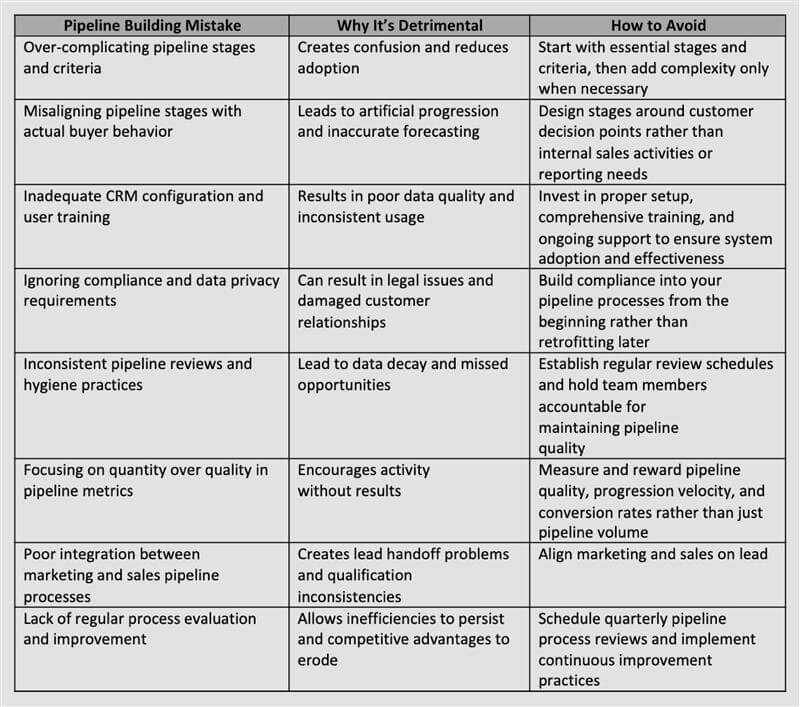
What Pipeline Building Mistakes Should You Avoid?
Learning from common mistakes can save you time, frustration, and missed revenue opportunities as you building and optimize your sales pipeline.
Conclusion
Building a strong sales pipeline requires more than a CRM—it demands clear processes, objective criteria, the right technology, and consistent execution. When your stages, qualification methods, data practices, and metrics work together, you create a system that drives predictable, scalable revenue. The key is continuous improvement: start with the fundamentals, track performance, and refine based on real data, not assumptions.
High-quality leads are the foundation of any successful pipeline, and that’s where Salesgenie® elevates your results. With access to over 19.5 million businesses, 255 million consumer contacts, and powerful filtering tools, you can fill your pipeline with verified prospects who fit your ideal customer profile.
Take the next step: Strengthen your pipeline with better data and integrated lead management tools—explore Salesgenie today.
FAQs
A sales pipeline tracks the steps your team takes to move a deal from prospect to customer. A sales funnel reflects the buyer’s journey and shows how many prospects remain as deals progress toward closing. Pipelines are built for internal process management; funnels help you understand conversion trends at each stage.
Most B2B pipelines include six to eight stages—Prospecting, Qualification, Needs Analysis, Proposal/Demo, Negotiation, Closing, and sometimes Post-Sale. The exact number depends on your industry, deal complexity, and internal process. The key is to define objective entry and exit criteria so every stage is measurable and consistent.
A healthy pipeline shows steady stage-by-stage progression, balanced deal distribution, and accurate forecasting. Metrics like conversion rates, deal velocity, pipeline coverage (typically 3–5x your target), and win/loss patterns reveal whether your pipeline can support predictable revenue. If deals regularly stall or forecasts are off, it’s a sign your pipeline needs refinement.
Use a structured qualification framework—such as BANT, MEDDIC, or CHAMP—and support it with scorecards, intent data, and engagement signals. Qualification should begin in prospecting and continue throughout the sales cycle, ensuring only viable opportunities remain in the pipeline. Consistent training and CRM-integrated workflows help teams apply criteria accurately.
Pipeline hygiene should be a weekly practice. This includes verifying deal statuses, logging recent activities, updating contact data, removing dead opportunities, and ensuring every deal has a next step. Regular maintenance prevents inflated forecasts, stalled deals, and misalignment between sales reps and managers.
CRMs are foundational, but advanced tools can significantly enhance visibility and predictability. Sales engagement platforms, intent data tools, conversation intelligence, predictive analytics, and automated lead routing systems help teams prioritize high-value opportunities and maintain consistency across outreach, qualification, and forecasting.