

Busywork often masquerades as progress in the world of B2B sales. Teams can rack up hundreds of calls, thousands of emails, and dozens of LinkedIn connections without materially moving conversion rates, in part because 96% of prospects research companies and products before they ever speak with a sales rep, and 71% would rather complete that research independently.
This signals that the problem is about alignment. Modern buyers are educated, selective, and increasingly self-directed, so chasing sheer volume won’t cut through the noise.
This guide will walk you through the proven prospecting techniques that help you identify and convert high-value leads efficiently. Along the way, we’ll share practical tactics and metrics so you can improve response and conversion rates without just increasing activity.
Are You Chasing Volume or Value?
Sellers are constantly urged to do more: more calls, more emails, more touches. But when the numbers come in, many teams find themselves stuck in a frustrating loop where activity is high but conversions remain flat.
This approach ignores the three factors that truly drive conversions: Buyer Fit, Buying Intent, and Channel Reachability.
When you align your time and channels with prospects who are the right fit, showing clear intent, and reachable through your chosen medium, you focus on fewer, more targeted touches that resonate with high-probability buyers instead of scattering effort across low-value leads.
Pro Tip
To keep your team accountable to outcomes, not just effort, set a weekly “value quota” alongside your activity metrics. This quota should focus on the number of qualified conversations booked, not just the number of calls made or emails sent.
So, how can you utilize these principles to drive conversion?
What Actually Drives Prospecting Conversions?
Boosting prospecting conversion rates isn’t just about working smarter. That means focusing on the three drivers that actually move the needle: Buyer Fit, Buying Intent, and Channel Reachability:
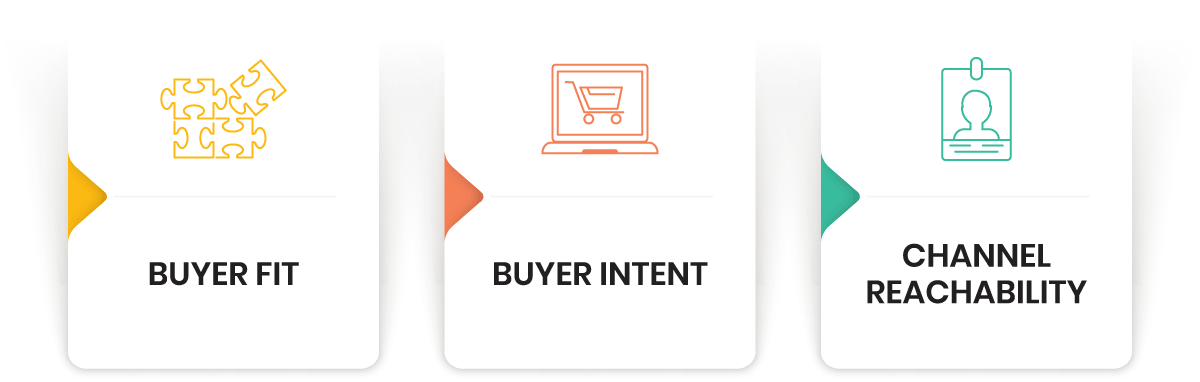
- Buyer Fit is all about how well a prospect matches your Ideal Customer Profile (ICP). Are they in the right industry? The right size company? The right role? The more boxes they check, the more likely they are to convert. When you’re targeting high Annual Contract Value (ACV) segments, this is especially crucial.
- Buying Intent measures whether your prospect is showing signs that they’re actively exploring solutions. Maybe they’ve visited your pricing page, attended a webinar, or engaged with your content. Or maybe there’s a triggering event, like a new round of funding or a key hire. These signals suggest that the timing is right for a conversation.
- Channel Reachability determines whether you can reach your prospect through the channels you’re using. Some roles are more responsive on the phone, while others prefer email or LinkedIn. And some companies have strict policies around communication. Understanding these norms and constraints helps you choose the channels that are most likely to get a response.
Pro Tip
Before launching your next prospecting campaign, score your lead list on the three value drivers: fit, intent, and reachability. Give each prospect a score from 1–5 on each factor. If their total score is less than 10, deprioritize them. Focus your efforts on the prospects with the highest scores.
When you anchor your prospecting decisions in these three variables, you naturally focus on the prospects who are most likely to convert, as well as the proper outbound prospecting methods.
How to Choose the Right Outbound Prospecting Methods
One of the biggest mistakes sales teams make is defaulting to a single outbound sales prospecting method. They blast out the same email to everyone, or they hammer the phones indiscriminately. But the right prospecting method depends on a variety of factors: deal size, sales cycle length, brand awareness, and compliance constraints.
High-ACV vs. Low-ACV Plays
If you’re chasing big deals with high ACVs, you’ll likely need to take a different approach than if you’re going after smaller opportunities.
- High-ACV deals often require multi-threading, such as engaging with multiple stakeholders across the organization. In these cases, prioritize phone and LinkedIn outreach to build those relationships.
- For lower-ACV deals, email sequences can be more efficient and scalable.
Cold vs. Warm Intent
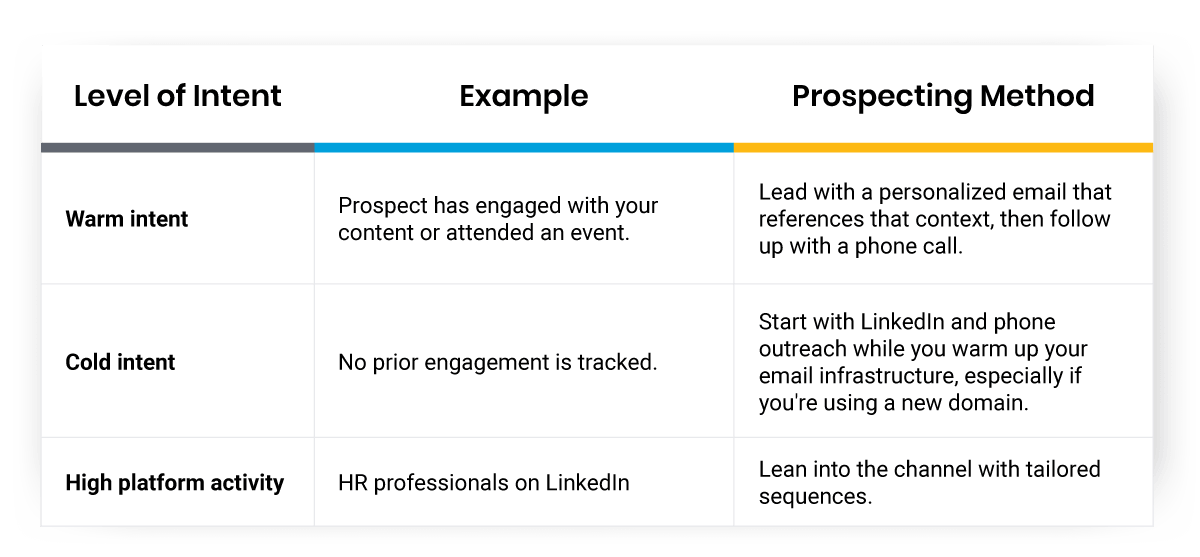
Most importantly, the key is to be adaptable and to choose the method that’s most likely to resonate with your specific prospects.
Where Does Cold Email Do The Heavy Lifting?
Cold email shines when you need to reach a large volume of prospects efficiently, but only if those prospects are reachable via email and your message is relevant. Email works best in these scenarios:
- High email engagement roles: Marketing leaders, RevOps professionals, and other roles that live in their inbox.
- Documented pain points: You have clear insight into a problem your prospect is facing and can articulate it in the subject line.
- Scalable outreach: You’re targeting a segment where personalization can be templated without losing relevance.
Cold email struggles when:
- Inbox saturation is high: Executives and high-level decision-makers often have gatekeepers or aggressive spam filters.
- Your domain reputation is weak: New domains or those with poor sender scores will land in spam.
- The message requires nuance: Complex value propositions that need real-time dialogue don’t translate well to email.
Pro Tip
Use email for the first touch only when you have a strong hook, for example, a mutual connection, a relevant trigger event, or a specific pain point you know they’re facing. Otherwise, consider warming them up on LinkedIn first.
When is Phone Prospecting Still Your Best Bet?
Phone outreach gets a bad rap, but it remains one of the most effective sales prospecting techniques for high-value deals when used strategically.
The phone works best when:
- You need real-time dialogue: Complex solutions or multi-stakeholder deals benefit from the back-and-forth that only a live conversation can provide.
- You’re targeting senior decision-makers: C-suite executives and VPs often prefer direct communication and appreciate the efficiency of a phone call.
- Timing is critical: If you’re responding to a trigger event or a warm referral, a phone call can capitalize on that momentum better than email.
Phone outreach is less effective when:
- Your prospect’s role is typically unreachable by phone: Some industries and roles (e.g., IT administrators, plant managers) rarely answer unknown numbers.
- You lack context: Cold calling without any prior research or relevance leads to low connect rates and wasted time.
- Your value proposition requires visual aids: If your pitch relies heavily on demos or visual content, email or LinkedIn may be better first touches.
Pro Tip
When you do use the phone, lead with a clear reason for the call, acknowledge that you’re interrupting their day, and get to value fast.
Next up, we’ll discuss how you can quickly qualify your leads.
How Do You Qualify Sales Leads Fast?
Qualification is where most prospecting efforts break down. Teams book meetings with anyone who shows a pulse, then waste hours on discovery calls that go nowhere. Fast, effective qualification requires asking the right questions early and being willing to disqualify aggressively.
Use these qualifying questions in your initial outreach or first conversation:
- Fit: “Are you currently using [category of solution] in your organization?”
- Intent: “What’s driving you to explore new options right now?”
- Authority: “Who else would need to be involved in evaluating a solution like this?”
- Timeline: “When are you looking to have a solution in place?”
Pro Tip
If a prospect is weak on two or more of these dimensions, deprioritize them. It’s better to focus your time on fewer, higher-quality opportunities than to chase every lead that shows mild interest.
If you’re considering leading your efforts with LinkedIn, we have some tips that will help you better understand the pros and cons of using the platform.
When Should You Lead with LinkedIn?
LinkedIn can be a powerful tool for sales prospecting, but it’s not always the best choice. The key is to understand where LinkedIn shines and where it falls short.
Which Sales Prospecting Techniques Work on LinkedIn?
LinkedIn prospecting tends to excel in these scenarios:
- Public titles and active profiles: Roles like VP and C-level executives, HR professionals, marketers, and RevOps leaders typically maintain active LinkedIn profiles, making them easier to research and reach.
- Visible mutual connections: If you share a connection with a prospect, mentioning that common link can establish trust and credibility right out of the gate.
- Timely triggers: LinkedIn is ideal for engaging with prospects after a relevant trigger event—a job change, a new round of funding, or participation in an industry conference.
Effective LinkedIn plays include:
- The value-add connection request: Instead of just hitting “Connect,” add a note that offers something of value, like an interesting article, a relevant case study, or an invitation to an upcoming webinar.
- The comment-to-DM pivot: If a prospect posts something interesting, leave a thoughtful comment and then follow up with a DM to continue the conversation.
- The voice note: Instead of another text-based message, send a quick voice note via LinkedIn to stand out and add a personal touch.
Less Effective LinkedIn Prospecting Techniques
LinkedIn isn’t always the best channel to utilize. It struggles when:
- Platform activity is low: Some roles and industries (e.g., plant managers, field operations staff) simply aren’t active on LinkedIn. If profiles are sparse or outdated, email or phone outreach may be more effective.
- Strict connection policies: Some organizations have policies around who their employees can connect with on LinkedIn. If you’re getting a lot of connection request rejections or seeing limited profile visibility, it may be a sign that LinkedIn isn’t the best channel for that segment.
With LinkedIn prospecting, your goal should be to start meaningful conversations that ultimately lead to booked meetings and closed deals.
How to Run Lean Experiments That Scale
The best prospecting strategies are built on experimentation, not guesswork. Instead of rolling out a new approach across your entire team, run small, controlled tests to see what works before you scale.
Here’s how to structure a lean prospecting experiment:
- Define your hypothesis: What do you believe will improve conversion rates? For example: “Leading with a phone call after a LinkedIn connection will increase meeting bookings by 20%.”
- Choose a small test segment: Select 50–100 prospects who match your ICP and split them into a control group and a test group.
- Run the experiment for 2–3 weeks: Execute your test consistently and track key metrics: response rate, meeting booking rate, and show rate.
- Analyze and iterate: If the test group outperforms the control, roll out the new approach. If not, adjust your hypothesis and test again.
The key is to test one variable at a time so you can isolate what’s actually driving results. Document your findings and share them with your team so everyone can benefit from what you learn.
Pro Tip
Create a simple experiment log in a shared document or your CRM. Track your hypothesis, test parameters, results, and next steps. Over time, this becomes a valuable knowledge base that informs your entire prospecting strategy.
Conclusion
Successful sales prospecting comes down to value alignment and choosing the right techniques for your specific context and executing them with discipline. When you align your prospecting approach with the factors that truly drive conversion, you create a clear path to high-value deals.
Salesgenie® gives you the data and insights you need to identify high-fit prospects, prioritize based on intent signals, and reach them through the right channels. With accurate contact data, firmographic intelligence, and real-time updates, you can build a prospecting strategy that’s both efficient and effective.
FAQs
The three critical factors are Buyer Fit (how well prospects match your Ideal Customer Profile), Buying Intent (signals that prospects are ready to buy), and Channel Reachability (your ability to reach prospects through your chosen communication methods). Focus your efforts on prospects who score high in all three areas to maximize conversion rates.
High-ACV deals typically require multi-threading and relationship building across multiple stakeholders, making phone and LinkedIn outreach more effective than email. For smaller deals, you can often use more direct approaches, but always consider your sales cycle length and brand awareness when choosing your method.
LinkedIn works best when targeting roles with public titles and active profiles (like executives, HR professionals, marketers), when you have visible mutual connections to leverage, or when engaging after timely trigger events like job changes or company announcements. Avoid LinkedIn for roles with low platform activity or organizations with strict connection policies.
Volume-focused prospecting emphasizes making more calls and sending more emails to any remotely promising lead. Value-focused prospecting prioritizes fewer, targeted touches to high-probability buyers who demonstrate strong fit, intent, and reachability, resulting in higher conversion rates and better use of time.
Set a weekly “value quota” that focuses on qualified conversations booked rather than just calls made or emails sent. Score your prospect lists on fit, intent, and reachability before outreach, and deprioritize prospects weak in two or more areas to ensure your efforts drive meaningful pipeline contribution.