
Are you tired of the endless confusion surrounding the terms “prospect” and “lead” in your sales and marketing efforts? You’re not alone. It’s more critical than ever for small and medium-sized businesses (SMBs) to have a clear understanding of these fundamental concepts.
Misaligned definitions can lead to missed opportunities, duplicated efforts, and frustrated potential customers who receive the wrong messaging at the wrong time.
Simply put, a lead is an initial contact that shows interest, while a prospect is a qualified lead that fits your ideal customer profile (ICP) and shows buying intent.
In this definitive guide, we’ll dive deep into prospects and leads, outline the two dominant models, and share actionable frameworks to move contacts through your funnel. We’ll also cover the tech stack, key metrics, and common mistakes to avoid. By the end, you’ll have a clear roadmap for optimizing your contact classification strategy and future-proofing your sales process.
How Lead vs. Prospect Confusion Hurts Your Business
Picture this: your marketing team is celebrating new leads from your latest campaign while your sales team dismisses them as unqualified. When your sales and marketing teams aren’t on the same page about what counts as a qualified lead, you end up with:
- Missed opportunities: Sales reps ignore leads that could have turned into customers with the right nurturing
- Wasted time:Marketers pass along contacts that aren’t a good fit, so sales wastes time chasing dead ends
- Frustrated prospects:Misclassified leads get the wrong messaging at the wrong time, leaving a bad impression
All of this adds up to lower conversion rates, inefficient teams, and ultimately, lost revenue for your business. Today, the cost of this confusion is only getting higher. With more competition, savvier buyers, and higher customer expectations than ever before, SMBs simply can’t afford to let qualified prospects slip through the cracks.
Ready to stop wasting money and start aligning your teams? As you embark on clarifying your prospect-vs-lead definitions, it’s important to realize there’s no one-size-fits-all approach. In the next section, we’ll break down the two most common frameworks SMBs use, so you can choose the best approach for your unique context.
The Two Dominant Models: Understanding Both Frameworks
There are two primary frameworks SMBs use to classify and advance contacts through their pipeline:
- The Lead-First Model (also known as the Marketing-Driven Model)
- The Prospect-First Model (also known as the Sales-Driven Model)
While both models aim to turn potential customers into closed deals, they each have a distinct philosophy and qualification sequence. A B2B software company with a long sales cycle may prefer the Lead-First Model. It allows marketing to do the heavy lifting of educating and qualifying leads before handing them off to sales. A transactional B2C business may find the Prospect-First Model more efficient, as sales can quickly identify and convert high-intent prospects.
Implementing a new framework requires clear definitions, updated processes, and the right technology to support your team. The payoff includes higher-quality leads, fewer wasted efforts, and a more aligned sales and marketing function.
Model A—Lead-First Framework (Marketing-Driven)

In the Lead-First Framework:
- Lead: An unqualified contact who has shown some initial interest in your product or service. This could be someone who filled out a form, downloaded a resource, or attended a webinar. At this stage, you don’t know much about their fit for your offering or their likelihood of buying.
- Prospect: A qualified lead who has been vetted by marketing and meets certain criteria, such as having the right budget, authority, need, and timeline (BANT). Essentially, a prospect is a lead that has demonstrated genuine interest and said, “I’m interested, tell me more!”
Let’s say you’re a B2B software company that sells a marketing automation platform. You generate leads when someone downloads a whitepaper or attends a webinar. If that lead starts engaging with more of your content, attending additional webinars, and providing more detailed information through forms, they may become a prospect. This model works best for SMBs that have a robust marketing operation and a longer sales cycle.
The Lead-First Model requires strong alignment between marketing and sales. Everyone must agree on what “qualified” looks like and establish clear handoff criteria to prevent leads from falling through the cracks.
Model B—Prospect-First Framework (Sales-Driven)

If sales prefers a more proactive outreach approach, the Prospect-First Model may be the better choice. In the Prospect-First Model:
- Prospect: Any contact that matches your ideal customer profile (ICP) that a salesperson is actively engaging.
- Lead: An engaged prospect who has shown clear buying intent
This approach allows sales teams to be more proactive. Instead of waiting for marketing to deliver qualified leads, sales can go out and identify their own prospects that fit the ICP. This model works particularly well for direct sales organizations and companies with shorter sales cycles.
Take the time to understand both dominant models and choose the one that fits your SMB best. The clarity you gain will translate directly into higher-quality leads and more consistent results across your sales team.
Lead vs. Prospect vs. Opportunity: The Complete Hierarchy
Misalignment between sales and marketing often arises from unclear definitions of leads, prospects, and opportunities. Without a shared understanding of these stages, teams struggle to prioritize outreach, tailor messaging, and track progress effectively. Establishing a clear framework ensures smoother collaboration, more precise targeting, and ultimately, stronger conversion outcomes.
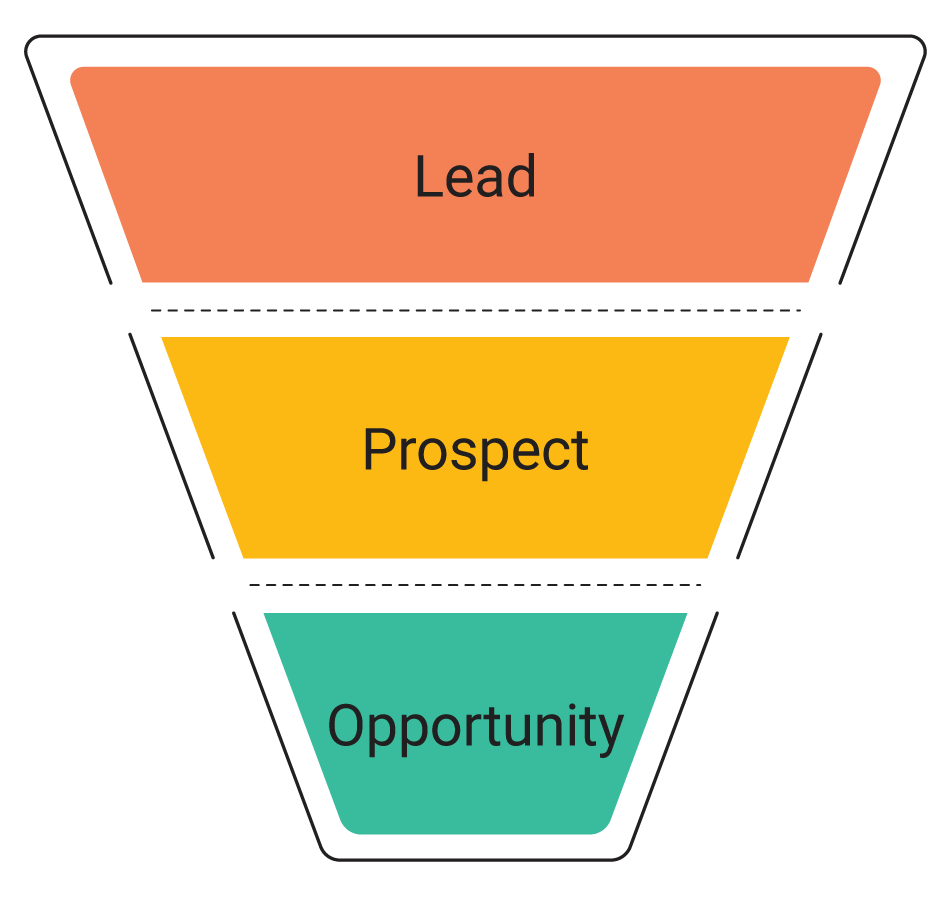
Understanding the distinct stages:
- Lead: Initial contact with basic interest signals
- Prospect: Qualified contact fitting your ICP criteria
- Opportunity: Active deal in your sales pipeline
Each stage maps to different levels of engagement, qualification status, and typical actions. Leads require nurturing and education. Prospects need qualification and discovery conversations. Opportunities demand focused sales efforts and deal management. This hierarchy helps your team understand exactly where each contact sits in your sales funnel and what actions to take next.
The progression isn’t always linear. A prospect might become dormant and require re-nurturing as a lead. An opportunity might stall and need to be reclassified as a prospect for future follow-up. Having clear definitions allows your team to make these adjustments without losing valuable contacts.
What is a Sales Prospect Definition? Breaking Down the Essentials
Not every contact is a true sales prospect. A qualified prospect must align with your ICP, show some level of buying intent, and meet basic BANT criteria. Fit alone isn’t enough; there must be actual interest or pain points your solution can address.
Core characteristics that define a qualified prospect include demographic alignment with your target market, behavioral signals indicating interest, and situational factors that create urgency or need. For example, a prospect might work at a company of the right size, in the right industry, and have downloaded multiple resources about solving a problem your product addresses.
The difference between fit and intent is crucial. A contact might perfectly fit your ICP but show no signs of active buying behavior. Conversely, someone might not be a perfect fit but demonstrate high intent through their actions. The best prospects combine both elements.
Common prospect identification mistakes SMBs make include focusing too heavily on demographics while ignoring behavioral signals, not updating ICP criteria based on actual customer data, and failing to distinguish between casual interest and genuine buying intent. Regular review of your prospect definition ensures it remains aligned with your most successful customer profiles.
MQL, SQL, SAL Qualification Stages: Your Contact Progression Roadmap
Marketing Qualified Lead (MQL), Sales Qualified Lead (SQL), and Sales Accepted Lead (SAL) define how leads flow from one stage to the next. By implementing lead scoring, monitoring engagement, and establishing clear handoff criteria, you’ll ensure valuable contacts move smoothly through your funnel.
Marketing Qualified Lead (MQL)
An MQL has reached specific engagement thresholds that indicate marketing readiness. Typical MQL activities include downloading multiple resources, opening and clicking email campaigns consistently, spending significant time on your website, and attending webinars or events.
Effective lead scoring and prospect conversion depend on both explicit actions (form fills, content downloads) and implicit behaviors (website visits, email engagement). The threshold for MQL status should be high enough to indicate genuine interest but not so high that you miss early-stage buyers.
Pro Tip
Review your MQL scoring model quarterly. Buyer behavior shifts fast—regular calibration ensures you’re sending only genuinely engaged contacts to sales.
Sales Qualified Lead (SQL)
An SQL represents two-way engagement confirmation. This typically means the contact has responded to outreach, participated in a discovery call, or otherwise engaged directly with your sales team. SQLs have moved beyond passive content consumption to active dialogue about their needs.
During qualification, validate budget parameters, identify decision-makers, and confirm timing.
Pro Tip
After every discovery call, summarize three key points in your CRM—pain point, timeline, and next step. This creates sales continuity and better follow-up personalization.
Sales Accepted Lead (SAL)
SAL represents the formal handoff process between marketing and sales. This stage confirms that sales accepts responsibility for the lead and commits to specific follow-up activities within defined timeframes.
The handoff process should include lead context, engagement history, and any specific insights gathered during the qualification process. This information helps sales personalize their approach and avoid asking questions the prospect has already answered.
Pro Tip
Automate SAL follow-up reminders. Leads lose warmth fast—contacts reached within 24–48 hours convert at significantly higher rates.
Lead to Sales Prospect Conversion: Practical Workflows for SMBs
Implementing a clear process for moving contacts through each qualification stage requires defining your qualification criteria, setting up your CRM properly, implementing lead scoring systems, automating your workflows, and monitoring conversion rates at each stage.
Your workflow should specify exactly what actions trigger stage transitions, who is responsible for each step, and what happens when contacts don’t progress as expected. Automation tools can handle routine tasks like lead scoring updates and follow-up reminders, but human judgment remains essential for qualification decisions.
Lead scoring should combine demographic fit with behavioral engagement. Weight different activities based on their correlation with actual purchases in your business. For example, requesting a demo might score higher than downloading a whitepaper because it indicates stronger buying intent.
Common conversion bottlenecks include unclear qualification criteria, poor handoff communication between teams, inadequate follow-up processes, and lack of lead nurturing for contacts who aren’t immediately ready to buy. Address these systematically to improve your overall conversion rates.
Measuring conversion rates at each stage helps identify where prospects are getting stuck. If many MQLs don’t become SQLs, you might need to adjust your scoring criteria or improve your sales outreach. If SQLs aren’t converting to opportunities, focus on qualification and discovery processes.
Prospect vs. Lead Examples B2B: Real Scenarios for Small Businesses
Understanding the difference between prospects and leads becomes clearer with specific examples across different business types.
Service-Based Business Examples
In a marketing consulting firm, a lead might be someone who downloaded a pricing guide but provided minimal company information and hasn’t engaged further. You know they’re interested in pricing but don’t know if they fit your ideal client profile or have the budget for your services.
A prospect in the same business would be a qualified company that requested a consultation call, provided detailed information about their challenges, and matches your ideal client profile in terms of company size, industry, and budget range. They’ve moved from passive interest to active engagement.
Product-Based Business Examples
For a B2B software company, a lead might be someone who signed up for a free trial with just an email address and company name. They’re testing your product, but you don’t know their role, company size, or specific use case.
A prospect would be an active trial user who matches your ICP, has engaged with your onboarding materials, invited team members to the trial, and confirmed they have the budget for a solution like yours. Their behavior indicates serious evaluation rather than casual browsing.
E-commerce and Retail Examples
In an e-commerce business targeting other businesses, a lead might be a newsletter subscriber who hasn’t made any purchases but opens emails regularly and visits your website occasionally. They’re aware of your brand but haven’t shown strong buying intent.
A prospect would be a repeat visitor who views high-value product pages, adds items to their cart, and fits your ideal customer profile based on their company information or previous interactions. Their browsing behavior suggests they’re actively considering a purchase.
Pro Tip
Track behavioral milestones—like demo requests or repeat visits—to identify when leads naturally graduate into prospects without manual review.
Building Your Prospect and Lead Management System
Choosing the right prospect or lead management model—and aligning it with the right technology—creates a strong foundation for predictable growth and seamless collaboration between sales and marketing teams.
Choose the Right Model for Your Business
Start by assessing your team structure, marketing automation maturity, and available resources. Smaller sales teams often benefit from the Lead-First Model, where marketing handles initial qualification before passing leads along. Larger teams, on the other hand, may prefer the Prospect-First Model, which gives sales more control over contact development from the start.
The sophistication of your marketing automation tools also plays a key role. Companies using robust platforms like HubSpot or Salesforce can automate complex nurturing sequences and handoffs, while smaller businesses using tools such as Pipedrive, Zoho CRM, or Freshsales may prefer more direct, hands-on engagement workflows.
Reviewing how similar SMBs in your industry structure their qualification and handoff models can also help you determine which framework best supports your sales motion and capacity.
Pro Tip
Test both models for 90 days. Compare conversion rates, lead velocity, and rep feedback. Data—not assumptions—should guide your framework choice.
Configure Your Technology Stack
Once you’ve chosen a model, ensure your technology supports it. Your CRM should be configured with custom fields, stages, and workflows that align with your chosen framework. Integration between your CRM and marketing automation platform—such as HubSpot Marketing Hub or Salesforce Marketing Cloud Account —is essential for accurate lead tracking and timely engagement.
Data enrichment tools can further enhance this setup by filling in missing company and contact information, helping your team qualify and prioritize leads with greater precision.
Streamline Integration and Workflows
Integration requirements include connecting your website, email marketing, social media, and other touchpoints to create a complete view of each contact’s journey. Workflow automation can handle routine tasks like lead scoring updates, follow-up reminders, and stage transitions based on predefined criteria.
Budget-friendly options exist for growing SMBs. Many CRM and marketing automation platforms offer tiered pricing that scales with your contact database and feature needs. Start with basic functionality and add advanced features as your processes mature and your budget allows.
Salesgenie provides critical data foundations and lead management capabilities that help eliminate guesswork in contact classification. With extensive business databases, lead scoring capabilities, and CRM integrations, Salesgenie ensures your team focuses on the highest-value opportunities while maintaining data accuracy throughout your chosen model.
Measuring Success: KPIs and Metrics That Matter
Tracking conversion rates, monitoring time-to-progression benchmarks, and measuring sales and marketing alignment helps identify bottlenecks and ensure efficient movement through your pipeline. Measure sales and marketing alignment through shared metrics and regular communication.
Key conversion metrics include your prospect conversion rate, MQL-to-SQL rates, SQL-to-opportunity rates, and opportunity-to-close rates. These percentages help you understand where contacts are getting stuck and where to focus improvement efforts. Industry benchmarks can provide context, but focus primarily on improving your own performance over time.
Time-based metrics reveal process efficiency. How long does it take for an MQL to become an SQL? How quickly do opportunities progress through your sales stages? Longer timeframes might indicate process problems or insufficient follow-up.
ROI measurement requires connecting your contact classification efforts to actual revenue results. Track which sources generate the highest-quality prospects and leads. Measure the cost of acquiring and converting contacts at each stage. This data helps optimize your marketing spend and sales focus.
Monthly reporting should include pipeline health, conversion trends, and team performance against targets. Dashboards provide real-time visibility into key metrics, while detailed reports enable deeper analysis of trends and opportunities for improvement.
Future-Proofing Your Contact Classification Strategy
Sales and marketing are evolving fast, and SMBs need a contact classification strategy that keeps pace. AI-driven lead scoring, account-based marketing, and advanced attribution modeling are transforming how teams track and prioritize prospects. Automation can handle routine qualification, freeing your team to focus on building relationships and tackling complex sales situations—but human judgment remains essential for understanding nuanced needs and building trust.
Privacy regulations make first-party data more important than ever. A future-ready strategy emphasizes direct engagement with prospects and leads rather than relying solely on third-party sources. Scalable processes prepare your business for growth, handling larger volumes of contacts and more complex sales scenarios. As your business expands into new markets or product lines, flexibility in your model ensures it adapts without requiring complete overhauls.
Turning Strategy Into Action
Strategy only works when it’s executed. Every SMB must choose the contact classification model that fits their business, define clear criteria for each stage, align teams on terminology, implement supporting technology, and establish metrics to measure success. A focused 30-day roadmap can jumpstart the process, including team workshops, CRM configuration, training sessions, and baseline measurements to track progress.
Team alignment workshops should cover why you’re implementing a new model, what the specific definitions mean for daily work, how handoff processes will change, and what success looks like for each team member. Interactive exercises help reinforce learning and identify potential implementation challenges.
With a clear classification framework, marketing can focus on nurturing early-stage leads while sales engages the most qualified prospects. Clear definitions and consistent processes translate into higher conversion rates, stronger team alignment, and better customer relationships.
Implementing a clear prospect vs. lead framework is just the first step toward building a scalable sales process. Salesgenie provides the data foundation and lead management tools that SMBs need to identify, qualify, and nurture contacts effectively through every stage of their chosen model for sustainable growth.
FAQs
Confusing leads and prospects creates inefficiency and misalignment between marketing and sales. A lead is an early-stage contact who has shown initial interest, while a prospect is a qualified lead that fits your Ideal Customer Profile (ICP) and shows clear buying intent. When teams use consistent definitions, messaging becomes more targeted, handoffs smoother, and conversion rates stronger.
A lead becomes a prospect once they meet specific prospect qualification criteria based on fit and intent. Fit means the contact aligns with your ICP—right industry, company size, or role. Intent comes from behavioral signals like demo requests, repeat visits, or high content engagement. True prospects demonstrate both alignment and active interest in solving a problem your product addresses.
Lead qualification focuses on determining whether a contact is ready for sales based on engagement and scoring thresholds, typically managed by marketing. Prospecting is the proactive process of identifying and reaching out to high-fit contacts, led by the sales team. In short, qualification evaluates readiness, while prospecting drives new opportunities.
Leads are measured by early engagement signals—downloads, email opens, or event attendance—showing awareness and initial interest. Prospects are tracked by deeper actions like discovery calls, demo requests, or verified budget and timeline. Monitoring stage-based metrics (MQL → SQL → Opportunity) helps visualize when leads transition into qualified prospects.
Marketing focuses on attracting and nurturing leads through campaigns, content, and automation until they’re ready for sales. Once that stage is reached, the process shifts from lead nurturing to prospecting—sales begins one-to-one engagement, discovery calls, and qualification to convert interest into opportunity. This handoff keeps both teams focused on their strengths while ensuring consistent buyer experiences.
When companies treat leads and prospects as interchangeable, they risk miscommunication, wasted effort, and missed opportunities. Leads may be pushed to sales too early, while ready-to-buy prospects can sit in nurturing workflows too long. Defining each stage and aligning handoff criteria keeps both teams efficient and ensures every contact receives the right level of engagement.