

Turning “No” Into “Yes”
Every “no” in sales is really a “not yet” if you know how to handle it. Objections aren’t deal-breakers. Instead, they’re often signs that your buyer is still engaged but needs clarity, confidence, or more value. From pricing concerns to “let me think about it,” knowing how to respond is a critical part of moving deals forward. In fact, between 40% and 60% of sales opportunities end in no decision, making objection handling one of the most overlooked levers for driving revenue.
Still, many reps treat pushback as a dead end instead of a doorway. Handling objections in sales is about staying curious, focused, and confident under pressure. In this guide, we’ll walk through proven frameworks, conversation examples, and practical tips to help your team respond with credibility and close more deals.
Just getting started? See our B2B Sales Guide to learn more.
How to Better Understand Sales Objections
Not every objection is created equal, and not every “no” really means no. In sales, objections are expressions of concern or hesitation that need to be addressed before a buyer can move forward. That’s different from a brush-off, which is typically a polite way to disengage or avoid the conversation altogether.
Pro Tip
Objections are rarely about what they seem on the surface. A price concern may actually be about perceived risk.
A timing delay might mask a misalignment with internal priorities. Instead of reacting too quickly, ask yourself: What’s the real concern this objection is pointing to?
Behind most common sales objections are deeper emotions: fear of making the wrong decision, uncertainty about outcomes, or hidden internal priorities that haven’t been voiced. Whether it’s a concern about pricing, timing, vendor risk, or simply not being the decision-maker, these objections signal that the buyer is still considering but not yet convinced.
Did you know? Close rates drop by 71% when “next steps” aren’t discussed on the first call, which is a clear signal that deals stall without explicit follow-ups.
You should be prepared to handle pushback in several recurring forms:
- Price/Budget – “It’s too expensive,” or “We don’t have budget this quarter.”
- Timing/Priority – “Now’s not the right time,” or “Circle back next year.”
- Authority – “I’m not the final decision-maker.”
- Need/Value – “We’re doing fine without this,” or “What’s the ROI?”
- Risk/Competition – “We’re evaluating other vendors,” or “What happens if it fails?”
What are the Core Principles of Effective Objection Handling?
Behind every successful objection response is a clear set of principles. Whether you’re dealing with pricing concerns, timeline stalls, or indecision, effective sales objection handling techniques rely on curiosity, clarity, and calm under pressure. Below are four foundational habits that can help you stay in control of the conversation.
- Lead with Active Listening and Empathy
Great reps don’t jump to rebuttals. They slow down and listen. When a buyer raises a concern, acknowledge it without rushing to fix it. A simple “That makes sense” or “I hear you” can defuse tension and build trust before you say another word.
Expert Insight
“It all starts with the universally applicable premise that people what to be understood and accepted. Listening is the cheapest, yet most effective concession we can make to get there.” — Chris Voss, Never Split the Difference
- Stay Curious, Not Defensive
Objections are often surface-level symptoms of deeper issues. Train yourself to respond with open-ended questions rather than explanations. Instead of arguing, ask: “Can I ask what’s driving that concern?” or “Help me understand what success looks like on your side.” - Reframe Around Value, Not Price
The moment a conversation becomes all about cost, you’ve lost control of the value narrative. Shift the focus back to ROI, risk reduction, or efficiency gains. Buyers rarely object to price when they clearly see the business case behind it. - Know Your Boundaries (and Your BATNA)
Confidence comes from knowing where you can flex and where you can’t. If the deal doesn’t make sense within your pricing, margin, or resource constraints, walk away professionally. Having a clear BATNA (Best Alternative to a Negotiated Agreement) helps you stay firm without being inflexible.
Proven Strategies & Frameworks
There’s no one-size-fits-all script for objection handling, but there are proven approaches that work across industries and deal types. These frameworks give sales reps structure without making them sound scripted. Mastering how to overcome objections in sales starts with knowing when (and how) to apply the right tool for the situation.
Feel–Felt–Found
A classic empathy-driven model.
Example: “I understand how you feel. Other clients have felt the same way at first, but they found that once they saw the results after implementation, the value was clear.”
LAER: Listen, Acknowledge, Explore, Respond
This model keeps reps from jumping too quickly to solutions.
Use it when: the objection may mask deeper concerns.
Ask follow-ups before responding—don’t assume you’ve heard the full story.
Ask–Tell–Ask Loop
Start by asking how the buyer sees the issue, share your perspective or data point, then ask again to invite a reaction.
Why it works: It keeps the conversation two-sided and uncovers hidden objections.
Reframe to ROI and Business Outcomes
When objections are tactical (“This is expensive,” or “We already have a vendor”), elevate the conversation to strategic outcomes.
Reframe: “This isn’t just about the cost. It’s about what it will return over the next 12 months.”
Silence & Strategic Pausing
Sometimes the best move is to say nothing. A well-timed pause after a statement or question gives the buyer room to think and often leads them to reveal more than they intended.
Pro Tip
Don’t force a method just because it’s familiar. Use discovery skills to understand the type of objection first, then choose the tool that best fits the moment.
Be prepared for any type of sales situation by reading our guide to building a winning sales strategy.
How to Handle the Most Common Objections
Most objections fall into familiar patterns. The key to effective sales objection handling is recognizing which type you’re hearing, diagnosing what’s really behind it, and responding with empathy, clarity, and confidence. Below are five of the most frequent objections, along with guidance on how to respond—and when to pivot.
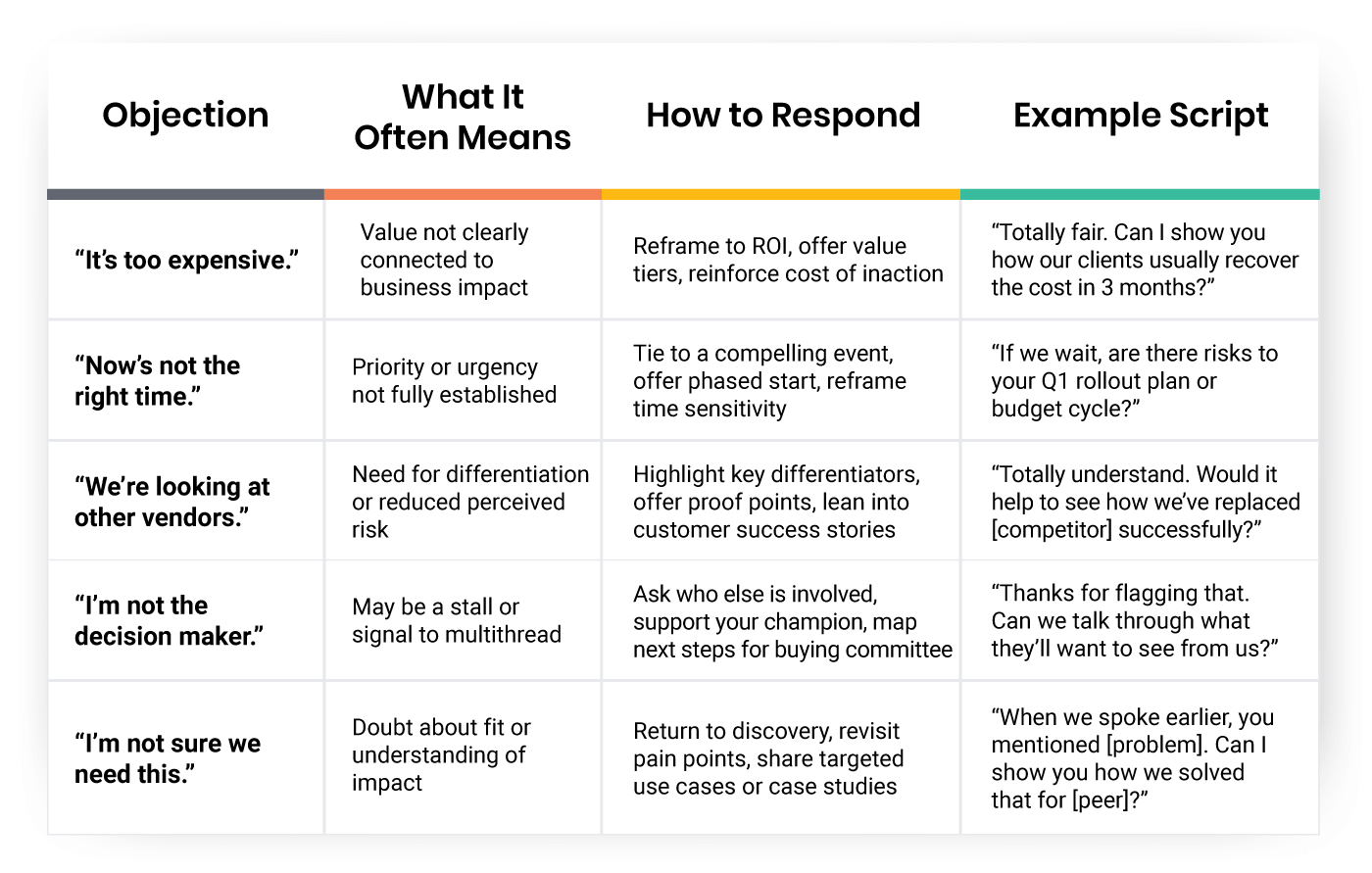
Pro Tip
The objection you hear isn’t always the one you’re solving for. Slow down, ask a follow-up question, and use the frameworks from Section 4 to guide your response.
Scripts & Objection Handling Examples for Reps
Even the best frameworks fall flat without the right delivery. That’s why it’s critical to arm reps with practical, real-world phrasing that sounds confident and not canned. In this section, we’ll show how to handle objections in sales (examples included), complete with tone guidance and use-case variations.
- Objection: “It’s too expensive.”
Rep: “I totally understand. It’s a big investment. Out of curiosity, how are you currently handling [X] today?”
Buyer: “We’re using [Workaround].”
Rep: “Got it. Many of our customers felt the same until they saw the ROI—most recover the cost within three months.”
Rep: “Fair point. Can I show you how this would cut down on rework and downtime? That’s where our customers typically see the return.”
Do: Focus on ROI or total cost of ownership.
Don’t: Apologize for your price or offer a discount immediately.
- Objection: “Now’s not the right time.”
Rep: “Makes sense—timing is everything. What’s happening on your side that’s affecting the timeline?”
Buyer: “We’re prepping for a system upgrade.”
Rep: “Could this help support that rollout, or is it better to align post-launch? We can tailor the start accordingly.”
Rep: “Understood. Would it help if we phased implementation by site or shift, so it doesn’t interrupt production?”
Do: Ask discovery questions and offer flexible options.
Don’t: Accept delay at face value without exploring context.
- Objection: “We’re looking at other vendors.”
SaaS Example:
Rep: “That’s great! You should. What matters most to you as you compare options?”
Buyer: “Ease of use and support.”
Rep: “That’s exactly where our customers say we stand out. Would it help to talk to someone who made the same switch?”
Manufacturing Example:
Rep: “If I can show you how we’re outperforming [Competitor] in both service level and lead time, would that be worth a look?”
Do: Respect the process, then reframe to your differentiators.
Don’t: Speak negatively about competitors.
Scripts give you the words, but technology gives you the systems to track, refine, and scale what works. Let’s look at the tools that support better objection handling across your entire sales process.
Tools & Tech to Support Objection Handling
Objection handling is about how well sales reps prepare, document, and improve over time. The right tools can turn scattered insights into structured learning and help reps respond faster and more effectively, especially when handling email sales objections or managing multi-threaded B2B conversations.

- CRM Templates & Concession Logging
Most CRMs today support objection-tracking workflows. Reps can log which objections appear most frequently, note how they were handled, and track discounting patterns or approvals in real time. Use custom fields or tags for objection type, response strategy, and outcome.
Pro Tip
Create a CRM note template that prompts reps to log the objection, root cause, framework used, and final resolution.
- Call Recording & AI-Powered Insights
Sales engagement platforms with call recording offer sentiment analysis, keyword detection, and objection tagging. These tools surface moments where buyers push back, allowing managers to coach against real examples and measure how reps respond under pressure. - Sales Enablement Platforms with Objection Libraries
Equip reps with objection-handling playbooks, response scripts, and vertical-specific examples, and make them easily accessible from your sales enablement platform.Bonus: include snippets for handling email sales objections, where tone and brevity matter even more.
Technology can capture data and highlight trends, but it’s the coaching behind those insights that turns them into real performance gains. The next step is helping your team turn analytics into action through consistent training and enablement.
Coaching & Team Enablement
Objection handling as a team is essential and building your competency takes more than one-off scripts or surface-level training. The best sales leaders understand the importance of coaching to the psychology of sales objection handling, equipping reps to stay calm, curious, and confident under pressure.
Here are some exercises you can run through with your team:
- Role-Play Exercises and Scorecards
Practice drives performance. Build role-play into weekly sales meetings using real objections from active deals. Use scorecards to grade reps on listening, curiosity, tone, and clarity—not just the outcome. Rotate roles between seller, buyer, and observer to strengthen empathy and response agility. - Call Review Frameworks for Managers
Listening to objection moments during recorded calls gives managers a powerful lens into how reps perform under pressure. Use a simple call review rubric:
- Was the objection clearly identified?
- Did the rep acknowledge it or skip ahead?
- Was the response framework appropriate?
- Was value re-established?
Even reviewing 1–2 objection-heavy calls per week can create measurable improvement.
- Metrics That Matter
Go beyond close rate to track the impact of objection handling specifically. Key metrics include:
- Win rate after objection raised
- Time-to-close from objection moment
- Concession-to-close ratio
- Frequency of same objection per rep or team
Over time, these signals help identify coaching gaps and refine objection playbooks.
With the right coaching structure in place, the next step is helping reps go from reactive to proactive by anticipating objections before they even surface.
Learn more: B2B Sales Negotiation Tactics That Win More Deals
Advanced Tips & Best Practices
Once you’ve mastered the basics of objection handling, the next level is about prevention, anticipation, and enablement. These best practices help reps reduce friction before it starts and respond faster when it does.
- Anticipate Objections Through Better Discovery
Most objections are born from missed discovery questions. Ask about budget ownership, decision process, past buying experiences, and success criteria early. This kind of sales negotiation preparation surfaces potential roadblocks before they become deal-breakers.
Expert Insight
“Success in the larger sale depends, more than anything else, on how the Investigating stage of the call is handled.” — Neil Rackham, SPIN Selling
- Use Case Studies and Testimonials as Objection Insurance
Build a bank of short, specific success stories you can drop into conversations. For example:“One of our clients had the exact same concern about onboarding complexity—here’s how we helped them go live in under 30 days.”When buyers hear a peer’s journey, it reduces risk perception and builds credibility instantly. - Build and Maintain an Objection Bank
Create a living document that logs real objections from the field by industry, persona, and product line. Include sample responses, frameworks used, win/loss outcomes, and timestamps. This becomes an internal enablement goldmine for onboarding new reps, refining messaging, and improving campaign alignment.
Pro Tip
If your team keeps hearing the same objections, don’t just train on them. Build assets to address them. Create one-pagers, calculators, customer videos, or ROI snapshots that let marketing and sales work from the same playbook.
Contact Salesgenie® to see how we can help you implement these tactics.
FAQs: Sales Objection Handling
Objections are usually rooted in fear, doubt, or internal misalignment. Great reps use empathy and curiosity to uncover what’s really holding the buyer back.
Reframe the conversation around value and ROI. Show outcomes before offering any pricing adjustments.
Typical objections include concerns about price, timing, competition, decision authority, or value. Each points to uncertainty that needs resolving.
Use models like LAER, Ask–Tell–Ask, or Feel–Felt–Found to guide structured, buyer-centered conversations.
Managers should review calls, run role-plays, and track objection metrics to coach more effectively.
Empathy helps buyers feel heard and lowers resistance, turning objections into collaborative problem-solving moments.
Anticipate objections early, respond with proof and context, and document learnings for continuous improvement.
Key Takeaways
Whether you’re new to sales or refining a high-performing team, mastering handling sales objections is one of the most powerful ways to increase close rates and build buyer trust. When reps are equipped with the right mindset, frameworks, and tools, objections become opportunities—not obstacles.
Must-do objection tactics recap:
- Use structured frameworks like LAER and Feel–Felt–Found.
- Log objections, responses, and outcomes in your CRM.
- Shift conversations from price to value and ROI.
- Coach reps through role-play, call reviews, and real metrics.
- Build enablement assets based on your most frequent objections.
- Anticipate objections early through better discovery.
Explore more of our sales strategy resources: