It’s easy to believe that if you optimize the bid and tweak the copy on your pay-per-click ads, clicks will simply roll in. They might, but clicks alone don’t pay the bills. What happens after someone clicks your ad?
Many businesses treat pay-per-click advertising as a standalone tactic, but an expert PPC strategy connects traffic to a coordinated system that turns interest into revenue. In this guide, you’ll learn how to align your PPC campaigns with other marketing strategies and build sequences that compound your engagement across channels.
What Is an Expert PPC Strategy?
An expert PPC strategy connects your pay-per-click campaigns to other aspects of marketing and sales.
- First-party data: Provides privacy-compliant, highly accurate information about potential prospects and better tunes your targeting.
- Email marketing: Helps convert high-cost paid traffic into a nurtured customer relationship with potential lifetime value.
- Direct mail: An often-overlooked marketing channel, delivering return on ad spend (ROAS) as high as 55% compared to search-based platform advertising (21%) or social media ads (4.6%).
This creates coordinated, multi-touch journeys for your prospects. It does not isolate value into standalone metrics like click-through rates. Instead, it builds an end-to-end system that turns more of those clicks into customers.
What defines true PPC expertise? Three things:
- Precise audience selection: Using your best customer data to inform targeting so your ads reach the people most likely to buy.
- Deliberate sequencing: Aligning your PPC, email, and direct mail touches in a way that compounds momentum so each interaction picks up where the last left off.
- Closed-loop feedback between channels: Using engagement signals from every channel to continually sharpen your targeting, timing, and offers.
Pro Tip
Write your one-sentence PPC job-to-be-done first (e.g., “Turn net-new searchers into booked consults in 14 days”), then align channels to that outcome. Clarity on the destination makes every optimization more purposeful.
The 3-Channel Amplification Model
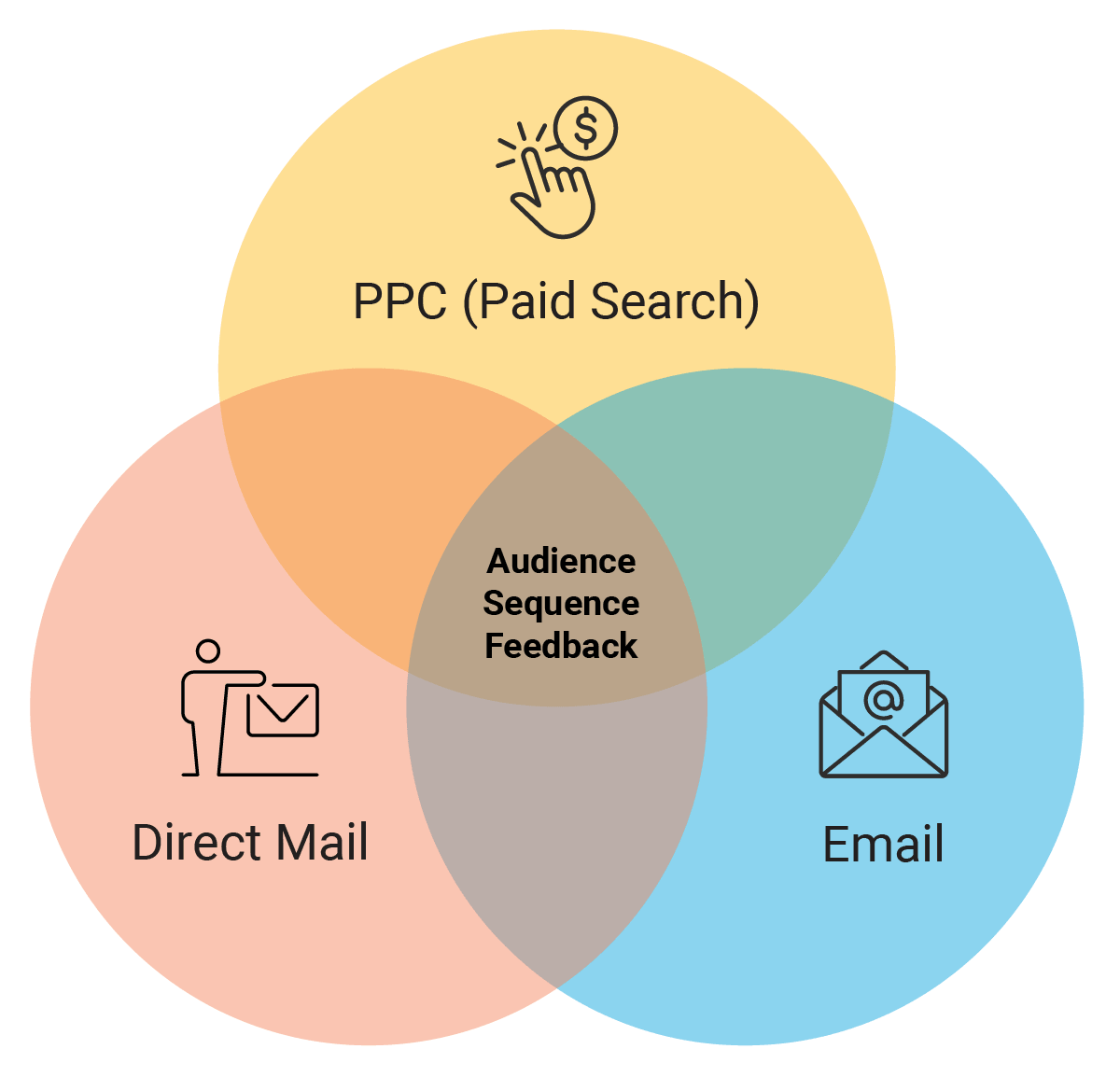
The foundation of expert PPC is a simple but powerful framework: the 3-Channel Amplification Model. This model coordinates paid search, email, and direct mail around three core levers—Audience, Sequence, and Feedback—to multiply the impact of every click.
The Channels at a Glance
Each channel plays a distinct role in the buyers’ journey:
- PPC (Paid Search): Captures intent at the moment of search and drives qualified traffic to your landing pages.
- Email: Nurtures engagement with timely, personalized messages that build familiarity and trust.
- Direct Mail: Cuts through digital noise with a tangible, memorable touchpoint that reinforces your message.
When these channels operate in isolation, you’re relying on a single interaction to convert. When they work together, each touch amplifies the next.
The Alignment Levers
The 3-Channel Amplification Model relies on three levers to keep your campaigns synchronized:
- Audience Alignment: Ensure your target segments are consistent across PPC, email, and direct mail. Use the same firmographic, demographic, and behavioral criteria to define who sees your ads, receives your emails, and gets your mailers.
- Sequence Timing: Coordinate the cadence of your touches. A click should trigger an email within hours, followed by a direct mail piece within days, and a sales outreach within a week.
- Feedback Loops: Use engagement signals from each channel—ad clicks, email opens, mail responses—to refine targeting and messaging in real time.
This framework ensures that every dollar you spend on PPC is working harder because it’s supported by a system, not left to stand alone.
Pro Tip
Name your model internally (e.g., “The 3-Channel Amplification Model”) and use it in planning meetings. A shared vocabulary helps your team align faster and troubleshoot smarter.
Why Do Clicks Stall Without Integration?
Your ad metrics look healthy, but pipeline and revenue barely budge. Clicks come in, but most never progress to become leads, opportunities, or sales. What causes this disconnect?
The most frequent culprits:
- Misaligned audience targeting: Your ads reach one group, your emails reach another, and your mailers reach a third.
- Sluggish follow-up: Hours or days pass between a click and the next touch, and interest fades.
- Overreliance on a single channel: You’re betting everything on one interaction to convert.
- Weak message continuity: Each touchpoint feels disjointed, and prospects don’t see a coherent story.
Picture this: a prospect searches for your solution and clicks your ad. But then nothing happens. No immediate next step, no email in their inbox, no timely direct mail. Just radio silence. Hours turn to days, and that momentary interest fades.
Now imagine an alternate scenario: that same click instantly triggers a welcome email with a relevant offer. A few days later, a postcard arrives in their mailbox reinforcing the same message. Soon after, a sales rep reaches out referencing the content they’ve received. That initial click is now woven into a sequence that builds familiarity, trust, and engagement.
The difference is striking. A standalone click is a single, fleeting chance to convert. But a click integrated into a coordinated multichannel journey? That’s a conversion opportunity multiplied.
Pro Tip
Diagnose your post-click engagement by mapping three key timestamps: the click, the first follow-up touch, and the first human response. If you’re seeing more than a 24-hour lag at any stage, that’s your integration opportunity.
What Sequence Turns Clicks into Customers?
Timing is everything. The 3-Channel Amplification Model works because it coordinates your touches along a deliberate timeline that keeps momentum alive. Here’s an example sequence for small and mid-sized businesses:
Minutes 0–5 (The Click): A prospect clicks your PPC ad and lands on a targeted page. Immediately, your CRM logs the visit and triggers the next step.
Hour 1–24 (Email Welcome): An automated email arrives in their inbox, acknowledging their interest and offering a relevant resource or next step (e.g., a guide, a demo link, a consultation booking page).
Day 2–5 (Direct Mail Arrives): A personalized postcard or letter hits their mailbox, reinforcing the same message and offer. The physical touchpoint cuts through digital noise and builds credibility.
Day 7–14 (Sales Outreach): A sales rep reaches out via phone or personalized email, referencing the content the prospect has received and offering to answer questions or schedule a deeper conversation.
This timeboxed sequence ensures that every click is supported by multiple touches, each building on the last. The result is higher engagement, shorter sales cycles, and more conversions.
Pro Tip
Test your sequence timing by running a small cohort through a compressed cadence (e.g., 7 days instead of 14) and comparing conversion rates. Faster sequences work well for high-intent buyers; longer sequences suit complex, considered purchases.
How Do You Align Audiences?
Audience alignment is the bedrock of an integrated, high-performing PPC strategy. At its core, alignment means your target segments are consistent across every channel. The same firmographic and demographic criteria, behavioral signals, and exclusion rules guide your PPC targeting, your email segments, and your direct mail campaigns.
Start with your highest-value customers. Analyze the attributes of the accounts or buyers that generate the most lifetime value. Turn those common traits—industry, company size, geography, title—into audience filters. Then, use a comprehensive data source to build and expand those core segments.
For example, if you need to define an Ideal Customer Profile (ICP) and find lookalike prospects that match those filters, use a reliable data source to build targeted audiences and sync them across your ad platforms and CRM for multichannel execution. This helps reduce wasted spend and improve the relevance of every touchpoint.
Pro Tip
Resist the temptation to over-target in the name of alignment. Start with two or three must-have criteria (say, industry plus revenue band plus geography), and layer on additional filters only if they demonstrably boost conversion rates, not just click-through rates.
Which Metrics Prove the Model Works?
Once you’ve aligned your audiences and built your multichannel sequences, how do you know if the orchestration is working? It’s time to evolve beyond surface-level metrics like click-through rate (CTR). Those numbers only tell you if people noticed your ad, not if they took meaningful action after the click.
Instead, zero in on metrics that connect ad exposure to revenue-generating behavior:
- Lead-to-Opportunity Conversion Rate: Track the rate at which leads convert to sales opportunities.
- Customer Acquisition Cost (CAC): Measure the total cost to acquire a customer across the entire journey, not just the initial ad spend.
- Multichannel Lift: Compare the volume and value of pipeline generated from segments that received the full PPC-email-mail sequence against those that only saw a subset of touches.
To build this complete picture, baseline your core metrics before you launch your test. Then, use holdout or control groups to isolate the impact of each new channel you introduce. For instance, if you’re testing the impact of layering direct mail into your PPC and email cadence, hold back the mailer for a portion of your target audience and measure the difference in qualified pipeline and closed revenue between the two groups.
Along the way, keep an eye on diagnostic metrics that can serve as early signals of impact:
- Are your email reply rates and booked meeting rates increasing as your sequences progress?
- Is the average time between a lead’s first ad click and first human touchpoint (e.g., an SDR call or personalized email) shrinking?
- Are you seeing a greater share of high-fit leads converting on your website’s “contact us” or “book a demo” page?
- Is your blended customer acquisition cost trending down quarter over quarter as your sequences mature?
Pro Tip
Implement a lightweight “learning log” to track your experiments over time. For each new play, record the start date, the target audience, the key change you introduced, the quantitative result, and your action plan based on those findings. A simple, consistent log will keep your learnings cumulative even as individual campaigns come and go.
Expert PPC vs DIY: When Should You Hire?
Not every business needs to hire a PPC consultant or agency. But knowing when to bring in outside expertise can save you time, money, and missed opportunities. Here’s how to decide:
You can likely handle PPC in-house if:
- You have a dedicated marketer with proven PPC experience and time to manage campaigns daily.
- Your target audience is straightforward, and your campaigns are limited to one or two channels.
- You have the internal tools and data infrastructure to track multichannel attribution and optimize based on full-funnel metrics.
- Your monthly ad spend is under $5,000, and you’re still testing product-market fit.
You should consider hiring expert help if:
- Your campaigns span multiple channels (PPC, email, direct mail), and you need someone to orchestrate them into a cohesive system.
- You’re spending $10,000+ per month on ads, and small improvements in efficiency can yield significant ROI.
- You lack the internal bandwidth or expertise to manage audience segmentation, sequence timing, and closed-loop feedback.
- You’ve hit a plateau in performance, and you need fresh strategic thinking to break through.
The cost of expert PPC help varies widely—from $2,000 to $10,000+ per month, depending on scope and complexity. But the ROI may be substantial if the consultant or agency can reduce your CAC by 20% or increase your lead-to-opportunity conversion rate by 10%.
Pro Tip
Before hiring, ask candidates to walk you through a real campaign they’ve orchestrated across PPC, email, and direct mail. Look for evidence of audience alignment, sequence discipline, and metrics-driven optimization—not just ad performance in isolation.
How to Set Up PPC Consultants for Success
If you hire a PPC consultant or agency, success usually comes down to three things:
- Clear first-90-day goals: Audit current performance, launch a focused test campaign, and scale what works.
- Defined ownership: Clarify who owns ads, CRM/email follow-up, sales outreach, and reporting.
- Shared metrics: Track CAC, lead quality, conversion rates, and pipeline impact—not just clicks.
Avoid common mistakes like slow follow-up, disconnected messaging, or optimizing for vanity metrics instead of revenue.
Pro Tip
Create a shared campaign calendar so marketing, sales, and your consultant stay aligned on launches, follow-up timing, and reporting.
Turn Clicks into Customers with Multichannel Orchestration
Expert PPC delivers business results only when your key channels work together as a coordinated system. Aligning your target audiences, timing and tailoring your messaging sequences, and wiring up closed-loop feedback between channels are the pillars of an approach that turns ad clicks into revenue-generating customer relationships.
The road to expert PPC is paved with precise audiences, disciplined sequencing, and a commitment to optimize based on revenue outcomes, not just ad performance. Ready to put this into action? Salesgenie can help you build high-fit audiences and align your PPC, email, and direct mail programs with one streamlined, data-driven workflow. Schedule a working session with our team to map your 14-day quick-start plan.
FAQs
An expert PPC strategy integrates pay-per-click campaigns with first-party data, email marketing, and direct mail to create coordinated multi-touch customer journeys. It focuses on precise audience selection, deliberate sequencing across channels, and closed-loop feedback to maximize conversions rather than isolated optimizations.
Clicks stall due to misaligned audience targeting, slow follow-up, overreliance on single channels, and weak message continuity between touchpoints. Without integration, clicks become isolated, fleeting opportunities instead of part of a coordinated conversion sequence that builds familiarity and trust over time.
Start by analyzing your highest-value customers to identify common traits like industry, company size, and geography, then use these criteria consistently across PPC, email, and direct mail targeting. Focus on two or three must-have criteria initially, and only add more filters if they demonstrably improve conversion rates, not just click-through rates.
Track revenue-generating behaviors like lead-to-opportunity conversion rates, total customer acquisition cost across the entire journey, and pipeline volume from integrated sequences versus single-channel approaches. Monitor diagnostic signals like email reply rates, time between first click and human contact, and blended customer acquisition cost trends.
Select one high-fit audience segment with meaningful pipeline potential and create a 14-day test sequence that coordinates ad creative, landing pages, email follow-ups, and direct mail around a coherent storyline. Use holdout groups to measure impact and baseline key metrics like conversion rates and deal cycle times before launching.